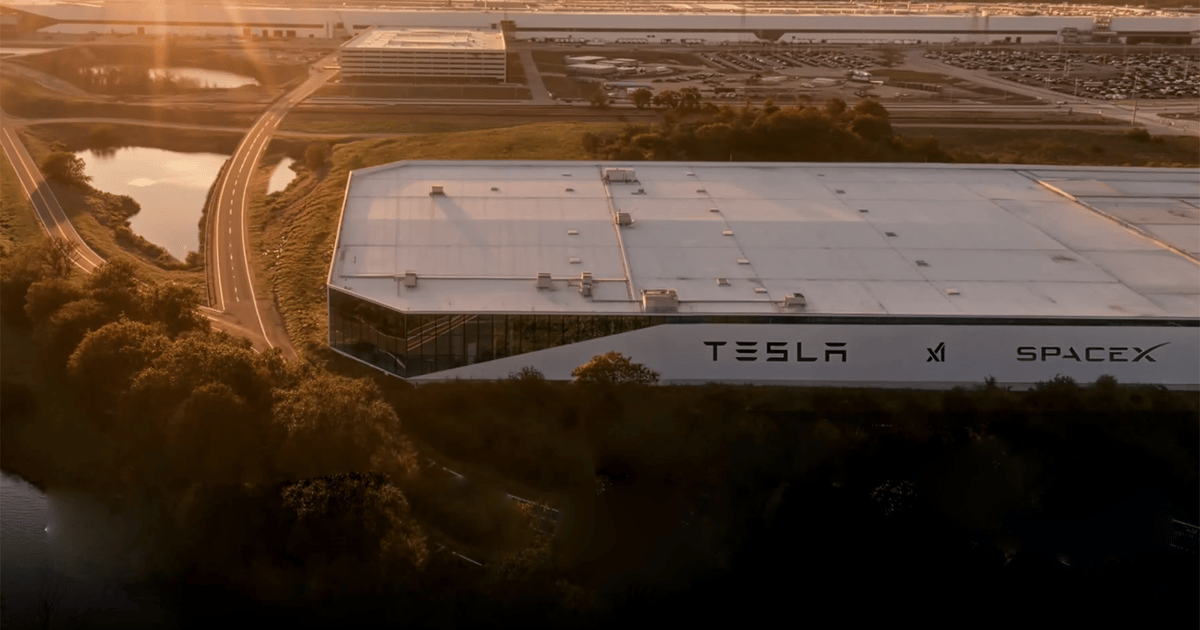
SpaceX plans to power its massive Texas chip campus with onsite generation and batteries rather than the grid, according to a signed county agreement.
SpaceX plans to power its massive Terafab semiconductor campus in Texas with onsite generation and battery storage rather than electricity from the grid, according to a fully executed tax-abatement agreement with Grimes County.
The agreement says the facilities, once operational, “are expected to be powered by electricity generated by on-site power plant(s) and are not expected to use electricity from the grid.”
SpaceX and Tesla unveiled an initial $16.8 billion investment in Terafab on Aug. 6. The companies plan a 100-million-square-foot campus in Grimes County, while Texas incentive filings describe a four-phase project with potential investment of $119 billion.
The county agreement also references “the battery storage project,” making onsite generation and storage part of the infrastructure contemplated for the development.
The arrangement would put SpaceX in charge of infrastructure normally supplied by the electric grid, including generation, reserves, voltage and frequency control, storage and restoration.
Power is Part of the Plan #
Grimes County designated the SpaceX property as a reinvestment zone June 3. The county’s order describes the proposed development as including a semiconductor manufacturing plant, an artificial intelligence facility and a power plant.
The tax-abatement agreement then specifies how SpaceX expects the facilities to operate: onsite power plants will supply electricity, and the facilities are not expected to use electricity from the grid.
That does not establish that Terafab will have no physical grid connection.
Neil Osnato, founder of Persistence Analytics Group, said the distinction is important because a facility can remain grid-connected while relying on onsite generation under normal conditions.
“For industrial facilities to use onsite generation, cogeneration or dedicated power is not unusual,” Osnato told Data Center Knowledge. “For a semiconductor/AI complex of the scale being contemplated here to plan for primary self-supply with essentially no routine grid electricity is much more unusual.”
A semiconductor fab needs more than enough annual electricity to run its equipment. Its manufacturing processes require high power quality, continuity and protection from voltage, frequency and other disturbances that can interrupt production.
That makes Terafab’s planned power system more than a conventional backup-power installation.
Natural Gas Enters the Picture #
Riley Trettel, SpaceX’s lead developer for Terafab, reportedly told Grimes County commissioners Aug. 5 that SpaceX plans to build natural gas-fired power plants and large battery arrays.
The June tax-abatement agreement does not identify natural gas as the fuel for the onsite plants. It establishes the onsite-generation plan but leaves the plants’ fuel, technology and capacity unspecified.
Osnato said a facility designed to operate primarily from onsite generation would need to function more like a private utility than a conventional industrial customer.
That could mean multiple generating units, reserve capacity, redundant electrical buses and substations, black-start capability and redundant gas delivery. Battery systems could provide fast response during generator trips, load changes and other events while gas generation supplies sustained energy.
“Gas provides energy and sustained capacity; batteries provide speed, stability and continuity,” Osnato said.
Batteries Add Another Layer #
The county agreement’s road-use provisions specifically refer to construction, installation, maintenance and operation of “the battery storage project.”
The agreement does not provide the battery project’s capacity, duration or technology.
SpaceX is also planning utility infrastructure for water and wastewater at the campus. The agreement says the company will use commercially reasonable efforts to control water use and promote water reuse and intends to construct an onsite wastewater-treatment facility. It also says SpaceX does not intend to use groundwater in its operations, subject to specified exceptions.
The combination would give SpaceX control over several infrastructure systems that typically depend on public utilities.
Moving the Reliability Boundary #
A Terafab that routinely supplies itself would reduce the amount of electricity ERCOT and utilities need to deliver to the campus. But self-supply would also move more of the reliability burden inside the project.
Instead of relying on the conventional grid generation, transmission and distribution, Terafab would depend on its own natural gas supply, generators, batteries and internal electrical network.
“If Terafab is genuinely electrically islanded and never takes ERCOT power, then its operating load would largely sit outside the normal ERCOT load-serving problem,” Osnato said.
A grid connection would change that calculation. Startup power, emergency imports, backup service or exports would create a continuing relationship between the campus and the ERCOT system even if Terafab normally supplies itself.
The county agreement says the facilities are “not expected to use electricity from the grid,” rather than saying they will have no grid connection.
That leaves Terafab’s electrical architecture as a potentially important precedent as Texas accommodates increasingly large AI and industrial loads.
A Different Model for Large Loads #
Terafab is planned as a vertically integrated semiconductor and advanced-computing campus. SpaceX and Tesla say the facility will produce chips for Tesla vehicles and Optimus robots as well as SpaceX’s computing systems.
SpaceX has framed the strategy more broadly in its IPO filing, saying the key constraints on AI growth are “physical chip manufacturing, data center infrastructure, and power generation” and that “the future of AI will be determined by the control of the physical stack.”
The companies have described a target of producing enough chips to support 1 terawatt of computing capacity annually. That figure describes the computing capacity of the chips, not Terafab’s electrical load or onsite generating capacity.
The initial phase carries a $16.8 billion investment, while Texas incentive filings describe four phases with potential investment of $119 billion.
The project’s planned power architecture sets it apart from conventional large-load projects. SpaceX is not simply seeking electricity for a massive industrial campus; it is planning to build the generation and storage needed to supply that campus alongside the manufacturing facilities.
For Texas grid planners, that creates a new category of large load: a facility whose gross electricity demand may be enormous while its routine grid demand could be substantially smaller. Osnato described the broader issue as a shift in the reliability boundary.
“Behind-the-meter generation does not eliminate the reliability problem,” he said. “It relocates the reliability boundary.”