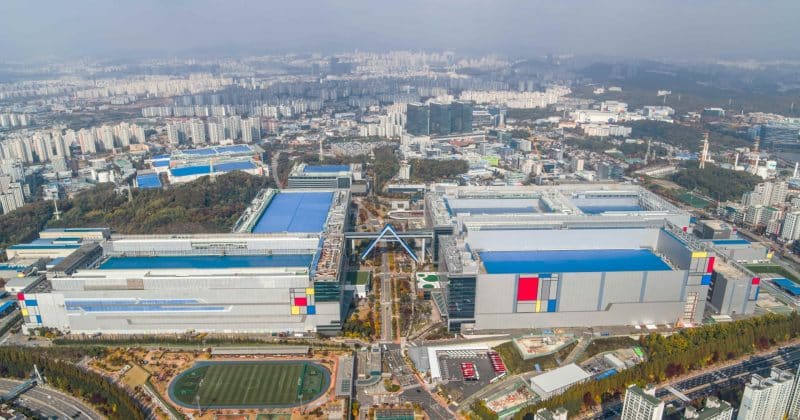
The country's largest-ever semiconductor investment includes four new fabs and a massive push into AI data centers
South Korea just placed the biggest bet in semiconductor history. President Lee Jae Myung unveiled an 800 trillion won investment plan, roughly $520 billion, to build four new chip fabrication plants and establish the country as the undisputed heavyweight of AI chip manufacturing.
Samsung Electronics and SK Hynix will each develop two of the four facilities in southwestern South Korea. The project is part of what the government is calling its “three mega-projects,” an initiative designed to revitalize regional economies while locking in Korea’s dominance over the chips that power artificial intelligence.
The full scope of the plan #
The fab construction is only part of the story. A separate 550 trillion won investment will fund the development of three AI data centers, with companies including SK, GS, and Naver participating in the effort. The target is an initial capacity of 8.4 GW.
Beyond the headline numbers, the plan channels significant funding toward high-bandwidth memory production, next-generation memory technologies, edge AI chips, advanced defense semiconductors, and robotics. South Korea is also targeting production of over 1,000 AI robots annually as part of the broader technology buildout.
The announcement carried symbolic weight, too. Lee Jae-yong of Samsung and Chey Tae-won of SK were both present at the unveiling.
To put $520 billion in perspective, that figure dwarfs the US CHIPS Act’s roughly $52 billion in direct subsidies by a factor of ten.
Why this is happening now #
SK Hynix has recently overtaken Samsung as the most valuable company in South Korea, driven by explosive demand for the high-bandwidth memory chips that power AI training and inference. SK Hynix’s market capitalization hit approximately 1.35 trillion won in mid-June 2026.
What this means for investors #
The data center component of the plan targets 8.4 GW of initial capacity across three facilities, positioning South Korea as a major hub for AI compute.
Projects of this magnitude take years to complete and involve massive capital expenditure. The history of chip manufacturing is littered with examples of overcapacity following periods of aggressive expansion.
The involvement of chaebols also introduces governance considerations that foreign investors tend to scrutinize. Korea’s large family-controlled conglomerates have historically delivered impressive growth, but their concentrated ownership structures and complex cross-holdings can create risks that don’t always show up in the headline numbers.
Disclosure: This article was edited by Editorial Team. For more information on how we create and review content, see our