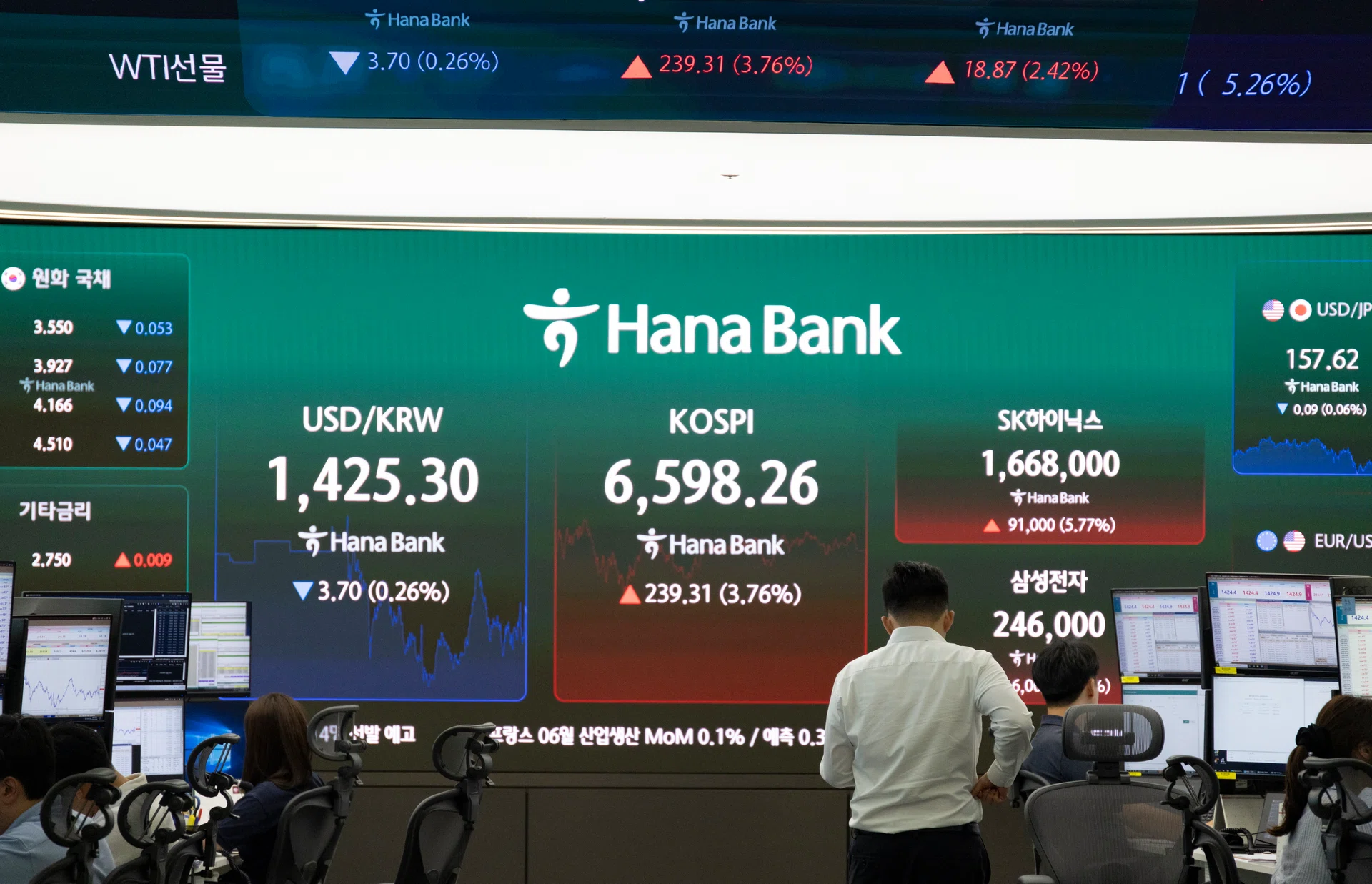
Enthusiasm for tech hardware stocks is returning on evidence of continued massive AI spending by global big tech firms
SOUTH Korean stocks climbed, putting the benchmark index on track to enter a technical bull market, as a global rebound in the AI trade fuelled a rapid reversal from July’s historic rout.
The benchmark Kospi gained as much as 4.8 per cent on Thursday (Aug 13), extending its gain from a Jul 30 low to around 22 per cent. Heavyweight memory chipmakers Samsung Electronics and SK Hynix drove the advance, each jumping more than 5 per cent.
Enthusiasm for tech hardware stocks is returning on evidence of continued massive AI spending by global big tech firms in the latest results.
The sentiment has sharply turned around from the past few months, when forced liquidations of leveraged chipmaker bets triggered trading halts and wiped out billions of dollars in retail wealth.
Recent government curbs on single-stock leveraged ETFs and signs of investors reducing margin debt have helped stabilise the market.
“I think the market overshot to the downside during the unwinding of leveraged positions, and the current rebound is a natural one as flow stabilised,” said Kang DaeKwun, chief executive officer at Life Asset Management. “That said, I think it will be difficult for the market to sustain a continued rally until we see some stabilisation in the AI narrative and US interest rates.”
A subdued US inflation report on Wednesday provided a fresh tailwind, as eased concerns about imminent interest-rate hikes by the US Federal Reserve supported US-listed chip peers.
Expectations that Samsung and SK Hynix will soon announce shareholder return plans have also lifted sentiment in recent sessions.
The Kospi is up more than 60 per cent so far in 2026 on a largely retail-driven rally, yet remains about 24 per cent down from its late June peak. It tumbled 22 per cent in July in its worst month since the global financial crisis.
Foreign investors remain sellers on a net basis, having withdrawn more than US$100 billion from South Korean shares in 2026 as the market grew crowded and overheated. Some overseas funds have started to come back, however, as the sell-off drove valuations down to more attractive levels.
While the rising threat of competition from China had also thrown some cold water on the blistering surge in memory stocks, the near-term demand outlook remains intact. The spread of AI into new applications and greater everyday usage is fuelling greater need for chips. “Because of AI agents and physical AI, memory demand has exploded, but we entered into this with a quite limited supply capacity – that’s where the bottleneck is,” said Qian Zhang, emerging markets equities investment specialist at Baillie Gifford.
“We’re not saying the world will be building data centres forever at this speed, but that is a real physical bottleneck that only a few companies in this world can resolve.” BLOOMBERG
Decoding Asia newsletter: your guide to navigating Asia in a new global order. Sign up here to get Decoding Asia newsletter. Delivered to your inbox. Free.
[South Korea stocks](https://www.businesstimes.com.sg/keywords/south-korea-stocks?ref=article-bottom-keyword)

[South Korea](https://www.businesstimes.com.sg/keywords/south-korea?ref=article-bottom-keyword)

[Tech stocks](https://www.businesstimes.com.sg/keywords/tech-stocks?ref=article-bottom-keyword)

[Samsung Electronics](https://www.businesstimes.com.sg/keywords/samsung-electronics?ref=article-bottom-keyword)

[SK Hynix](https://www.businesstimes.com.sg/keywords/sk-hynix?ref=article-bottom-keyword)

[Artificial Intelligence](https://www.businesstimes.com.sg/keywords/artificial-intelligence?ref=article-bottom-keyword)

[Semiconductors](https://www.businesstimes.com.sg/keywords/semiconductors?ref=article-bottom-keyword)
Share with us your feedback on BT's products and services
TRENDING NOW Singtel Q1 gain drops 71% to S$818 million in absence of Airtel stake sale; weaker Singapore business
Sembcorp raises interim dividend despite 72% H1 profit slide to S$150 million on Alinta deal costs
How BYD disrupted Singapore’s car market – and why the strategy is turning on itself
CDL H1 profit jumps three times to S$301 million on strong condo sales, doubles interim dividend