Support CleanTechnica's work througha Substack subscription,on Patreon, oron Stripe. Help us produce all of thehigh-quality, original content we publish week after weekdespite the challenges of content-scraping AI, antisocial media, inflation, and other hurdles.Energy storage is the key to the clean energy transition. It is true that the sun does not always shine and the winds don’t always blow, but when they do, they make far more electricity than the electrical grid needs at any particular time. If only there was a way to capture electrons now for use later at a cost that makes cents sense!
Twenty years ago, no such energy storage miracle existed, other than clunky lead acid batteries that required lots of maintenance and were expensive in grid scale quantities. Then came Tesla with its electric cars that many critics laughed at. They used hundreds and hundreds of lithium ion battery cells — similar in size to AA batteries — and suddenly the electric car revolution was here.
Then Elon Musk figured out those same battery cells could be used to store energy and the grid storage revolution began. The first large energy storage project was the Hornsdale Power Reserve in South Australia. That installation shocked Australia and the world when it responded in microseconds to a large power outage, proving that grid stabilization was as important as grid storage. In its first year of operation, it saved the grid operator over $40 million. That was really the event that let the grid scale battery storage horse out of the barn.
But the first grid storage batteries relied on NMC chemistry — the same chemistry that resulted in some truly epic battery fires in Tesla automobiles. They required complex and expensive cooling systems in order to reduce the risk of fires.
Then came LFP batteries, which used iron and phosphate instead of manganese and cobalt. The so-called “iron batteries” were far less susceptible to thermal runaway events — the polite term the industry uses instead of saying “battery fires.” Nonetheless, they still require cooling systems that take up space and add to the cost of energy storage systems. LFP has become the most-installed chemistry type in grid-scale and residential applications, accounting for 80 percent of new battery storage worldwide in 2023.
Most of us never heard of sodium ion batteries until last year, when CATL began introducing them in certain electric car models in China. Since then, they have surged in popularity for a number of reasons,. First, sodium is much less expensive than lithium. Second, sodium batteries perform much better at low temperatures. Third, they required far less cooling, which saves space and money.
But there is a fourth reason that has nothing to do with battery performance and everything to do with politics. China has a hammerlock on the world’s supply of battery grade lithium. For countries in Europe and the US that want to be less dependent on Chinese suppliers, sodium is a slam dunk. Sodium batteries have a lower energy density than NMC, which makes them a poor choice for high performance electric cars, but energy storage is a different ball game. Because they require little or no cooling systems, more cells can be packed into a given space, which makes them ideal for energy storage duties.
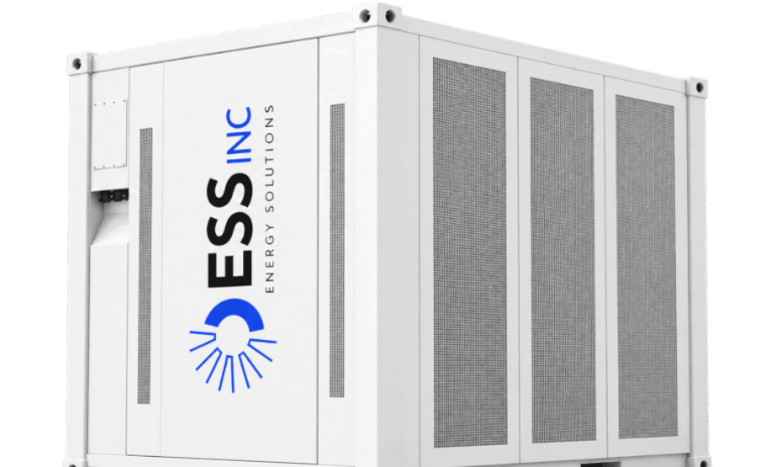
One US company that is all in on sodium batteries for energy storage is ESS. It’s chief commercial officer, Randy Selsky, told Kelly Pickerel of * Solar Power World* recently, “It’s been fun. I’ve been in this market a long time, and I have not seen the market really grab on to something this fast.”
Made from an abundant nontoxic element, sodium batteries can be manufactured on the same production lines as other lithium batteries. They have a wide operating temperature range of -40°F to 140°F without output degradation, which negates the need for cooling systems.
Earlier this year, Morgan Stanley Research estimated that sodium-ion batteries would hold 2 percent market share by deployment in 2027, but would jump to 20 percent by 2030 and 37 percent by 2035. Two sodium chemistries — sodium chromium oxide (NCO) and sodium iron-phosphate pyrophosphate (NFPP) — are leading the market into the next decade. NCO has a higher energy density while NFPP is cheaper to manufacture, but either offers an apt alternative to lithium, said Darren Tan, co-founder and CEO of sodium cell developer Unigrid.
“New technologies always serve to open new markets or new applications,” he said. “When we encounter customers who already use LFP for their applications, we tell them that they’re doing a great job and should keep doing it, unless they have certain challenges like not getting enough power or enough safety, it’s not lasting long enough, they need to run in the cold or extreme heat. That’s when we step in to solve these problems.”
The promise of sodium-ion technology has attracted players from all corners of the energy storage market. Flow battery pioneer ESS has taken an interest and will release its first grid-scale sodium design next year. Selesky said the move into sodium isn’t a step away from long-duration flow batteries; it’s just adding another lithium alternative to the company’s offerings.
“Lithium is still 95% of the market, in that two to eight hour range. This is the first product we’ve seen that can go head-to-head against the traditional use-cases of lithium-ion. We saw this as an opportunity to go after 95 percent of the market, leveraging our 14 years’ [experience] of being able to do installation, integration, and ongoing maintenance support.”
He said ESS will shift its R&D to producing a 16 to 48 hour discharge flow battery, because there are still plenty of opportunities where long duration energy storage is necessary. “We see this as a perfect opportunity to reset iron-flow,” he said. “When you’re in long-duration, you’re creating a market and that market is still being created. [Working with sodium] gives us an opportunity to get on the flywheel and really start spinning product out.”
ESS will use NFPP cells from Alsym in its 1.2 MWh AC energy storage system. Alsym, a Boston-based sodium-ion cell developer, is manufacturing a small amount of product on the East Coast, and ESS will assemble the cells into the “Bridge” energy storage system at its manufacturing site in Oregon.
“[NFPP] follows the same characteristics that ESS has followed since its birth — no risk of fires and it’s safe,” Selesky said. “Our first launch is in 2027, and then we’re doing a second launch, which increases the density, in late 2028. That’s how fast this technology is moving. I can already see what’s in R&D that will come out three years from now.”
Peak Energy Joins The Sodium Party
Peak Energy is also pushing into the sodium battery storage space and expects to begin delivering its GS1 storage system by mid 2027. Brandon Kelly, the company’s chief scientist, said Peak’s meteoric rise was all part of the original plan. “Peak’s approach is to get to product quickly, not develop in a lab for 10 years and then launch a product and try and find a market. There is a strong market demand, and there’s a technology that the base chemistry enables a much better product to meet that demand — from the actual product itself, the supply chain and energy security here in the States.”
Peak Energy’s core selling point is the sodium battery’s passive cooling, which cuts chillers and fans out of the equation. “[With chillers,] there are moving parts, there’s refrigerant, coolant, filters, fans, tons of noise. It’s great that we can do it, and I’m happy that it’s enabling a lot of things. But those are engineering workarounds we have to do for lithium to meet the application.
Because this version of sodium-ion is more temperature tolerant, we can just let it get hotter and we can still hit the lifetime. Even in our passive system, we’re still at 85% state of health after 20 years. Lithium-ion, even with liquid cooling, is around 65%. And with sodium, you don’t have any moving parts, the amount of maintenance goes way down. It’s beautiful simplicity, which is enabled all the way down at the chemistry level.”
Residential Storage Opportunities
While most focus across the entire energy storage market is spent on grid scale applications, the residential market can benefit from sodium designs too. Unigrid, a sodium-ion cell R&D company that originated at the University of California San Diego, has been quietly developing the technology since the start of the decade. The company just announced a partnership with manufacturer Syntropic Power to make NCO batteries in the United States. “It checks all the boxes. It has a great cycle life, great safety, great power, great cost,” Tan said of the NCO chemistry. “The only downside is it’s not available in China, so you can’t just buy if off the market. We work with foundries to develop this new production process. It not being available also means that we’ll be the only one supplying it, so that’s one of our key advantages.”
With Unigrid’s focus on NCO chemistry, Tan said the company is looking toward the less crowded residential storage space. “In China, there is no such thing as a residential market, so the major Chinese players don’t dominate this space. It’s also the reason why residential batteries are historically unaffordable. You have utility-scale batteries fighting for cents on the dollar, and then you have [residential batteries] that are still $10,000 and above. We realized this is an opportunity for us to step in and change the status quo. Sodium-ion is a reset.”
“Unlike lithium-ion, where a big chunk of your cost is lithium and its critical materials, sodium-ion is very much flipped,” Tan said. “The sodium-ion raw materials are extremely low cost, and most [of your cost] is in manufacturing. That means the potential for sodium-ion costs to come down is much greater. Today it is still higher than lithium-ion, but I expect in the next five to 10 years it will come down very sharply.”
Sodium battery companies may already be walking the walk, but soon they just might be running away with the energy storage market, says Solar Power World. We agree with that assessment.
Sign up for
CleanTechnica's Weekly Substack for Zach and Scott's in-depth analyses and high level summaries, sign up forour daily newsletter, andfollow us on Google News!Have a tip for CleanTechnica? Want to advertise? Want to suggest a guest for our CleanTech Talk podcast?
Contact us here.Sign up for our daily newsletter for 15 new cleantech stories a day. Or sign up forour weekly one on top stories of the weekif daily is too frequent.
CleanTechnica uses affiliate links. See our policy
here.CleanTechnica's Comment Policy