TL;DR — Key Takeaways
SnapGPT is evolving from copilot to operator. The upgraded agent can now plan, build, validate, execute and manage integrations across SnapLogic’s iPaaS platform.Planning comes before execution. A new plan mode helps teams assess requirements, review existing assets and identify potential issues before development begins.AI could lower the integration skills barrier. By automating more complex workflows, SnapLogic aims to reduce the expertise and manual effort required to connect applications and data sources.
SnapLogic today revealed it has upgraded its generative artificial intelligence (AI) tool into a full blown agent capable of autonomously completing a much wider range of complex tasks.
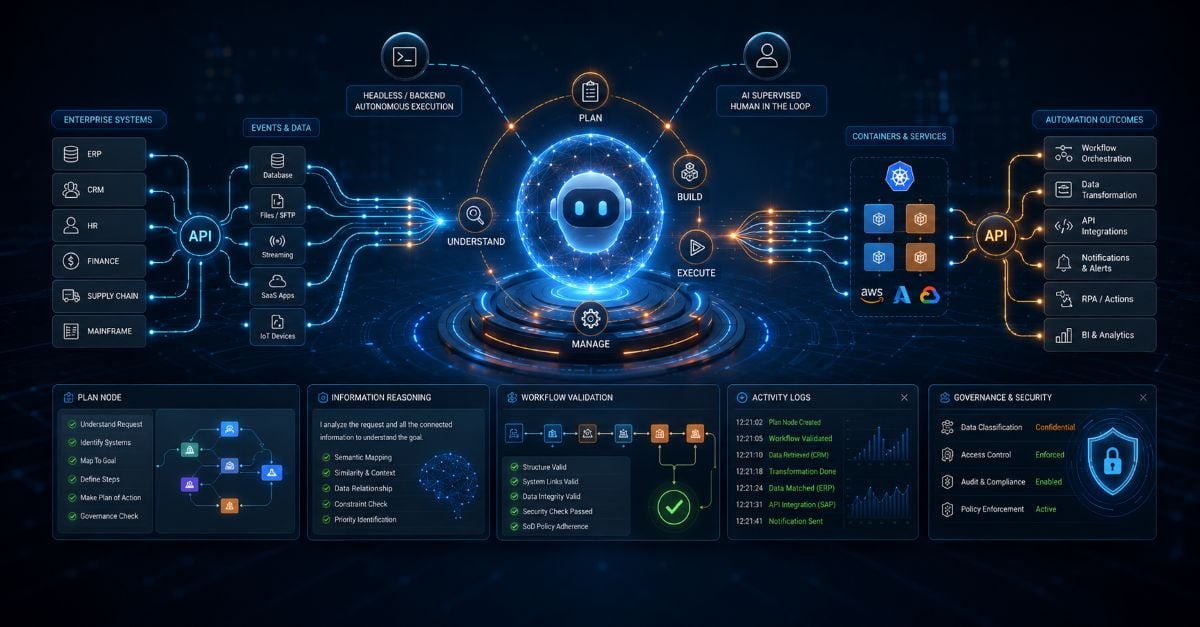
The latest iteration of SnapGPT combines agentic planning, integration-specific reasoning and pipeline execution validation to move beyond being a comparatively simple AI co-pilot to now being able to plan, build, understand, execute and manage integrations across the company’s integration platform-as-a-service (iPaaS) environment, says SnapLogic CTO Jeremiah Stone.
For example, a plan mode enables IT teams to validate requirements, explore implementation approaches, refine workflows, and identify potential issues before development begins after analyzing existing integration assets to provide the context required. There is also now a SnapGPT Activity Log that provides administrators with visibility into AI-assisted development activity. The overall goal is to reduce the level of expertise that would otherwise be required to integrate data sources across a wide range of multi-dimensional business workflows, says Stone. “More thought can be applied toward architectural design,” he adds.
Much of that capability is enabled because the AI agent now runs across multiple containers that make it simpler to manage those integrations, versus trying to invoke multiple distinct microservices that don’t scale as well, notes Stone.
At the same time, IT teams should be able to manage a broader range of integration initiatives as they rely more on AI agents to automate various tasks, says Stone.
Collectively, these capabilities make it much simpler to either automate a new process or, just as importantly, launch a business process re-engineering initiative that relies more on AI to complete tasks that previously required a significant amount of manual effort, adds Stone.
In general, the way IT organizations approach integration is evolving in the AI era. In many cases, there are still processes that require a graphical user interface (GUI) through which humans manage a process. However, there are now many more processes that an AI agent will be able to automate by invoking a series of application programming interfaces (APIs) or a Model Context Protocol (MCP) server. The challenge then becomes striking a balance between processes that humans need to supervise versus a task that could largely be completed by an AI agent accessing multiple headless backend systems.
Each organization, naturally, will need to determine for itself at what pace to launch those initiatives. However, it’s apparent that while there are still data governance and security issues to be worked through, just about every process is, to one degree or another, going to be augmented or extended using AI agents. The challenge now is finding a way to make sure that the outcomes generated are based on reliable sources of data that ensure the task is completed as designed versus allowing an AI agent to randomly determine what to access in a way that leads to an unexpected outcome.
IT teams, in the meantime, will need to revisit how data governance is actually managed within their organization. The simple truth of the matter is that many AI experiments are failing simply because governance policies were either not designed with AI in mind or, more commonly, might not have ever really existed in the first place.