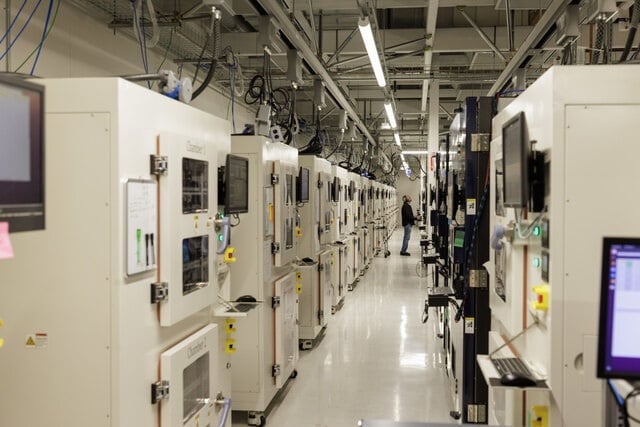
SK hynix and its subsidiary Solidigm are following a two-part manufacturing plan to keep mature flash production separate from next-generation memory. Recent updates show they are expanding older production capacity overseas while also investing heavily at home. These moves will support future demand for AI storage, but current production schedules mean that enterprise SSD shortages are likely to continue for now.
Dalian Fab 2 Restart and Offshore Capacity Expansion #
Solidigm has restarted investment in its second factory in Dalian, China, after about four years, according to the Seoul Economic Daily. The building for Fab 2 is finished, and equipment could start arriving as early as November 2026. The reports put full production in the first half of 2027. Neither Solidigm nor SK hynix has announced the restart through its own channels, so the timing rests on Korean press reporting for now.
If completed, the new line could add about 50,000 wafer starts per month to the current Dalian Fab 1 output of around 100,000 wafers per month. This would increase the company’s flash manufacturing in China by about 50 percent. The Dalian site will continue to focus on mature-node NAND, helping Solidigm boost production of mainstream enterprise flash products while adhering to rules on advanced semiconductor equipment.
Multi-Trillion-Won Domestic Buildout for Advanced Nodes #
Alongside its overseas expansion, SK hynix announced in early August a ₩54 trillion (about $38 billion) investment in its South Korean factories, according to company reports. Most of the money will go to two main sites: ₩35.2 trillion for the Yongin Y2 facility, which will make advanced DRAM and high-bandwidth memory, and ₩19.1 trillion for the Cheongju M17 fab, which will focus on next-generation NAND flash and enterprise SSDs.
The M17 investment will create a dedicated site for making high-layer, high-density flash needed for large-scale AI tasks. However, this new capacity will take time to come online. The first cleanroom at M17 should be finished by the end of 2028, with commercial production starting in 2029 or later.
Market Position and Enterprise SSD Pricing Implications #
TrendForce data for the first quarter of 2026 shows that SK hynix Group, including Solidigm, stayed in second place for global NAND flash revenue. The group posted $7.53 billion in revenue for a 17.6 percent share, behind Samsung’s 31.6 percent. To keep or grow this share, they need to increase production of both mature and advanced memory types.
The demand side explains the urgency. Counterpoint Research’s second-quarter tracker puts enterprise SSDs at 48 percent of global NAND shipments, nearly double the 26 percent share a year earlier, and the firm expects eSSDs to absorb more than half of all NAND bits by the end of 2026. Solidigm stood out in that data, growing bit shipments roughly 40 percent quarter over quarter per Counterpoint, and that mature-node, high-capacity product line is exactly what the reported Dalian expansion would feed.
The main issue is still how much product is available and at what price. By sending mature-node production to Dalian and focusing on advanced memory at home, SK hynix will not solve the current shortage of enterprise SSDs. Since Dalian Fab 2 will not start producing until at least the first half of 2027, and Cheongju M17 will not be ready until the end of the decade, enterprise storage supplies will stay limited for now.