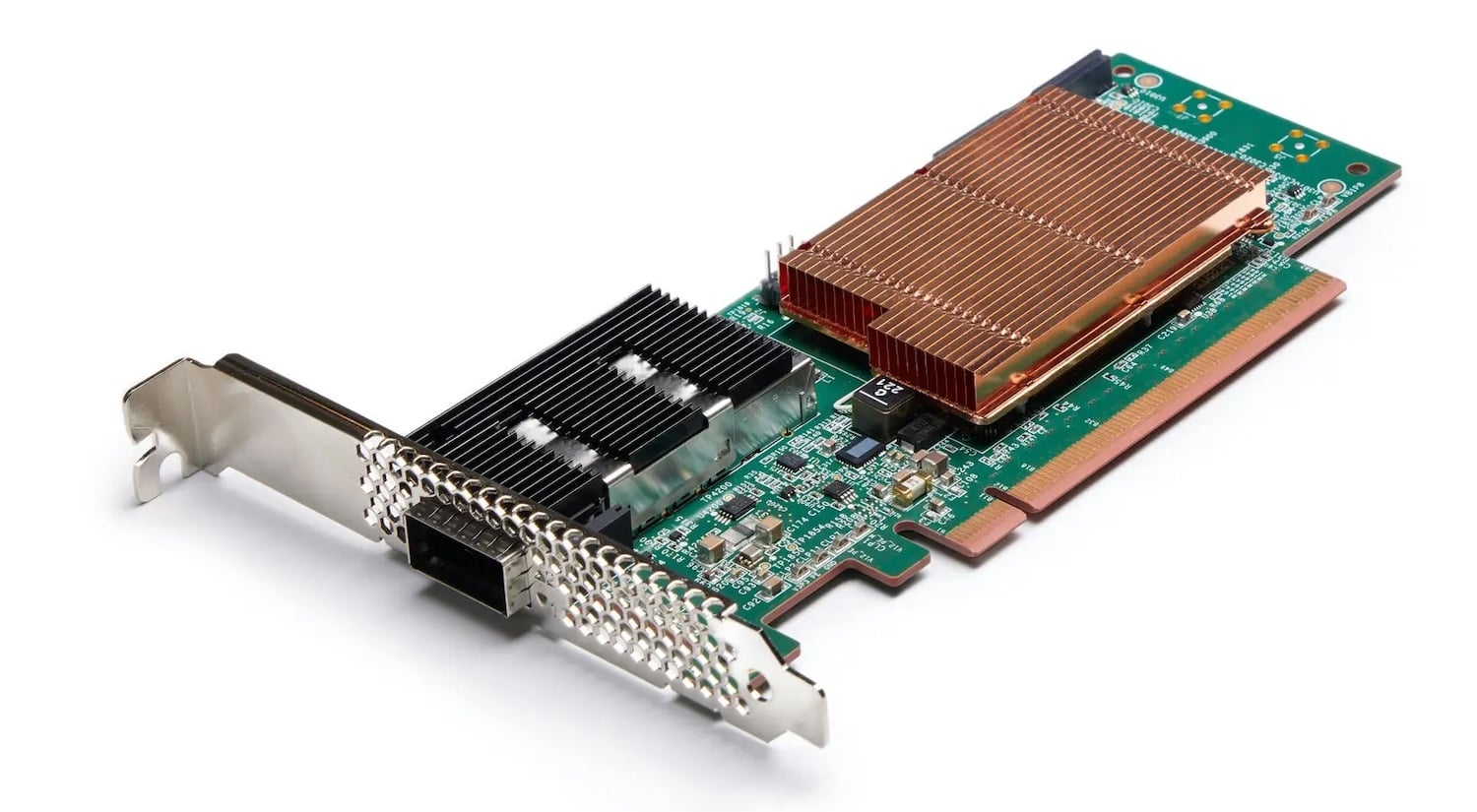
Cornelis has announced the CN6000 family, an 800G networking platform for AI and high-performance computing (HPC) clusters that doubles the bandwidth of the company’s CN5000 generation. The family has three parts: an Omni-Path SuperNIC, a 48-port Omni-Path switch, and an Ethernet SuperNIC that runs RoCEv2 against standard 800G switches. Cornelis says the adapters, switch, and software are available now for evaluation and early deployments, with systems from OEM and system partners expected to begin in Q1 2027.
Cornelis CEO Lisa Spelman framed the launch around idle accelerators, saying that every minute one waits on the network is “capacity our customers paid for and didn’t use.”
800G Omni-Path Fabric #
The CN6000 Omni-Path SuperNIC is a low-profile PCIe 6.0 x16 card with two QSFP-DD ports, each carrying a 400Gb/s data path for 800Gb/s in total. Cornelis rates it at 1.6 billion messages per second, which the company calls the industry’s highest, and at sub-microsecond MPI latency. Cornelis lists both figures as design targets and describes the message rate as bidirectional. Typical power is 42.4W with passive copper cables and 57.5W with active optical cables.
Cornelis also says its MPI latency is 21 percent lower than NVIDIA InfiniBand XDR at the same 800G speed. The comparison comes from internal Cornelis testing of an 8-byte MPI ping-pong with Intel MPI, where the CN6000 Omni-Path SuperNIC measured 0.95µs against 1.2µs for InfiniBand XDR. These are vendor results, and we did not run or audit them. Cornelis has not published the test conditions behind the message-rate figure.
The SuperNIC supports multi-plane and multi-rail configurations, which Cornelis says let operators isolate traffic and keep a fabric running through link failures, and it uses credit-based flow control for lossless delivery. A dedicated hardware Root of Trust verifies firmware before the adapter joins the system, using SPDM 1.4 attestation and ML-DSA post-quantum signatures. Cornelis puts the scale of an Omni-Path fabric at more than 500,000 endpoints.
The CN6000 Omni-Path switch is a 1U system with 48 QSFP-DD ports at 800G, or 96 ports at 400G, for 76.8Tb/s of full-duplex capacity. It can also run as two independent 48-port 400G planes, and Cornelis lists switch latency as low as 105ns. When the SuperNIC is paired with the switch, adaptive routing spreads traffic across the available paths to reduce congestion. Typical draw is 856W with all-copper cabling and 1,663W with active optical cables on every port, and the switch takes 240-277VAC or 48VDC through hot-swap N+N power supplies.
Ethernet and Software Support #
The Ethernet SuperNIC uses the same low-profile PCIe 6.0 x16 format and dual QSFP-DD ports, and it connects to industry-standard Ethernet switches over RoCEv2. Cornelis lists Priority Flow Control across eight priorities, IEEE 1588 PTP, SR-IOV, and GPUDirect support for NVIDIA and AMD accelerators. Ultra Ethernet support is in preview and will follow through software updates, and NVMe-oF over RoCEv2 is on the roadmap. Cornelis has not given a date for either.
On Omni-Path, CN6000 supports NCCL, RCCL, libfabric, MPI, and OpenSHMEM, and it uses the same software stack and host driver as CN5000. That gives sites running the current generation a common software base as they add 800G hardware. For the Ethernet SuperNIC, Cornelis lists Red Hat Enterprise Linux support, with other distributions available on request.
Platform Validation and Availability #
Cornelis says CN6000 supports AMD, Arm-based, and Intel CPU platforms along with AMD, NVIDIA, and Qualcomm accelerators. The company is validating the family with AMD EPYC 9006 Series CPUs and next-generation AMD Instinct GPU platforms, and it is extending its Intel collaboration to CN6000 and next-generation Xeon platforms. OEM and system partners planning validation and support include Dell Technologies, Hyve Solutions, Lenovo, NEC, Penguin Solutions, and Supermicro.
Among the partners, Lenovo has qualified CN5000 across its ThinkSystem V3 and V4 servers and is now qualifying Cornelis hardware with its new AMD EPYC-powered ThinkSystem servers. Supermicro has validated CN5000 on its FlexTwin, BigTwin, and Hyper platforms and plans to extend that work to CN6000, and Penguin Solutions plans to validate and support CN6000 in its AI and HPC systems. Cornelis is demonstrating the family at SC26 in Chicago.