Sharing an AI agent: what to keep, what to strip, and what never to trust
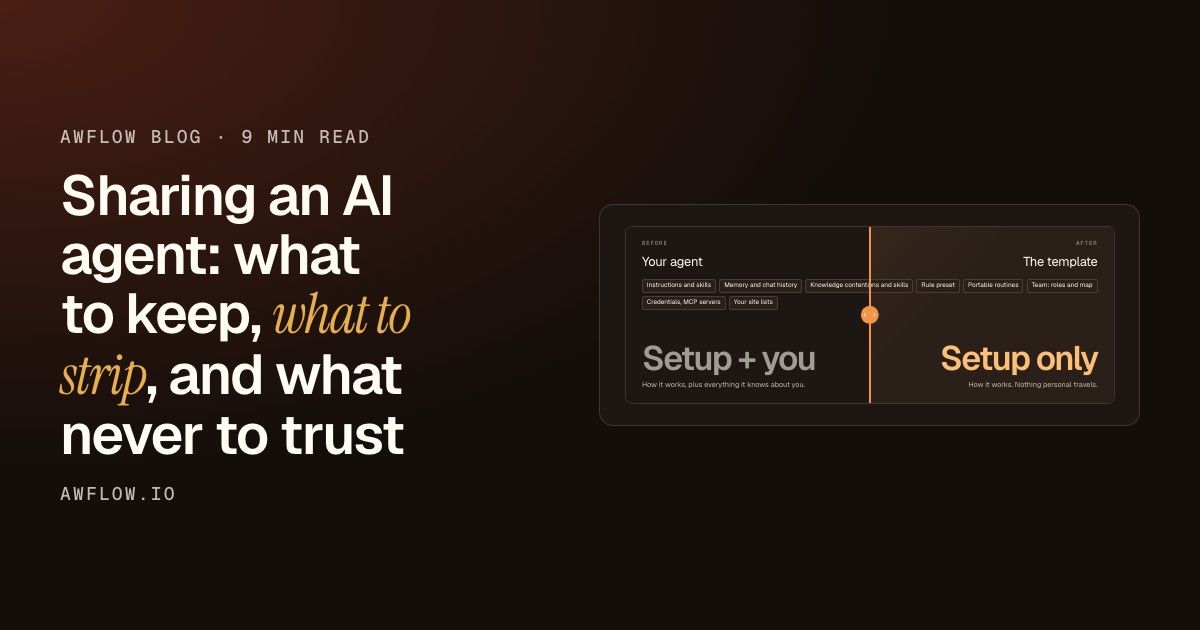
An agent is more than a prompt: it has memory, skills, rules and connections. Here is where we drew the line between the reusable setup and the personal state, and the rules we follow when someone installs a template.
You built an agent that works. Someone asks for it. What do you actually send them?
An AI agent is more than a prompt. In AWFlow (a browser automation tool I build) an agent has a model, instructions, memory, skills, rules and routines, and agents can form teams with a handoff map (the coordination runtime behind teams has its own post). We recently added a marketplace where people can share agents and whole teams as templates.
That raises a design question every “share your agent” feature has to answer: what’s the reusable part, and what’s personal? Get it wrong one way and templates are useless. Get it wrong the other way and people leak their memory, their sites and their credentials. Here’s how we drew the line, and the rules we follow on install.
What travels and what stays
An agent template should carry how the agent works, never what it knows about its author or what it’s connected to on the author’s machine.
Knowledge-base contents (the collection references are emptied)
Skills it uses (browser, web search, on-device AI…) Credentials and the author’s MCP servers
Rule preset and generic per-action rules
Per-site rules and the author’s allow/block site lists
Portable routines (schedule, page triggers…)
Routines tied to a local workflow or a recording
Team: members, roles, way of working, handoff map
IDs of the author’s own workflows
On-device model choice
Cloud model choice (it names the author’s provider)
A few of these deserve a word.
Models: on-device travels, cloud doesn’t
If the author picked an in-browser model, the template keeps it: anyone can download the same model. If they picked a cloud model, the template says “inherit” and the installer’s own default applies. A cloud pick names the author’s provider and account setup, which the installer may not have. Rules: keep the intent, drop the specifics
The agent’s rule preset and its generic per-action rules (“ask before submitting forms”) are the safety intent, so they travel. Rules tied to specific sites, and the author’s allow/block site lists, are personal browsing context, so they’re dropped.
Dependencies become “needs”, not secrets
If an agent uses one of the author’s workflows as a skill, or an MCP server, the template can’t include those. Instead it records what’s needed: the workflow’s name, the MCP server’s host. The agent depends on the author’s things
A workflow that lives on the author’s device, an MCP server they connected. Neither can travel.
Export records the need The template keeps the workflow’s name and the server’s host, so the installer knows what is missing.
Install creates the agent
The new agent starts without those tools, rather than pretending to have them.
You get a plain note
After installing, the user sees “Add these to finish setting it up: …”.
That’s much better than an agent that silently has fewer tools than its description promises.
Routines: only the portable ones
A routine triggered by a schedule or a page event travels. A routine that depends on a local workflow or a recorded sequence can’t work on someone else’s machine, so it’s left out rather than shipped broken.
On install: never trust the file
A template is just data, and data from strangers is untrusted.
Install follows a few rules:
The re-mapping is worth seeing, because it’s where a careless importer leaks or overwrites things.
The marketplace on top
The marketplace adds the social layer. Listings are reviewed by a moderator before they go live, and anyone can browse agent and team templates in Marketplace › Agents & teams without signing in. Installing is one click, plus a single confirmation when the template’s agents can act in your browser or run on their own. The install is counted on the server (once per signed-in person), but the agents themselves are created locally on your device.
One honest limit: stripping protects your state and your connections, not your words. Instructions are shared as written. The marketplace checks a template again when it is submitted and refuses anything that looks like a key or personal data, but read your instructions before you share. The templates page in the docs lists everything that is and isn’t shared.
If you’re building “share your agent” in your own product, this is the short list: