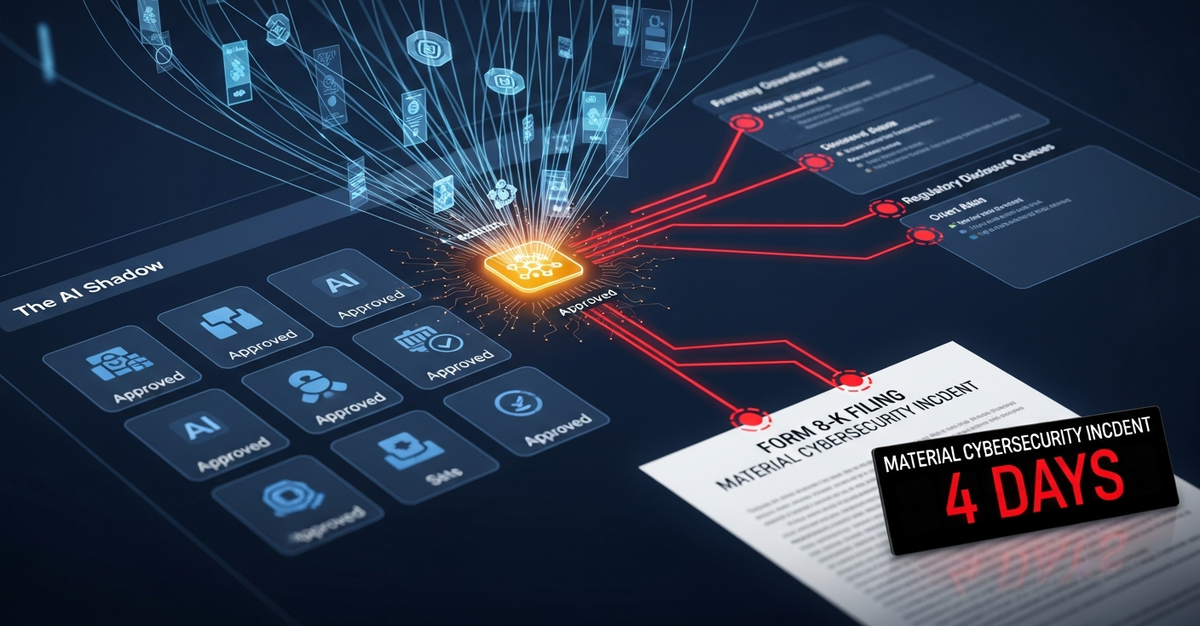
A Pennsylvania bank employee used an unauthorized AI tool on customer data — no hacker, no breach, no operational disruption — and the bank still filed an SEC Form 8-K. The first shadow AI disclosure is a blueprint for what your regulators are about to ask.
Table of Contents #
On May 5, 2026, a bank employee at Community Bank — a Pennsylvania-based regional institution and wholly owned subsidiary of CB Financial Services, Inc. — used an unauthorized AI application to process customer data. There was no external attacker. The bank’s systems were not breached. Core banking operations were unaffected. And yet, two days later, CB’s parent company determined the incident was material under SEC rules, and on May 11 it filed a Form 8-K under Item 1.05 — the cybersecurity disclosure provision.
The compromised data included names, Social Security numbers, and dates of birth. The number of affected customers was not disclosed. Neither was the specific AI tool involved. What was disclosed is enough to reframe how every bank, broker-dealer, and insurance company should be thinking about employee AI use: the first shadow AI incident to trigger a material SEC cybersecurity disclosure at a regulated financial institution didn’t involve a hacker. It involved someone trying to work faster.
This is the scenario most bank AI governance programs were not designed to catch. It sits in the gap between the CISO’s external threat model and the business line’s emerging AI usage. Neither owns it clearly. And the regulatory obligations that flow from it — SEC disclosure, GLBA Safeguards Rule compliance, state breach notification, OCC examination scrutiny — apply regardless of whether your governance program has caught up to employee behavior yet.
Regulatory & Compliance Angle #
The CB Financial incident activates at least four distinct regulatory frameworks simultaneously, each with independent obligations and timelines.
SEC Item 1.05 — the materiality trigger. The SEC’s cybersecurity disclosure rule, effective since December 2023, requires public companies to disclose material cybersecurity incidents within four business days of a materiality determination. CB made that determination two days after detecting the incident and filed within the required window. Critically, CB determined materiality based solely on “the volume and sensitive nature of the non-public information at issue” — not on operational disruption or financial impact. CB explicitly stated the incident had not had, and was not expected to have, a material impact on its financial condition or results of operations. The data sensitivity alone was enough. For any bank or financial holding company that is publicly traded, an employee feeding customer SSNs and dates of birth into an unauthorized AI platform is now, by regulatory precedent, a potentially material cybersecurity incident — regardless of whether anything was exploited or exfiltrated downstream.
GLBA Safeguards Rule — the operational obligation. The Gramm-Leach-Bliley Act Safeguards Rule requires financial institutions to implement comprehensive information security programs covering administrative, technical, and physical safeguards for customer information. Unauthorized employee transmission of nonpublic personal information to an external AI platform is a straightforward failure of required safeguards — the information left the institution’s control without authorization. The FTC enforces the Safeguards Rule for non-bank financial institutions; the OCC, Fed, and FDIC enforce parallel requirements for their supervised institutions. None of those regulators require an external attacker for a safeguards failure to be actionable.
State breach notification — the notification clock. The exposure of names, SSNs, and dates of birth triggers mandatory breach notification under most U.S. state laws. Notice requirements typically apply within 30 to 90 days of discovery, with obligations to notify both affected individuals and in many states the state attorney general or a designated regulatory authority. Class action plaintiff firms had already announced investigations within days of the CB filing — incidents involving SSNs routinely attract per-person statutory damages claims that don’t require plaintiffs to demonstrate actual harm.
NYDFS 23 NYCRR 500 and analogous frameworks. For financial institutions subject to the New York Department of Financial Services cybersecurity regulation — and any institution subject to comparable state-level cybersecurity frameworks — unauthorized employee AI use implicates access control requirements, data classification obligations, and audit trail requirements. The regulation requires covered entities to maintain written policies governing the handling of nonpublic information, implement technical controls commensurate with their risk profile, and report covered cybersecurity events to the NYDFS within 72 hours. Shadow AI usage that lacks DLP coverage and endpoint monitoring represents a gap in the technical safeguards required under these frameworks.
What the Examiner Will Find #
Federal banking examiners were already embedding AI questions into routine supervisory examinations before the CB Financial incident. Since June 2026, according to reporting in American Banker, OCC, Fed, and FDIC examiners have been adding structured AI governance inquiries to every bank examination — asking about kill switches, vendor chains, data boundary controls, and AI governance frameworks. The CB incident gives examiners a specific, documented precedent to anchor those inquiries: what would have stopped what happened at Community Bank from happening at your institution?
In practice, examiners will look for three things. First, does the institution have a comprehensive AI use policy that defines approved AI tools, governs the handling of customer data in AI contexts, and imposes consequences for violations? Most banks have such a policy in some form. The harder question is whether the policy covers AI features embedded in standard workplace tools — productivity suites, CRM platforms, communication tools — where AI functionality is being added by vendors through routine updates, often without the bank’s explicit awareness or review.
Second, are technical controls in place to enforce the policy? A written acceptable use policy with no corresponding DLP configuration, endpoint monitoring, or shadow IT discovery capability is a governance gap that examiners will flag. The employee at Community Bank presumably wasn’t attempting to circumvent security controls — they were doing what employees everywhere are doing: finding a faster way to get work done using tools that are freely available. The institution’s failure was not having technical mechanisms to detect and prevent that behavior before it resulted in a disclosure obligation.
Third, is shadow AI addressed in the institution’s third-party risk management program and vendor management policy? Most banks have mature processes for reviewing and approving AI vendors before deployment. Those processes typically don’t catch unauthorized employee-initiated use of consumer AI platforms, because those tools were never put through any procurement or vendor review process. The gap between the formal vendor management program and the actual universe of AI tools touching customer data is the specific failure mode the CB incident exposes.
A Matter Requiring Attention in this area will focus on the control environment, not just the incident. Examiners don’t want a post-incident remediation plan — they want evidence that the institution assessed this risk before it materialized, had controls in place proportionate to the sensitivity of customer data involved, and has a tested incident response process that includes unauthorized AI use as a covered scenario.
The Governance Gap #
The CB Financial incident is not a story about a rogue employee. It is a story about a gap that exists at virtually every financial institution: the space between what employees are already doing with AI tools and what the institution’s governance program actually covers.
Every bank has policies prohibiting the use of unauthorized software for handling customer data. Those policies predate AI by decades. They were written for a world where accessing an unauthorized tool required deliberate IT workarounds, where employees generally understood that customer data into an external system was a serious compliance violation, and where the risk of detection was reasonably high. None of those conditions hold for consumer AI platforms. These tools are browser-based, free to use, and designed with interfaces optimized to make pasting text into them feel natural. The productivity incentive is immediate and real. The compliance risk is invisible to the employee until something goes wrong.
The governance gap is structural. A written AI acceptable use policy addresses intent, not behavior. The CB incident involved what is almost certainly good-faith behavior — an employee trying to process information efficiently — not a deliberate attempt to circumvent security controls. That intent didn’t change the regulatory outcome. What would have changed the outcome is technical control: DLP configuration that flags or blocks transmission of fields matching SSN patterns to unrecognized endpoints, shadow IT discovery tooling that surfaces unauthorized AI platform usage to the security team, or endpoint monitoring that detects browser-based AI tool sessions involving paste events above a threshold.
The second dimension of the governance gap is vendor-embedded AI. The CB incident involved an application that the employee deliberately chose. A harder-to-govern problem is AI functionality that vendors are adding to existing approved platforms without formal disclosure or security review. A document management system that adds AI summarization. A CRM that adds AI-assisted call logging. A productivity suite that adds an AI assistant with access to email and calendar data. Each of these represents AI touching customer information in ways that may not be covered by the institution’s existing AI governance framework, because the capability was added after the vendor was approved and the AI governance program was designed around deliberate AI deployments, not embedded vendor features.
The SuperML Take #
The CB Financial incident is the first to produce a public regulatory consequence, but it is not describing an unusual failure mode. It is describing the default state of shadow AI at most financial institutions right now. If you ran a survey of your institution’s employees today and asked whether anyone had ever pasted customer information into an AI tool to process it faster, the answer at most institutions would not be “no.” The question is whether you have the visibility to know, the controls to prevent it, and the incident response procedures to identify and contain it quickly enough to manage the regulatory timeline.
The four-business-day disclosure clock in SEC Item 1.05 starts at the materiality determination, not at detection. That sequence matters enormously in practice. Detection at a well-instrumented institution might happen in hours or days. Materiality determination requires legal and compliance judgment about data sensitivity and volume — a process that could take additional days. Building a disclosure decision involving board-level notification, legal counsel, and regulatory notification into a four-business-day window is operationally demanding under any circumstances. Doing it without having previously established protocols for unauthorized AI use as a distinct incident category — separate from external breach, separate from ransomware — makes it harder still.
The precedent CB Financial establishes changes the risk calculus in two ways. First, it removes any ambiguity about whether unauthorized employee AI use can be material without operational disruption or financial impact. The SEC disclosure was explicit: materiality was determined on data sensitivity alone. Any bank legal or compliance function that was previously treating shadow AI as a low-priority policy matter rather than a disclosure-relevant cybersecurity risk needs to update that assessment. Second, it establishes that the exposure is not limited to institutions that experience a downstream harm. The filing was triggered by the unauthorized use itself — the exposure of data to an external platform — not by confirmed misuse of the exposed data. A bank doesn’t need to wait for fraud or identity theft to result from shadow AI use before a disclosure obligation is potentially triggered.
What a senior model risk officer or CISO should take from this: shadow AI governance is no longer a “nice to have” compliance posture. It is a control-environment deficiency that examiners are actively testing for, that class action plaintiff firms are actively monitoring, and that the SEC has now confirmed can independently trigger material disclosure. The remediation is not primarily a policy exercise — banks that lack the technical controls to detect and prevent unauthorized AI use are exposed regardless of what their acceptable use policy says. The practical work is DLP configuration, shadow IT discovery, endpoint monitoring, and incident response tabletop exercises that include unauthorized AI use as an explicit scenario. That work needs to happen before the next exam, not after it.
Sources #
CB Financial Services Form 8-K, Item 1.05 (May 11, 2026)“Shadow AI” Triggers First SEC Form 8-K for Unauthorized AI Use — Wilson Sonsini (May 28, 2026)A Bank Breaks Its Silence on Its Shadow-AI Breach — American Banker (June 2026)Cybersecurity 8-K Filed for ‘Shadow AI’ — TheCorporateCounsel.net (June 2026)Shadow AI Lands on the SEC’s Radar — Intelligize (June 2026)Bank AI Oversight Expands to Every Exam — TechTimes (June 13, 2026)CSA Research Note: Shadow AI Apps — Cloud Security Alliance (May 2026)OCC Bulletin 2026-13: Model Risk Management Revised GuidanceFinance Firms Face Surging AI Risks as Conduct Incidents Average USD 14 Million — RepRisk / PRNewswire (June 11, 2026)
Enterprise AI Architecture
Want more enterprise AI architecture breakdowns? #
Subscribe to SuperML.