Tito Porras formally introduced Inner Logic on Wednesday in a Business Wire announcement, rebranding Semaphor and pairing the new name with the formal announcement of an $11.5 million seed round.
The financing was co-led by General Catalyst and Bison Ventures, with participation from J2 Ventures, Defined, PTX Capital, Valia Ventures, Page One Ventures, Alumni Ventures and Flare Capital Partners. Inner Logic did not disclose a valuation.
The financing appears to have closed well before Wednesday's release. A Johns Hopkins page for a March 4th event described Semaphor as having raised more than $11.5 million in an oversubscribed seed from several of the same investors. The page does not state when that biographical copy was added.
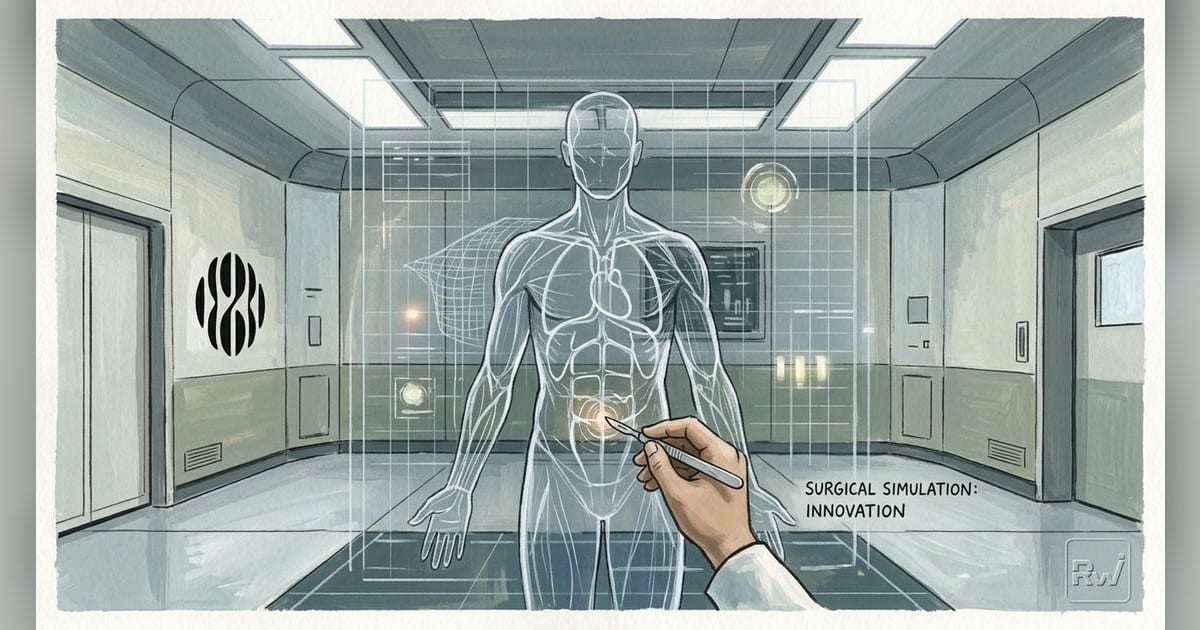
That makes the rebrand and the articulation of Inner Logic's commercial strategy the current news. Porras is moving the work out of a broad surgical-AI frame and presenting Inner Logic as infrastructure for medical-device manufacturers: software for designing, testing and validating procedural devices across simulated patients before physical testing and clinical deployment.
A surgeon turns research infrastructure into a startup
Porras trained in neurosurgery at Johns Hopkins Hospital. Inner Logic's release says he left his residency to build Inner Logic. An older Flare Capital biography described him as a sixth-year resident pursuing research in surgical education, AI and robotics while completing an MBA at Johns Hopkins Carey Business School. He earned his medical degree from Dartmouth's Geisel School of Medicine after studying psychology at the University of Texas at Austin.
Semaphor began in Johns Hopkins' Fuel accelerator, according to the university. Porras then brought in two Johns Hopkins researchers whose work covers the technical problems that surgical autonomy creates.
CTO Mathias Unberath is the John C. Malone Associate Professor of Computer Science at Johns Hopkins and leads the ARCADE Lab. His research spans computer vision, medical imaging, mixed reality and medical robotics. Johns Hopkins credits him with more than 150 journal and conference articles.
Chief Robotics Officer Axel Krieger is a Johns Hopkins associate professor of mechanical engineering and director of the IMERSE Lab. His Johns Hopkins bio says he earned a PhD from Johns Hopkins in 2008, previously worked as an assistant professor at the University of Maryland, and was a research professor and program lead for smart tools at Children's National Hospital.
Krieger also led work on the Smart Tissue Autonomous Robot, or STAR. In a 2022 peer-reviewed study, STAR performed laparoscopic intestinal anastomosis in living pigs using an autonomous strategy. The robot still relied on an operator to choose among generated surgical plans, but it executed a range of tasks independently. That distinction matters: demonstrated autonomy in a controlled animal study remains far removed from an autonomous system cleared for routine human surgery.
Inner Logic says Porras, Unberath and Krieger have collectively authored more than 400 peer-reviewed papers and are named inventors on more than 40 patents. Those totals are self-reported in the funding release, although the founders' individual Johns Hopkins biographies support substantial publication and patent records.
The bet is on the development layer
Porras is borrowing a lesson from self-driving cars. "Surgery is on the same path as autonomous driving," he said in the release, arguing that autonomy became practical in transportation only after developers built simulation and data systems capable of testing behavior at scale.
Procedural devices face a similar coverage problem. A catheter, implant or surgical robot must work across differences in anatomy, imaging quality, tissue behavior and clinical technique. Cadaver laboratories, animal studies and physical prototypes examine only a limited set of those conditions, and each iteration consumes time and specialized resources.
Inner Logic says its infrastructure generates virtual patients from real clinical and procedural data, allowing manufacturers to run device designs through thousands of simulated procedures. Inner Logic also says it can document each development cycle for regulatory use and move some exploratory work out of cadaver and animal laboratories.
The regulatory case for simulation is established, though narrower than Inner Logic's most ambitious pitch. The Food and Drug Administration describes modeling and simulation as a complement to bench, animal and clinical evidence. Its 2023 guidance for medical-device submissions sets out a risk-based framework for assessing whether computational models are credible enough to support regulatory review.
Inner Logic's near-term commercial job is therefore concrete: help manufacturers explore more designs, identify failures earlier and produce traceable evidence before expensive physical studies begin. Surgical autonomy is the longer bet built on top of that workflow.
Inner Logic says Porras, Unberath and Krieger have already trained orthopedic-trauma AI entirely in simulation before deploying it on physical hardware and patient anatomy. Wednesday's release also claims work on critical portions of gallbladder removal in a live animal without surgeon intervention. Inner Logic did not identify the corresponding studies in the announcement, so those demonstrations remain company-reported claims.
The unanswered commercial questions are equally important. Inner Logic has not named customers, data partners or production deployments. It has not disclosed revenue, pricing or how clinical data used to create virtual patients is sourced and governed. Inner Logic also has not identified a medical-device submission that has used its evidence package.
The $11.5 million gives Porras room to turn a Johns Hopkins research base into a product that device manufacturers can place inside regulated development programs. The rebrand makes the intended position explicit: Inner Logic wants to supply the testing and evidence infrastructure underneath intelligent medical devices, leaving manufacturers to build the devices themselves.