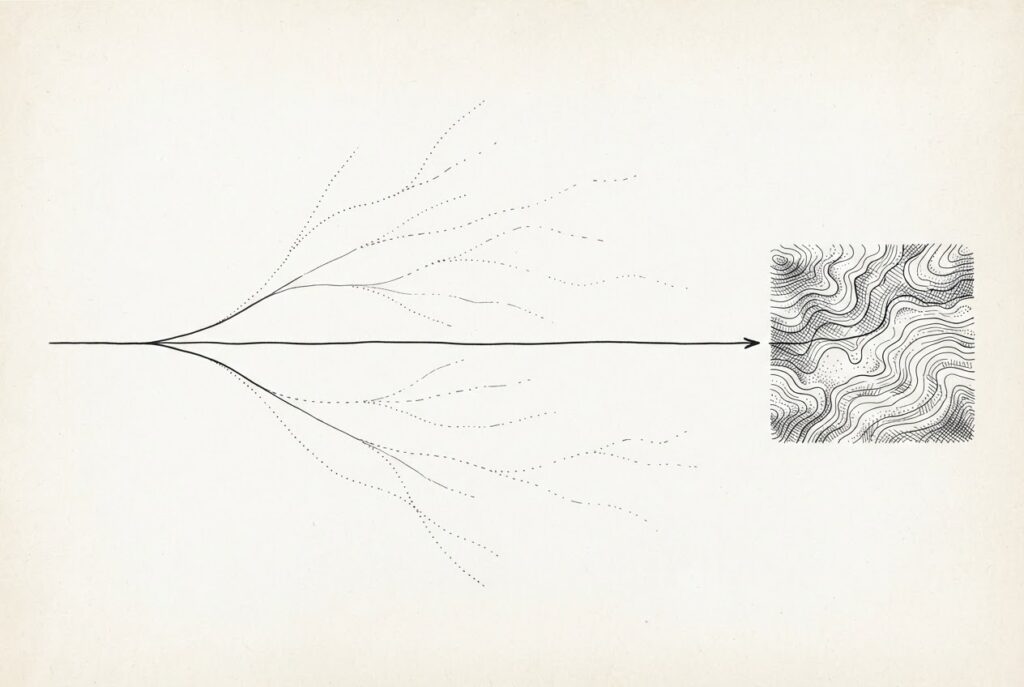
For builders of deep-research agents, the primary architectural challenge is comparing candidate next steps without making a real tool call for every discarded option. The Seer paper, with an arXiv record dated Nov. 19, 2026, introduces a framework to address this by utilizing two shared decision models that guide a frozen agent at inference time: a tool-response simulator and a value estimator. These components rely on distinct training signals to function. The simulator is trained on 0.7 million observed tool call-response pairs, learning to predict the likely output of a tool. Conversely, the value estimator is trained on 1 million samples derived from interaction histories, specifically labeled with discounted terminal correctness. This allows the estimator to score the potential of a history rather than the correctness of a single isolated action. Crucially, these checkpoints are frozen after training and reused across different agent models without further updates, providing a consistent decision-making layer.
At inference, the frozen agent proposes a set of candidate actions. The simulator predicts responses for these imagined branches, and the estimator subsequently scores the resulting histories. The framework employs depth-one imagined search, meaning each candidate extends the real history by exactly one imagined action before evaluation occurs. The candidate width, set to 32 in the experiments, represents the maximum number of proposed next actions at a single expansion point, rather than the generation of 32 complete, multi-step simulated research trajectories. Seer then commits to the action associated with the most-visited root edge. Only this selected action is executed, and only the actual tool response is integrated into the committed history. It is vital to distinguish that predicted content serves only to guide the selection process and does not constitute evidence of what a source actually returned.
The authors report significant performance gains on question-answering benchmarks. On the GAIA benchmark, which evaluates reasoning and tool-use proficiency, a candidate width of 32 reportedly increased accuracy for the Qwen3.5-4B model from 13.6% to 41.7%, and for the Qwen3.5-9B model from 22.3% to 50.5%. Across six tested models and five benchmarks, this width improved performance over the base agent in 26 of 30 comparisons. These results are author-reported, and independent reproduction has not yet been established.
A critical distinction exists between external tool-call counts and total system cost. The Seer paper reports that Seer achieves the highest accuracy on BrowseComp-200 while keeping real tool-call counts close to those of a Base Agent. The original BrowseComp paper describes its full benchmark as 1,266 questions requiring persistent internet navigation. Seer avoids real tool calls for discarded candidates but uses additional local inference and model memory. External-call counts alone do not quantify the inference spent on discarded branches or the total resource budget; the study did not take hardware measurements of cost, latency, or energy consumption.
There are inherent limits to the estimator’s utility. The authors clarify that the estimator score is not a calibrated success probability for a specific deployed policy; prediction and scoring errors can influence which branch the agent favors. Furthermore, a width of 32 performed worse than the best-tested width in 14 of 40 settings, indicating that wider search is not universally superior. The evaluation is currently limited to question-answering tasks and does not address open-ended research reports, evidence synthesis, or comprehensive coverage.
For builders, Seer represents a design pattern to evaluate when comparing tool-use options, rather than definitive proof of resource savings or a ready-to-deploy on-device solution. Its practical utility depends on whether task-specific accuracy gains justify the added local inference and memory overhead. The reported results leave the net resource trade-off unresolved: avoided calls to external tools must be assessed alongside the local inference and memory the guidance models add. The paper leaves that hardware-specific cost question unmeasured in this study.