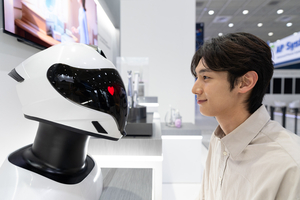
Samsung Display and LG Display each unveiled OLED panels designed for humanoid robot faces at K-Display 2026 in Seoul on Wednesday, marking an attempt to open a new application for screen technology already refined in smartphones and cars.
Samsung Display placed a humanoid head at the front of its booth, fitted with a 6.9-inch curved OLED that displays expressions and status cues and tracks visitors' gaze with eye-tracking.
The company also showed a 1.3-inch circular OLED built into a companion AI toy, a pendant-style AI necklace and a pocket-sized robot concept.
LG Display presented what it called the first domestic showing of a plastic OLED, or P-OLED, aimed at humanoids. The panel runs at 1,080-by-520 resolution and uses a plastic substrate instead of glass, making it thinner and lighter, and can operate at extreme temperatures between minus 30 and 85 degrees Celsius.
"P-OLED was applied to vehicles first, where its stability was verified," an LG Display official said. "That makes it well suited to humanoids that will be deployed across varied industrial environments," the official added.
Neither company disclosed customers, pricing or production timelines for the humanoid panels.
Samsung Display has one robot customer on the record. Reports in August 2025 said Tesla selected it to supply the face display for Optimus, with an 8-inch spherical curved OLED slated for the Gen 3 model. Earlier versions carried a featureless black panel with no display. Tesla has targeted second-half 2026 production for Gen 3, though the company shipped only hundreds of units last year against a 5,000-unit goal.
Not all humanoids are designed with faces. Boston Dynamics gives its Atlas robot a flat, ring-lit head packed with cameras and depth sensors, a deliberately un-human design meant to read as industrial equipment rather than a companion.
Actuators, reducers, sensors and batteries mainly determine a humanoid's cost and capability. Face panels are likelier to find early buyers in guidance, care and education settings, where conveying attention and status carries product value.
Both Korean products draw on platforms the companies already run. LG Display began mass-producing P-OLED for cars in 2020 and applied the technology to laptops in 2024, so the humanoid panel is the automotive product repurposed to survive in different conditions.
Samsung Display's curved-and-cut-out processing ties back to the camera hole it commercialized on the Galaxy S10 in 2019, since scaled up to 80-millimeter openings for car consoles.
mjh@heraldcorp.com