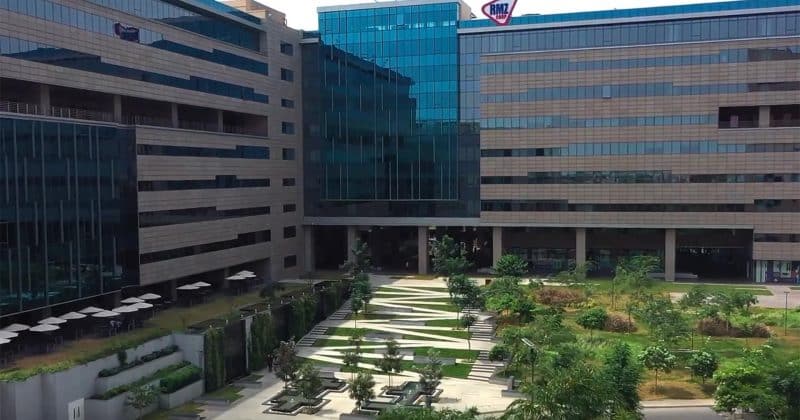
The Bengaluru-based real estate giant is betting big on India's massive gap between data generation and data center infrastructure
India generates roughly 20% of the world’s data but runs on just 2% of global data center capacity. RMZ Group looked at that mismatch and saw a $35 billion opportunity.
The Bengaluru-based real estate and alternative asset platform has unveiled a five-year investment plan aimed at expanding its data center footprint from approximately 250 MW to a staggering 2-3 gigawatts.
Where the money goes #
About half of the total investment, roughly $17.5B, is earmarked specifically for digital infrastructure. That bucket includes colocation data centers and what the company calls “AI factories,” purpose-built facilities designed to handle the intensive compute workloads that artificial intelligence demands.
The remaining funds will flow into mixed-use commercial and residential projects.
RMZ isn’t starting from scratch. In November 2024, the company formed a joint venture with Colt Data Centre Services, committing $1.7B to develop 250 MW of capacity across locations including Navi Mumbai and Chennai.
On top of the Colt partnership, RMZ has separately committed $10B toward building a 1 GW hyperscale cluster in the Visakhapatnam region of Andhra Pradesh.
Why India, why now #
India’s data generation is growing at a ferocious pace, driven by a massive and increasingly digital population, expanding cloud adoption among enterprises, and the AI boom. Yet the infrastructure to house all that data and computation hasn’t kept pace. That 20%-generation-versus-2%-capacity gap represents one of the most obvious supply-demand imbalances in global tech infrastructure.
RMZ has created a dedicated entity focused specifically on AI factory capabilities — a separate business unit whose entire job is building and operating facilities tailored for AI training and inference workloads.
The company is also exploring an initial public offering to fund the long-term capital needs of this expansion.
What this means for investors #
There are risks worth watching. Power availability is a genuine constraint in India, and securing reliable electricity for gigawatt-scale facilities requires significant coordination with state and central governments. Regulatory approvals, land acquisition, and water access for cooling systems can all introduce delays.
The potential IPO adds another variable. If RMZ goes public to fund this expansion, the company’s growth trajectory will be subject to public market scrutiny and the unpredictable moods of equity investors.
Disclosure: This article was edited by Editorial Team. For more information on how we create and review content, see our