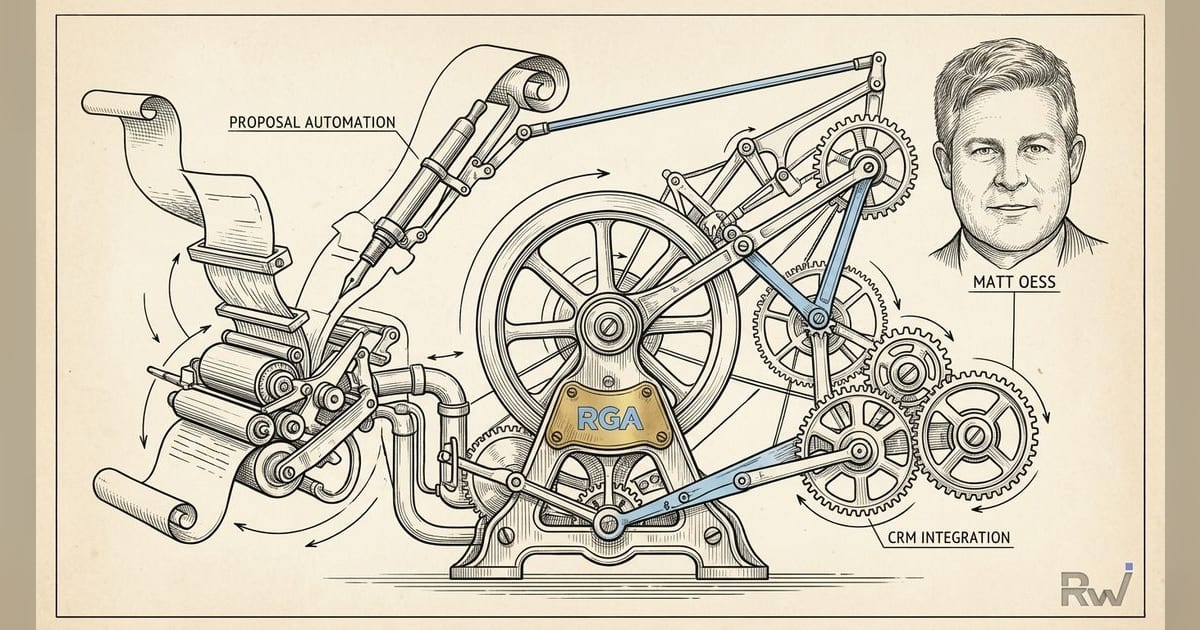
Matt Oess (@mattoess) is expanding Revenue Growth Agent from AI meeting preparation into a broader sales execution system that carries buyer context through discovery, HubSpot workflows, proposals and Statements of Work, the Cape Coral, Florida company announced on July 14th, 2026.
The release is a product expansion, not a financing announcement. Revenue Growth Agent has not disclosed outside funding, valuation, revenue, paid customer count or named investors. That matters because the company is entering a category where incumbents are selling AI as the new control layer for revenue teams, and where distribution through CRM workflows can matter as much as the model underneath.
Oess is a domain founder rather than a founder chasing a newly hot category. Revenue Growth Agent's about page describes him as a Yale School of Management MBA and TechCXO partner with more than 20 years in B2B sales transformation, including work connected to Cisco, Infor and GE Digital. TechCXO's profile lists him as an interim and fractional CRO/CSO and Executive Coaching Practice Lead.
That background explains the product's bias. Revenue Growth Agent is built around the daily handoff failures inside B2B sales: what a rep learned in a call, what made it into the CRM, what the manager sees, and what finally appears in the follow-up or proposal. Oess framed the problem bluntly in the announcement: many sales teams have a "sales execution problem." His argument is that opportunities are won or lost around the meeting itself, when context is either converted into a useful next step or disappears by the next call.
From prep assistant to deal memory
The Summer 2026 release adds transcript-based discovery analysis through Revenue Growth Agent's Discovery Conversion Agent. According to the company, the agent analyzes transcripts from AI notetakers for MEDDIC qualification signals, emotional themes, buyer commitments, deal-stage recommendations, risks, missing information and next steps.
The more important feature is multi-meeting deal intelligence. Revenue Growth Agent says qualification signals, commitments, themes and risks now carry forward across conversations, which moves the product closer to a deal memory layer than a one-off call coach. In longer B2B cycles, the buyer's priorities are rarely captured in a single meeting. The value of a sales AI product depends on whether it can preserve that thread without making reps maintain yet another record system.
Oess has been selling that premise on Revenue Growth Agent's own site as a way to deliver "Dream Team performance" quickly. Revenue Growth Agent's about page says the original question behind RGA was whether AI could solve B2B sales problems that had persisted for decades, especially the tradeoff between high-volume outreach and truly relevant preparation.
Revenue Growth Agent's homepage positions the system around three named agents: Meeting Prepper Agent for pre-call research, Discovery Conversion Agent for call analysis and coaching, and Solution Proposal Agent for post-call proposal drafting. Revenue Growth Agent says customers train RGA on their own value propositions, case studies, testimonials, pricing and sales content, rather than relying only on generic company research.
Proposal generation is the commercial move
The new release pushes Revenue Growth Agent past prep and coaching into proposal and SOW generation. RGA says its Solution Proposal Agent combines discovery insights with company-approved content to create buyer-specific proposals that include relevant solutions, proof points, pricing context and recommended next steps. The same release adds customized SOW and agreement creation using approved templates, pricing information and delivery knowledge.
That is the sharpest part of the announcement because it places RGA closer to revenue operations and professional-services workflows, where the output is a commercial document that a buyer can share internally. Generic proposal drafting is easy to demo and hard to trust. Revenue Growth Agent's bet is that company-specific training, discovery context and approved templates make the output usable inside real sales cycles.
Revenue Growth Agent says the platform can process PDFs, Word documents, PowerPoint presentations, web pages, YouTube videos and files up to 50 MB. It also says the release improves extraction of project structures, staffing models, implementation approaches and risk considerations. Those details point to a particular customer: B2B teams selling services, implementation-heavy software or consultative deals where proposals and SOWs still take human time to assemble.
Revenue Growth Agent's public pricing page lists an annual plan at $87 per user per month, billed at $1,046.40 annually, with 180 Meeting Prepper sessions and 120 Discovery sessions per year. The monthly plan is listed at $109 per user per month, with 15 Meeting Prepper sessions and 10 Discovery sessions per month. Teams of 10 or more receive an additional 10% discount, according to the company.
Revenue Growth Agent also markets several outcome metrics on its homepage, including faster proposal drafting, shorter sales cycles and higher conversion rates. Those figures are company-marketed claims and Revenue Growth Agent has not published an independent benchmark, audited customer study or named customer cohort to support them.
HubSpot is the first CRM surface
The HubSpot integration is the distribution hook. Revenue Growth Agent says Meeting Prepper is now available as an app card on HubSpot contact and lead records, allowing reps to generate preparation briefs inside the CRM, share them by link, download them as Word documents and save them back to contact records.
Revenue Growth Agent's HubSpot integration page is more precise than the announcement: Meeting Prepper is available now as a native CRM card, while Discovery Agent and Solution Proposal CRM cards are marked as coming soon. RGA says the current HubSpot card pre-fills from HubSpot contact data, enriches blanks from public data, generates research in about a minute and writes prep information back to HubSpot custom properties.
Revenue Growth Agent is also building beyond HubSpot. Its Salesforce quick start documentation, updated July 14th, 2026, describes Meeting Prepper embedded on Salesforce Lead and Contact record pages, with Discovery and proposal generation still running in the RGA web app. The Salesforce installation guide lists RGA 2.1 as the current managed package version and says Salesforce-embedded versions of discovery and proposal generation are on the roadmap.
That split is important. Revenue Growth Agent's core product claim is end-to-end continuity from prep to proposal, but its CRM embedding is still most mature at the prep layer. The rest of the workflow remains partly inside RGA's own application, at least according to the company's public integration docs.
A crowded market is moving the same way
Revenue Growth Agent is entering a sales AI market that has already moved past prospecting copy. Gong's June 2026 Mission Big Dipper release introduced a Revenue Harness for governed agents across the revenue cycle. Outreach's April 2026 product release framed its own agentic platform around execution, best-practice scaling and AI control across the sales cycle. HubSpot's Breeze-powered RFP agent, last updated March 31st, 2026, can auto-fill RFPs using past responses and connected knowledge.
Those products make RGA's opportunity and constraint visible. Oess is building for the same revenue-stack shift as larger vendors: agents that understand the deal, the company playbook and the next commercial document. RGA's differentiation depends on whether a smaller, founder-led company can deliver more practical sales-workflow depth than platforms with stronger CRM gravity, larger customer bases and more data.
The Summer 2026 release adds administrative and security controls as well. Revenue Growth Agent says it has introduced an Administrator Storage Manager for uploaded sources and training data, plus controls for tenant isolation, resource-ownership validation, organization-specific caching, credential protection, automated security enforcement and production monitoring. The timing is logical: once a sales AI product starts ingesting proposals, SOWs, pricing, customer proof points and CRM records, trust and data boundaries become part of the sale.
Revenue Growth Agent is still early. The company context around Oess is stronger than the public traction record around the business. No financing record, revenue figure or named customer list has been verified. The product direction, however, is coherent: Oess is turning the sales transformation work he has done as a fractional CRO into software that tries to make every rep behave as if the best seller, strategist and proposal writer were sitting beside them before and after every meeting.