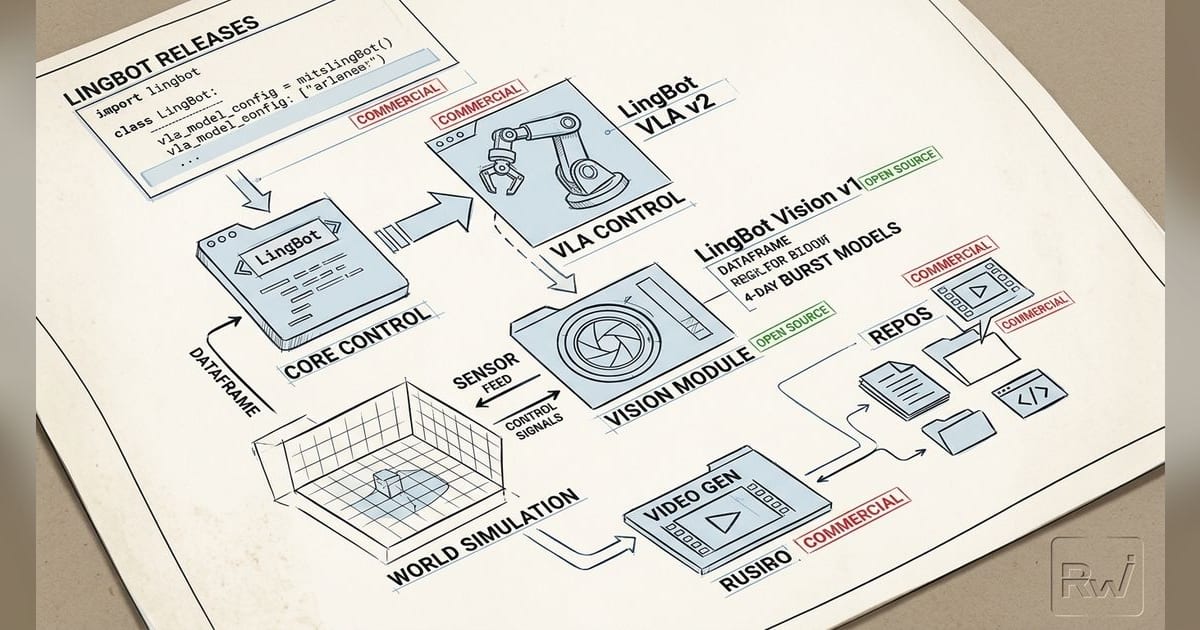
Robbyant is associated with a cluster of LingBot model repos. An X post said it released six embodied-AI models over four days spanning perception, action, world modeling and video.
Post on X The public artifact trail supports the broader point: we can directly verify active LingBot repos, model cards and a paper around the same stack label. The exact six-item count is harder to audit from the provided pages because some work appears as model families, some as checkpoints, and some as full repos.
The LingBot label shows up across perception and action in sources we can verify. That framing implies a stack: visual backbones for spatial understanding and VLA models for robot actions.
The release cadence is the message
The clearest recent perception artifact is LingBot-Vision, a repository titled "Vision Pretraining for Dense Spatial Perception." A related Hugging Face model page identifies a LingBot-Vision ViT-Large checkpoint. The public pages reviewed here establish the model family and its spatial-perception framing, but they do not provide enough included text to independently verify parameter counts, teacher-student distillation details, benchmark tables or license terms.
The action layer includes LingBot-VLA 2.0, paired with the arXiv paper From Foundation to Application: Improving VLA Models in Practice. The available source text does not support the more precise claims that often decide whether a robot-control model is ready for adoption: dataset hours, robot-configuration counts, canonical action-vector dimensions or benchmark comparisons.
Those missing details matter because cross-embodiment control is the hard commercial problem. A VLA model that can normalize different robot bodies into a shared control scheme would reduce the cost of training separate policies for every arm, gripper, base and sensor package. The public materials available here are enough to establish the positioning, though not enough to verify the underlying scale claims.
Video and world models: noted, not verified here
The X post also referenced video and world-model work. Those pages were not included in our provided source set, so we are not evaluating specific claims about LingBot-Video or LingBot-World in this article.
Per the repos and paper we reviewed, LingBot-Vision and LingBot-VLA 2.0 outline perception and action components of a potential stack. Specific dataset sizes, parameter counts, benchmark results and license terms are company-reported where they appear on public pages and were not independently verified from the materials supplied for this article.
Robbyant is betting on stack coherence
The open questions are practical. The supplied materials do not tie the burst of releases to a named product, customer deployment, robot fleet, revenue model or commercial API. Founder and leadership details are also absent from the provided source set. The visible public footprint is a research-and-model release program organized around GitHub, Hugging Face, arXiv and an X account.
That leaves Robbyant easier to read as a platform push than as a conventional robotics product launch. Open model releases can win attention from researchers, robotics teams and developers before monetization is clear. Robbyant gets feedback, citations, forks and downstream testing. Developers get access to pieces of an embodied-AI stack that would be expensive to reproduce. The unresolved question for adopters is which pieces can be used in commercial systems, which remain research artifacts, and how tightly the components work together.
The next proof point will come outside the repos. Robbyant's public pages show a team trying to make perception, prediction and action speak the same language. Robots will decide whether that language survives contact with hardware, latency, failed grasps, occlusions and the long tail of real rooms.