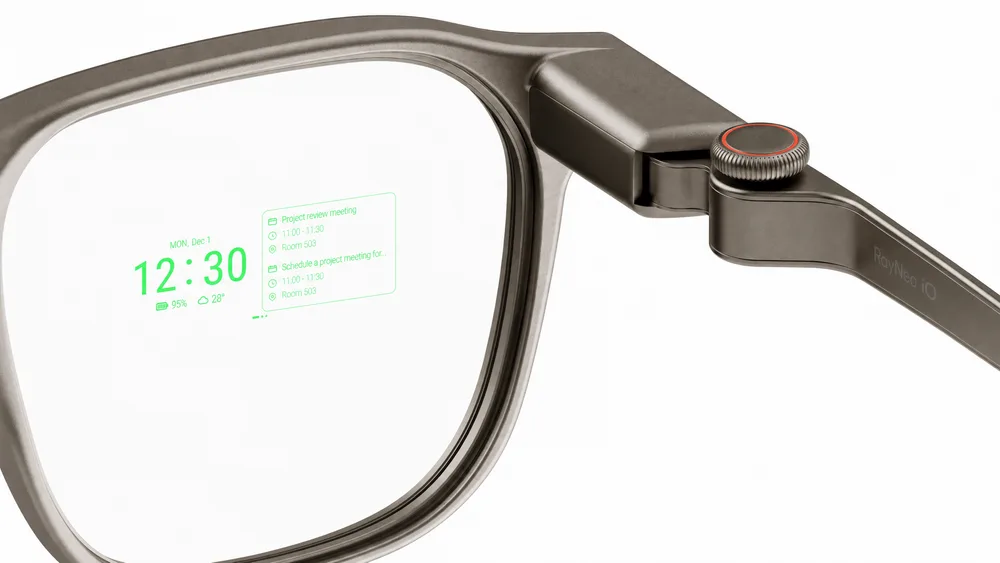
By stripping out the camera and the speakers, they are essentially re-engineering the device from a multimedia capture tool into a dedicated heads-up display (HUD). This isn't just about privacy; it’s a massive win for the hardware's form factor and battery life. Most AI wearables struggle to stay slim because they are constantly trying to process high-bandwidth video streams or power heavy audio drivers. Without those requirements, the device can stay lightweight enough for all-day use.
The shift toward text-centric AI workflows #
Instead of trying to "see" the world through a camera and interpret it in real-time—which is computationally expensive and prone to errors—this approach relies on feeding the glasses structured data. Think of it as a mobile notification center that lives in your peripheral vision.
In a real-world deployment, this changes how you interact with an LLM agent. Instead of saying "Hey, look at this menu and tell me what's vegetarian," you are looking at a system that pushes relevant text snippets, translations, or navigation cues directly onto your lenses. This is a much more efficient AI workflow for tasks like:
Real-time translation: Seeing subtitles for a foreign language speaker without needing a camera to OCR the room.Navigation: Having turn-by-turn text directions overlaid on your walking path.Contextual reminders: Getting meeting notes or contact info popped up during a conversation.
Hardware trade-offs and the privacy win #
The decision to skip speakers is also telling. Most smart glasses try to use bone conduction or directional audio, which can still be a distraction or a privacy concern in quiet environments. By leaning into visual text overlays, RayNeo is betting that users want information that is silent and discrete.
Privacy: Zero camera means zero fear of accidental recordings or being flagged by privacy-conscious bystanders.Battery Life: Removing the constant video processing loop significantly extends the time between charges.Weight: The reduction in sensor weight makes the glasses look more like standard eyewear and less like a piece of sci-fi tech.
It is a bold move to step away from the "multimedia" hype that Meta and others are chasing. While the "see what I see" feature is the holy grail for many, it might be the very thing preventing smart glasses from becoming a mainstream consumer staple. RayNeo is essentially building a practical tutorial for how to integrate AI into daily life without making everyone else in the room uncomfortable. Whether a text-only interface provides enough "magic" to compete with more feature-rich devices remains to be seen, but from a deployment and usability standpoint, it makes a lot of sense.
Next Why current world models like Sora keep failing at human →
a library of Claude prompt techniques, with plenty of directly applicable cases.