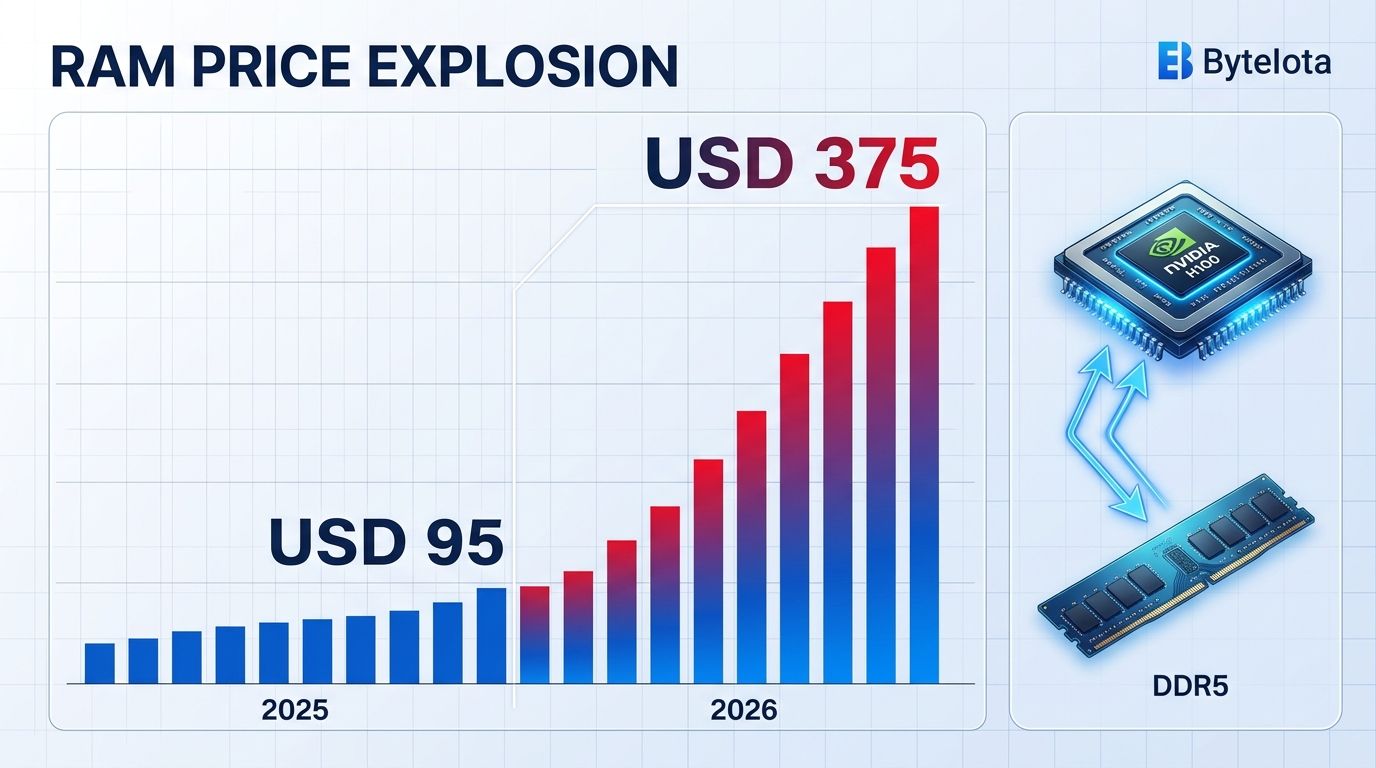
RAM prices are up 500% in 2026. Tom’s Hardware confirmed this week that a 128GB DDR5 kit now costs $3,399 — more than 10 times the lowest price the publication has ever tracked for that configuration. A 32GB kit, which cost roughly $95 in mid-2025, now floors at $374.97. The culprit is not a factory fire, a tariff war, or a shipping crisis. It’s AI infrastructure: the same DRAM fabs that produce your workstation memory, server RAM, and homelab builds are being redirected to make high-bandwidth memory (HBM) for Nvidia’s AI accelerators, where margins are far higher.
Why AI Is Cannibalizing the DDR5 Supply #
HBM is not just regular memory made faster. It requires roughly 3-4x more wafer area per gigabyte to manufacture compared to standard DDR5, and it commands 3-5x more revenue per wafer. For Samsung, SK Hynix, and Micron — the three companies that control 95%+ of global DRAM production — the economics are obvious. According to TrendForce, HBM consumed 23% of global DRAM wafers in 2026, up from just 8% in 2024. Every wafer redirected to HBM removes the equivalent of roughly three wafers’ worth of DDR5 from the consumer and enterprise market.
SK Hynix stated in October 2025 that its entire 2026 HBM production was already committed. Micron has similarly sold out all 2026 HBM supply. The hyperscalers — Google, Microsoft, Meta, Amazon — have locked in nearly all 2027 HBM capacity as well. This is a structural reallocation of the global memory ecosystem, not a temporary blip. Consumer and server buyers are last in line, and that line is getting longer.
Related:[AI API Price War: What Developers Must Act on in August]— AI infrastructure costs are rising on multiple fronts, not just hardware.
What You’re Actually Paying Now #
The numbers are stark. A 32GB DDR5 kit that cost $80-100 twelve months ago now has a floor price of $374.97. DDR5 costs $12-14 per gigabyte today, versus roughly $3/GB a year ago. The 64GB kits developers want for comfortable AI development workstations run $630-875. For server buyers, a 256GB DDR5 ECC RDIMM refresh that was budgeted at $800-1,200 now costs $2,000-3,500. Storage has followed: a 1TB Gen4 NVMe that was $70-80 is now $180-250.

For homelab builders, the math has become brutal. A $500 budget build that previously allocated $90-120 for RAM and storage now needs $450-600 for identical specs — essentially the entire budget. The irony is direct: AI is pricing out the very developers who are building AI products. A developer wanting 32GB of RAM to run a local model comfortably is now paying what used to cover an entire workstation’s worth of components.
Don’t Wait for Relief — There Isn’t Any Coming #
The timeline is not encouraging. Samsung and SK Hynix have both stated the shortage extends through at least 2027. TrendForce projects HBM contract prices will surge even higher in 2027 as tight supply gives manufacturers more pricing power. New fabrication capacity — including SK Hynix’s M15X fab in Cheongju and its $3.87B Indiana packaging plant — won’t come online until late 2027 at the earliest. The question is not “when will prices drop?” It is “how long can you wait?”
“Memory is going to be expensive for the foreseeable future,” one developer wrote on Slashdot’s thread covering the Tom’s Hardware report, which hit 437 upvotes on Hacker News this week. “And all because of what’s essentially a con job.” The frustration is understandable. Three manufacturers making a rational business decision — prioritize HBM where margins are 3-5x higher — has locked the rest of the market into years of inflated prices with no competitive backstop.
What Developers Can Actually Do #
DDR4 is the most underrated option right now. At roughly $4.31/GB versus $12-14/GB for DDR5, it is dramatically cheaper, and [for most developer workloads — including CPU-offloaded LLM inference — it performs within 2-4 tokens per second of DDR5](https://www.runaihome.com/blog/ddr5-ssd-price-surge-ai-hbm-impact-local-builds-2026/). A used Ryzen 5000 system with DDR4-3200 costs $400-450 for the full platform and delivers comparable inference performance for GPU-resident models while keeping the rest of the budget intact. For non-AI workloads, DDR4 is simply a better value at current prices.

For those committed to DDR5: buy the exact capacity you need and no more. The standard advice to over-provision — buy 64GB for future-proofing when you need 32GB — does not hold in a market where prices rose 90-95% in Q1 2026 and another 58-63% in Q2. Prioritize GPU VRAM first; it remains the actual bottleneck for AI inference workloads. For memory-intensive tasks that don’t need to be on-premises, cloud compute may be temporarily more cost-effective than buying hardware that costs 4x what it should.
Key Takeaways #
- RAM prices are up 500% year-over-year. A 32GB DDR5 kit now floors at $375; a 128GB kit costs $3,399. This is confirmed, not projected.
- The cause is structural: HBM for AI GPUs consumes 4x more wafer area per gigabyte than DDR5 and earns manufacturers 3-5x more revenue. DRAM makers have rationally reallocated capacity.
- Relief is locked out through at least 2027. Hyperscalers have already contracted virtually all 2027 HBM capacity. New fabs come online late 2027 at best.
- DDR4 is a legitimate alternative. For most dev workflows and GPU-resident AI inference, the performance gap versus DDR5 is marginal compared to the 3-4x price difference.
- If you need DDR5 now, buy the minimum you need — no buffer. Prioritize GPU VRAM over system RAM for AI workloads.