8 min read
Radisson put live hotel discovery inside ChatGPT and reports booking conversion at about 1.5 times organic search. The comparison did not randomise visitors, so the story is as much about measurement as the number.
TL;DR #
- Radisson Hotel Group and Accenture built a ChatGPT hotel discovery plugin in six weeks, connecting live prices, maps and hotel details to Radisson’s direct booking site.
- For July and August 2026, Radisson reports that visits arriving through the plugin converted to bookings at about 1.5 times the rate of organic search.
- The result is an early channel comparison rather than a randomised test. Traffic, bookings, markets and confidence intervals haven’t been published, and visitor intent may differ between channels.
- The copyable lever is the measured handoff. Give an AI discovery surface live commercial data, send the customer into an owned checkout, and keep that source visible through the booking event.
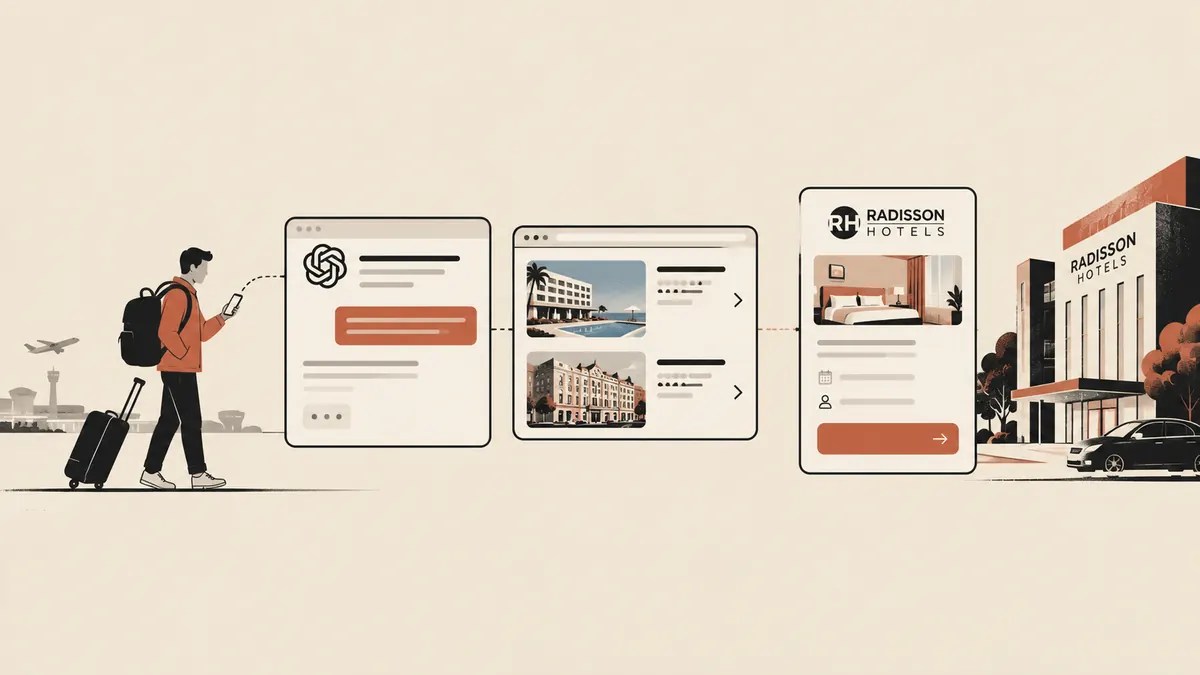
Choosing a hotel can mean a small mountain of tabs. Radisson’s answer was to put properties, maps, prices and amenities inside ChatGPT, then send travellers to its own site to book. The conversation stayed connected to a reservation the company could count.
Radisson Hotel Group, headquartered in Brussels, operates ten hotel brands across EMEA and APAC. It worked with Accenture Song and OpenAI to turn hotel search into a branded ChatGPT experience. OpenAI’s customer account, published on 7 October 2026, reports that the plugin’s visit-to-booking conversion rate was about 1.5 times Radisson’s organic search rate during July and August 2026.
The Radisson ChatGPT conversion figure is a strong one, and it raises a fair question. People asking an assistant to compare named hotels may already be closer to booking than someone arriving from a search engine, so the 50% gap could reflect who arrived as well as how they got there.
The shortlist moved #
The hotel shortlist was taking shape before Radisson saw the visitor. Travellers were using AI to choose destinations and shortlist hotels before visiting a hotel website, and by the time one of them reached Radisson, much of the comparison could already be over.
The source doesn’t state a formal hypothesis, so this is our reading. If Radisson put accurate inventory and property information inside the planning conversation, then sent the traveller into its own booking flow, it could win more direct bookings from a decision surface it doesn’t control. The assistant handles discovery and comparison, while Radisson’s site takes payment and keeps the direct customer relationship. It’s a new front door with the booking desk still inside.
Six weeks of plumbing #
Accenture built and launched the plugin in six weeks, according to OpenAI. It shows hotel suggestions, a map, current prices and amenity details inside ChatGPT, so a user can move from a broad travel idea to a particular property and then click through to Radisson’s direct booking experience.
The chat window needs a route to the hotel’s live systems. OpenAI says Accenture created an MCP server and APIs that connect the assistant with Radisson’s systems. The same layer supports Radisson’s advertising experience and gives future features a connection to build on.
The team also removed an adoption hurdle. The original experience asked users to invoke the plugin by typing its name. After a ChatGPT update, an installed plugin could appear on its own when a relevant travel request was detected. That changes how easily people find it without touching the hotel catalogue or the booking engine.
What the Radisson ChatGPT conversion number shows #
The main metric was visit-to-booking conversion, and OpenAI reports about 1.5 times the organic search rate for plugin traffic during July and August 2026. The baseline rate, visitor count, number of bookings, countries, traffic allocation and statistical significance haven’t been published, and they’d be welcome in a follow-up.
Radisson also launched sponsored advertising in ChatGPT alongside the organic plugin and expanded campaigns into more European markets and beyond. OpenAI says 54% of recorded checkout and booking events connected with the advertising were attributed through view-through measurement. That’s a separate attribution claim from the plugin comparison. A person may see an ad, use the plugin later and book through the site, so teams should keep paid exposure, plugin referral and completed booking as distinct events.
Radisson reported the result and OpenAI published it, with Accenture building the system. Velit Dundar, Radisson’s vice president of global ecommerce, is quoted in the account, and his public professional profile confirms the role. No independent audit of the data is public yet.
Different guests, different odds #
Organic search is a practical benchmark because it’s an established route into the same booking site. It isn’t a perfect counterfactual. The two channels can differ in destination, market, device, brand familiarity and urgency. A conversational user may spend several minutes refining dates and preferences before Radisson records the visit, while search traffic includes people at every stage, from browsing a city guide to hunting for one property.
To separate the audience from the experience, Radisson could hold back part of the eligible plugin audience or compare matched groups by destination, date, market, device and brand intent. It could also watch for novelty effects. The public window covers two months, so conversion by week, market and first time versus returning visitor would show whether the rate holds up with wider distribution and automatic invocation.
Keep the booking trail #
Most growth teams can’t build a hotel recommendation model, and they don’t need to copy that part. The useful lever is to measure one narrow, high intent job across an external AI surface and the owned transaction. A software company might let a buyer configure a plan in conversation, then carry the configuration into checkout. A marketplace could let a user compare a short list, then keep the selected filters on arrival.
The minimum system has four pieces. It needs reliable commercial data, a defined action the assistant can complete, a source identifier that survives the click and an owned conversion event. With the last two in place, a team can measure direct booking conversion and compare cohorts honestly, even though the channels weren’t randomised.
Radisson’s next priorities are encouraging plugin adoption, adding personalised recommendations, connecting its loyalty programme and eventually supporting booking and reservation management inside ChatGPT. Each step changes the funnel. In chat booking could remove a click and also the clean website visit that anchors today’s measurement, so the tracking will have to move with the transaction.
Follow the next click #
Radisson connected live inventory to a new discovery channel in six weeks. The next job is finding out whether that channel brings extra bookings or simply catches travellers who were ready to book anyway, and keeping the evidence visible if the last click moves into the conversation.
The handoff is easier to judge beside TreeHouse’s route from AI citations to paid trials, since both cases depend on following discovery through to a recorded conversion. Our ChatGPT advertising case separates a paid placement from the organic discovery route.
| Experiment detail | What the reporting shows |
|---|---|
| Change | Radisson and Accenture connected ChatGPT hotel discovery to live property information, prices and amenities, with a handoff to Radisson’s direct booking website. |
| Reported result | OpenAI reports that visitors arriving through the ChatGPT integration converted to bookings at approximately 1.5 times the organic-search rate during July and August 2026. |
| Evidence | OpenAI-published Radisson and Accenture customer case, reporting two months of channel conversion comparisons without a randomised control. |
| Limits | Company-reported result published by OpenAI. This is a comparison between traffic sources, not a randomised experiment or proof of a 50% incremental lift. Absolute rates and sample sizes are not disclosed. |
Sources and disclosure #
The reported conversion comparison comes from an OpenAI-published customer case about Radisson Hotel Group and Accenture. OpenAI provided the platform, Accenture developed the integration and Radisson supplied the commercial results. The public account doesn’t give absolute conversion rates, traffic volumes or a randomised control group, and the 1.5 times figure compares acquisition channels rather than proving incremental bookings.
FAQ #
What did Radisson test in ChatGPT? #
Radisson connected hotel discovery, current prices and property information in ChatGPT to a direct booking handoff.
Did ChatGPT increase bookings by 50%? #
Not yet shown. The reported booking conversion rate for ChatGPT visitors was about 1.5 times the rate for organic search visitors, but the audiences weren’t randomly assigned.
What should growth teams measure next? #
Compare similar audiences, keep referral attribution through to the booking, and measure incremental bookings, acquisition costs and cancellations rather than relying on channel conversion alone.
Find the reported method, result and limitations of other experiments in the Growth Signal Index in IC Lab.