8 min read
Radisson put live hotel discovery inside ChatGPT and reports booking conversion at about 1.5 times organic search. The comparison did not randomise visitors.
TL;DR #
- Radisson Hotel Group and Accenture built a ChatGPT hotel discovery plugin in six weeks, connecting live prices, maps and hotel details to Radisson’s direct booking site.
- For July and August 2026, Radisson reports that visits arriving through the plugin converted to bookings at about 1.5 times the rate of organic search.
- The result is an early channel comparison, not a randomised test. Radisson and OpenAI do not publish traffic, bookings, markets, confidence intervals or an adjustment for differences in visitor intent.
- The copyable lever is the measured handoff: give an AI discovery surface live commercial data, send the customer into an owned checkout, and keep that source visible through the booking event.
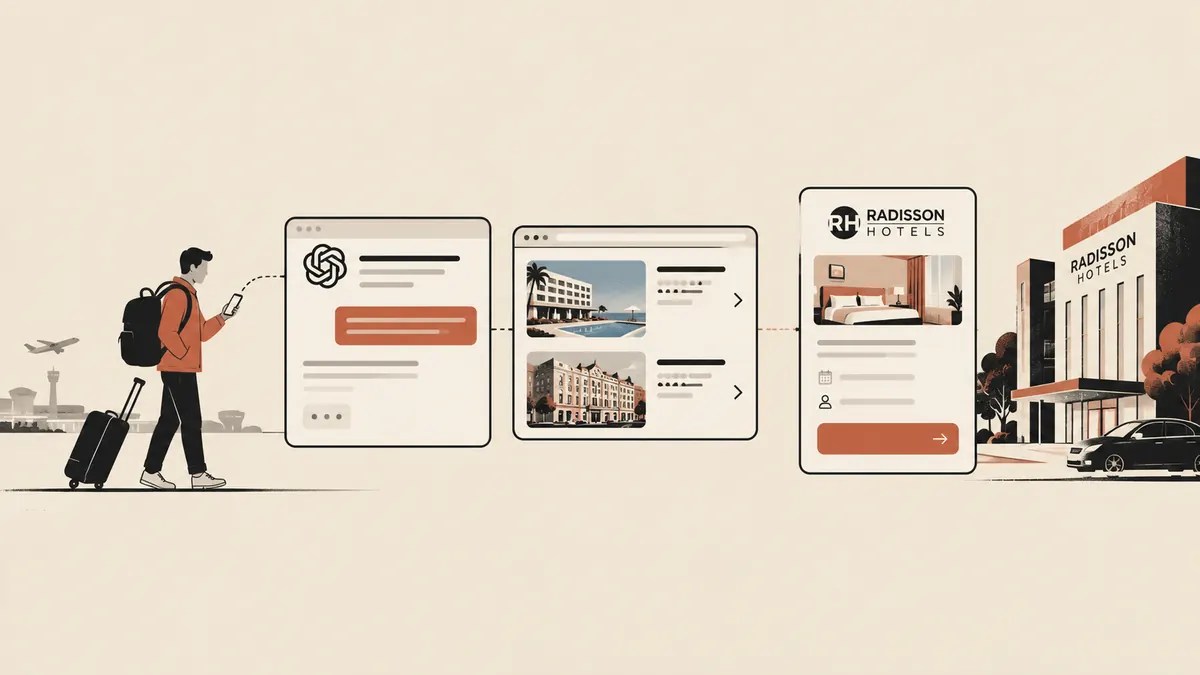
A traveller planning Madrid can now ask ChatGPT for a hotel, compare Radisson properties on a map, inspect prices and amenities, and then continue to Radisson’s site to book. That final handoff is the important part. Conversational discovery often disappears into a website visit that looks like any other referral. Radisson designed the route so it could see whether the conversation ended in a reservation.
Radisson Hotel Group, headquartered in Brussels, operates ten hotel brands across EMEA and APAC. It worked with Accenture Song and OpenAI to turn hotel search into a branded ChatGPT experience. OpenAI’s customer account, published on 7 October 2026, reports that the plugin’s visit-to-booking conversion rate was approximately 1.5 times Radisson’s organic-search rate during July and August 2026.
That is a useful result and an easy one to overread. It does not show that the plugin caused a 50% lift. People who ask a conversational assistant to compare named hotels may already be closer to booking than people arriving from a search engine. The Radisson ChatGPT conversion figure measures how two acquisition routes performed, not what would have happened to the same travellers without the plugin.
The booking journey moved before the website visit #
Radisson’s constraint was not a weak checkout. The decision was moving upstream. Travellers were using AI to choose destinations and shortlist hotels before visiting a hotel website. By the time one of those people reached Radisson, much of the comparison could already be over.
The hypothesis is not stated formally in the source, so it should be treated as a reconstruction. If Radisson placed accurate inventory and property information inside the conversational planning session, then sent the user into its own booking flow, it could earn more direct bookings from a decision surface it did not control.
This is why the case belongs in growth rather than product novelty. A ChatGPT hotel booking journey creates a new entry point, but Radisson still owns the transaction. The assistant helps with discovery and comparison. The hotel’s existing site completes payment, preserves the direct customer relationship and produces the event the growth team can measure.
Six weeks connected conversation with inventory #
Accenture built and launched the plugin in six weeks, according to OpenAI. It exposes hotel suggestions, a map, current prices and amenity details inside ChatGPT. A user can move from a broad travel idea to a particular property, then click through to Radisson’s direct booking experience.
The infrastructure matters more than the chat window. OpenAI says Accenture created an MCP server and APIs that connect the assistant with Radisson’s systems. The same layer also supports its advertising experience and is intended for future features. This makes the project an AI travel discovery system sitting on reusable commercial plumbing, rather than a standalone campaign page.
The team also reduced an adoption step. The original experience required users to invoke the plugin by typing its name. After a ChatGPT update, an installed plugin could appear automatically when a relevant travel request was detected. That changes discoverability without changing the hotel catalogue or the booking engine.
A two-month comparison delivered the headline #
The primary metric was visit-to-booking conversion. OpenAI reports approximately 1.5 times the organic-search rate for traffic from the plugin during July and August 2026. It does not publish the baseline rate, visitor count, number of bookings, countries, traffic allocation, confidence interval or statistical significance. The word approximately also signals that the public number has been rounded.
Radisson launched sponsored advertising in ChatGPT alongside the organic plugin and expanded campaigns into more European markets and beyond. OpenAI says 54% of recorded checkout and booking events connected with the advertising were attributed through view-through measurement. That is a separate attribution claim, not support for the plugin conversion comparison. A person may see an ad, use the plugin later and book through the site, so teams should keep paid exposure, plugin referral and completed booking as distinct events.
The result is company reported and vendor published. OpenAI supplied the platform, Accenture built the system, and Radisson provided the commercial outcome. No public source independently audits the data. Velit Dundar, Radisson’s vice president of global ecommerce, is quoted in the account and his public professional profile confirms the role.
The measurement problem sits in the audience #
Organic search is a practical benchmark because it is an established route into the same booking site. It is not a counterfactual. The two channels can differ in destination, market, device, brand familiarity and urgency. A conversational user may spend several minutes refining dates and preferences before Radisson records the visit. Search traffic includes people at many stages, from browsing a city guide to looking for a particular property.
That selection effect can inflate direct booking conversion without making the channel unimportant. The correct reading is narrower. Radisson found a cohort arriving from ChatGPT that booked at a higher observed rate than its organic-search cohort. The next test should separate channel quality from product lift, either through a holdout among eligible plugin users or matched cohorts that control for destination, date, market, device and brand intent.
A conversational commerce experiment can also protect against novelty effects by watching repeat performance. The public window covers two months. Reporting conversion by week, market and first-time versus returning visitor would show whether the rate survives wider distribution and automatic invocation.
The copyable part is the handoff #
Most growth teams cannot build a hotel recommendation model, and they do not need to copy that part. The useful lever is to instrument one narrow, high-intent job across an external AI surface and the owned transaction. A software company might let a buyer configure a plan in conversation, then carry the configuration into checkout. A marketplace could let a user compare a short list, then preserve the selected filters on arrival.
The minimum system has four pieces. It needs reliable commercial data, a defined action the assistant can complete, a source identifier that survives the click and an owned conversion event. Without the last two, AI discovery becomes a story about engagement. With them, the team can measure direct booking conversion and compare cohorts without pretending the channels are randomised.
Radisson’s next priorities are encouraging plugin adoption, adding personalised recommendations, connecting its loyalty programme and eventually supporting booking and reservation management inside ChatGPT. Each step changes the funnel. In-chat booking could remove a click and also remove the clean website visit that anchors today’s measurement. The instrumentation will have to move with the transaction.
What earns the next test #
The first result justifies continued testing, not a victory lap. Radisson built quickly, connected live data, kept a route to its direct channel and named a business metric. The missing control means the 1.5 times figure should guide the next experiment rather than close the case.
The strongest next test would hold out part of the eligible audience while preserving the same destination and booking intent. Until then, the structural lesson is simpler. When customer discovery moves into an AI interface, build the measurement bridge before celebrating the new traffic. That bridge, more than the conversational surface, is what turns an AI experiment into a growth system.
Sources and disclosure #
The reported conversion comparison comes from an OpenAI-published customer case about Radisson Hotel Group and Accenture. OpenAI provided the platform, Accenture developed the integration and Radisson supplied the commercial results. The public account does not provide absolute conversion rates, traffic volumes or a randomised control group. The 1.5-times figure compares acquisition channels and does not prove incremental bookings.
FAQ #
What did Radisson test in ChatGPT? #
Radisson connected hotel discovery, current prices and property information in ChatGPT to a direct booking handoff.
Did ChatGPT increase bookings by 50%? #
That has not been established. The reported booking conversion rate for ChatGPT visitors was about 1.5 times the rate for organic-search visitors, but the audiences were not randomly assigned.
What should growth teams measure next? #
Compare similar audiences, preserve referral attribution through booking, and measure incremental bookings, acquisition costs and cancellations rather than relying on channel conversion alone.