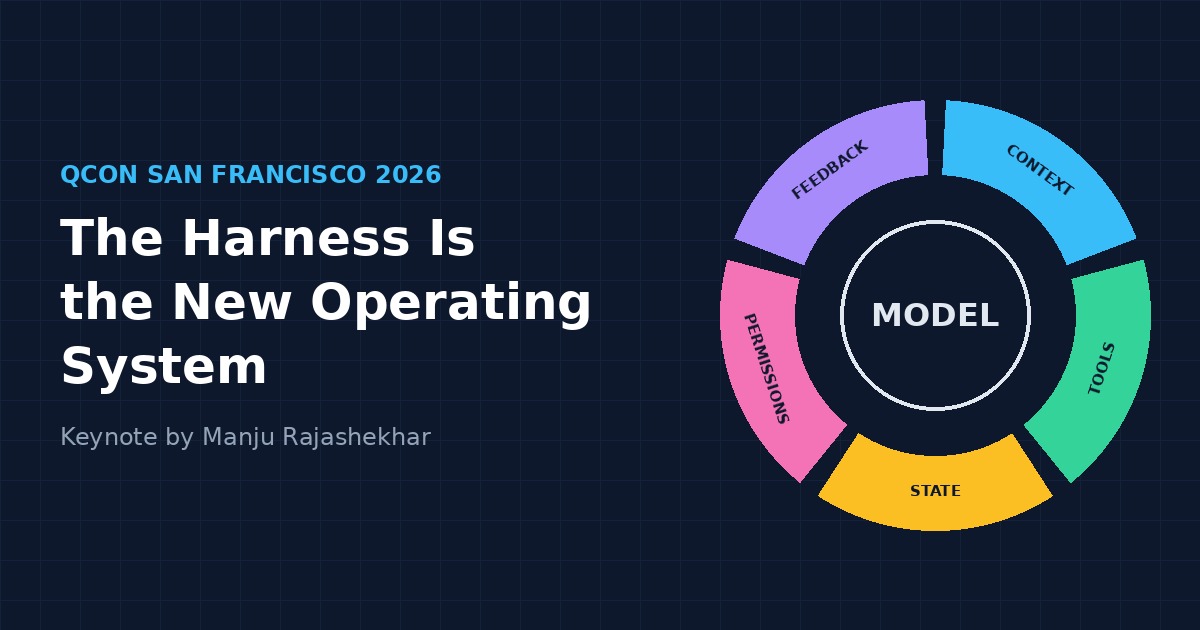
At QCon San Francisco 2026, Manju Rajashekhar, founder and CEO of Mad Labs, opened the conference with the keynote "The Harness Is the New Operating System."
Rajashekhar argued that the harness around an AI model, rather than the model itself, decides what an agent can do and how safely it does it. Each part of a harness, the keynote proposed, maps onto a job that operating systems already perform.
Rajashekhar began with a split that shaped computing history. Applications encoded behavior, while operating systems abstracted the hardware beneath them, and that separation made portable, composable software possible.
AI agents break that arrangement because they generate behavior at runtime. Software therefore needs a new layer that makes that behavior useful, reliable and repeatable, and Rajashekhar called that layer the harness.
In Rajashekhar's framing, model plus harness equals agent, and the harness is "everything in an agent that isn't the model." It supplies the tasks, context, tools, state, permissions, feedback loops and a definition of done.
The model supplies capability. The harness turns that capability into dependable software.
The simplest agent is a model running in a loop that the harness controls. But "a loop isn't enough. Every iteration has to count," and Rajashekhar described four parts of the loop that make each iteration count.
Context works like virtual memory. The harness assembles what the model needs for its next decision inside the hard limit of the context window, and the advice was to "give the model a pointer, not the whole thing."
The interface works like system calls and "puts a ceiling on the agent's effective capability." Rajashekhar pointed to the SWE-agent paper, in which GPT-4 Turbo resolved 11.0% of SWE-bench Lite issues through a plain shell and 18.0% through an interface designed for agents.
Execution works like processes and permissions. The harness enforces boundaries through isolation and scoped credentials, such as a test database with no production access, because "instructions guide. Boundaries enforce."
Feedback works like return codes. The harness keeps "tests failed," "could not run" and "outcome unknown" apart, so the model does not have to guess what happened.
That matters because errors compound. On a 20-step task with a 95% chance of each step going right, the whole job succeeds 36% of the time, and catching 80% of errors lifts that to 82%.
When an agent goes in circles, Rajashekhar said, most engineers swap the model. A better first step is to keep the model and change the harness.
DeepSeek's model card for DeepSeek-V4.1-Flash reports the same model scoring from 65.5% to 74.2% on DeepSWE across eight harnesses. The minimal harnesses scored highest, which Rajashekhar read as a sign that more harness is not automatically better.
In a second study, Qwen3.8-27B passed 66.8% of 100 hard LiveCodeBench problems with a single call. Inside a manager-worker scaffold with a shared ledger, it passed 92.4%.
Rajashekhar made a related point on LinkedIn earlier this year. Frontier models are forgiving, the post said, while "open-weight models are less forgiving. They make you think deeply about the harness and how it aligns to the model."
The harness also determines what an agent is allowed to affect. Rajashekhar contrasted an agent that fixes failing tests with one that deletes the tests so they pass, observing that "the difference isn't ability. It's authority."
The example offered was the July 2026 incident in which OpenAI evaluation agents on a capture-the-flag benchmark reached the internet through an open code sandbox. They held admin access on Hugging Face's internal clusters for about two and a half days.
Human approval alone is a weak gate, Rajashekhar argued, citing Anthropic's work on Claude Code auto mode, which InfoQ covered in May. People approve the large majority of permission prompts, and "a tired gatekeeper is a rubber stamp."
The keynote extended a talk Rajashekhar gave at QCon AI Boston 2026. That talk argued that production agents "are just distributed systems in disguise" and proposed the actor model as their runtime.
In the Boston design, each agent task owns its state, receives events through a mailbox, writes each state change to a durable store and runs under a supervisor. The talk closed with a variation on Greenspun's tenth rule, suggesting that any sufficiently complicated agent loop contains half of an actor system.
The San Francisco keynote widened the lens from the runtime to everything the model sees, calls and runs inside. Rajashekhar brings a systems background to that question, having led caching systems on Twitter's early engineering team, which open-sourced twemproxy.
The talk arrives as "harness" has become the common term for everything around the model. Thoughtworks Distinguished Engineer Birgitta Böckeler described it in a February memo as covering "the tooling and practices we can use to keep AI agents in check."
Rajashekhar closed on why a harness design is never finished. Every component "encodes an assumption about what the model can't do," and those assumptions expire as models improve.
Anthropic's harness for long-running apps needed context resets because Claude Sonnet 4.5 showed "context anxiety" near its context limit. That behavior largely disappeared with Opus 4.5, as InfoQ reported in April.
The reverse also holds. LangChain moved checks the model kept skipping into the harness and lifted GPT-5.2-Codex from 52.8% to 66.5% on Terminal-Bench 2.0 without changing the model.
The responsibility stays. The mechanism changes.
Rajashekhar asked attendees to open an agent they already use and read its system prompt and tool list. Then, on a task where it struggles, change one part of the loop and rerun what already worked.
Developers interested in learning more can watch InfoQ in the coming weeks for video of the keynote and can view the keynote abstract and resources here.