TL;DR — Key Takeaways
- Small-business AI adoption is rising rapidly.
- Paid generative AI tools can now cost as little as $20–$30 per month.
- Most SMBs use AI for writing, research, document analysis and administrative work.
- Current evidence shows augmentation is far more common than job replacement.
- Only a small percentage of AI-using firms reported employment reductions.
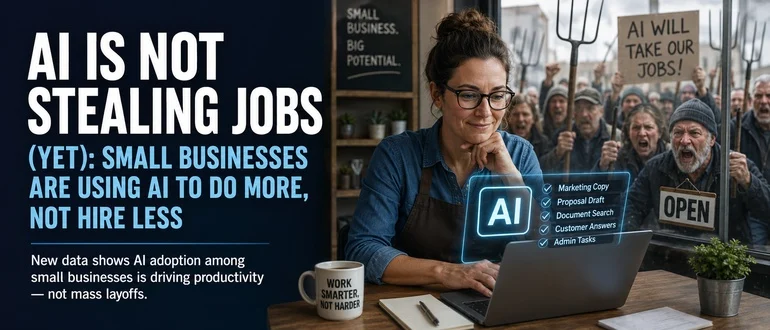
The angry mob has been waiting outside with its pitchforks.
Ever since generative AI escaped the lab and landed in the hands of ordinary businesses, we have been warned that mass unemployment was right around the corner. Artificial intelligence would eliminate entry-level jobs, replace whole departments and allow companies to operate with a fraction of their existing workforces. Small businesses, with their thinner margins and limited resources, would presumably be among the first to start cutting
It has not happened. At least not yet.
The evidence emerging from the small and midsize business market tells a much less apocalyptic story. Small businesses are adopting AI, finding value in it and, for the most part, using it to help people get more done rather than eliminate them. AI is writing marketing copy, preparing proposals, answering routine questions, searching documents and taking administrative work off the plates of owners and employees.
That does not mean AI will never displace jobs. It already has in some industries, and deeper integration will almost certainly affect employment over time. But the predicted Main Street job massacre has not materialized. If anything, AI appears to be giving resource-constrained businesses additional capacity they have long needed.
The mob can put down the pitchforks.
What Small Businesses Are Actually Doing With AI
One of the problems with the AI employment debate is that it is often based on predictions, intentions and surveys that ask executives what they expect to happen. A new report from the JPMorganChase Institute gives us something more concrete.
JPMorganChase analyzed de-identified transaction data from 4.6 million small businesses between 2019 and 2025. Instead of asking owners whether they were interested in AI or experimenting with it, researchers looked at whether businesses were paying for AI services.
By the end of 2025, 17.7% of the small businesses in the study had adopted a paid AI service. New businesses were adopting dramatically faster than earlier generations. It took the 2019 business cohort more than six years to reach 10% adoption. The 2025 cohort reached that same level in six months.
At the same time, the cost of getting started collapsed. Earlier adopters typically entered the market spending around $50 per month. By 2025, an expanding class of small businesses was entering through generative AI subscriptions costing $20 to $30 per month.
That distinction matters. Small businesses are not necessarily hiring teams of data scientists, building proprietary models or creating elaborate AI infrastructure. Many are buying the digital equivalent of a power tool. If it saves time or helps produce better work, they keep using it. If it does not, they cancel the subscription.
The JPMorganChase numbers probably understate overall adoption because the research does not capture free AI services, AI capabilities bundled into other software or systems developed internally. But that limitation also makes the results more meaningful. These businesses were not merely playing with a free chatbot. They made an explicit decision to pay for something.
Their behavior after adoption is equally revealing. Established users generally maintained or increased their spending, while more businesses began paying for multiple AI services. That is not the behavior of a market collectively discovering that AI has no value. It suggests that companies finding useful applications are gradually doing more with them.
Where is the Job Apocalypse?
The best evidence concerning employment comes from the U.S. Census Bureau. Its nationally representative 2026 research found that 18% of firms used AI in at least one business function. Among those users, the scope remained relatively narrow. Fifty-seven percent used AI in three or fewer business functions, and 65% applied it to three or fewer worker tasks.
Writing, document analysis and information search were among the leading applications. These are real tasks consuming real employee time, but they are not the same as replacing the employee.
In fact, 66% of AI-using firms reported relying on the technology solely to augment tasks. AI-related employment decreases occurred at only 2% of firms.
Two percent is not zero. Anyone claiming that AI does not affect employment would be ignoring both the data and what we can see happening in certain parts of the economy. The Census researchers also found that broader functional integration and heavier operational investment were associated with employment decreases. As businesses move from using AI for individual tasks to redesigning entire workflows, the labor consequences may become more pronounced.
For now, however, the dominant SMB use case is augmentation. That finding is reinforced by a Goldman Sachs survey of 1,256 participants in its 10,000 Small Businesses program. Seventy-six percent reported using AI, and 93% of those users said it had positively affected their business. Eighty-four percent cited increased efficiency and productivity, while 87% said AI was augmenting rather than displacing employees.
Only 14%, however, said they had fully integrated AI into their core operations.
That could be viewed as evidence that small businesses are behind. It might also help explain why they are finding value without experiencing the disruption many people predicted. They are not trying to transform everything at once. They are using AI where it solves an identifiable problem and leaving the rest of the business alone.
The Goldman sample is not representative of every small business in America. Participants in its entrepreneurial program may be more growth-oriented and technologically engaged than the average owner. The broader conclusion nevertheless aligns with the harder Census and JPMorganChase evidence: Adoption is expanding, value is being found and workforce augmentation is far more common than displacement.
A Power Tool, Not a Transformation Program
Network Solutions Group Product Manager Bonita Langle draws an important line between removing work and removing the human from the business.
“AI can help small businesses get a lot more done, but that doesn’t mean it’s taking away the human side of the business,” Langle says. “There’s a big difference between a business owner using AI to handle admin tasks or streamline processes and AI replacing the personal touch that makes that business unique.”
Those two ideas are routinely mixed. The public conversation gravitates toward the most sensational applications and abuses of AI: deepfake videos, autonomous systems and predictions of companies operating without employees. Meanwhile, a contractor is using AI to prepare estimates, an accountant is summarizing documents, a retailer is creating product descriptions and a professional services firm is drafting follow-up emails.
Nobody makes a movie about the business owner who gets through the paperwork in half the time.
This may also explain the apparent contrast between the SMB experience and what we hear from large enterprises. Enterprise AI adoption is widespread, but enterprise-level returns remain much harder to demonstrate.
McKinsey’s 2025 global survey found that 88% of respondents said their organizations regularly used AI in at least one business function. Yet nearly two-thirds had not begun scaling AI across the enterprise, and only 39% reported an effect on enterprise-level earnings before interest and taxes.
Boston Consulting Group offered an even starker assessment. Only 5% of companies in its study were achieving AI value at scale. Sixty percent reported little or no material value despite substantial investment.
Small businesses are not necessarily better at AI. They are often pursuing a different kind of return.
A small-business owner who spends $20 per month on an AI service does not need it to transform the company. If the tool saves five hours a month, helps respond to customers more quickly or allows the business to complete one additional proposal, it may have already paid for itself.
A global enterprise has a considerably more complicated equation. It must integrate AI with legacy systems, secure access to sensitive data, establish governance, satisfy regulators, train thousands of employees and measure results across business units. Add infrastructure, consultants, model costs and the growing expense of AI inference, and the project can accumulate a significant bill before producing a dollar of attributable profit.
The small-business owner can try a tool on Monday, decide by Friday whether it is useful and cancel it if it is not. An enterprise AI program may require 18 months before anyone is willing to admit the original plan did not work.
Small Businesses Need Capacity
Another difference may be even more important. Many small businesses do not have excess labor waiting to be eliminated. They have an owner and a small team already trying to fit too much work into too few hours.
Small businesses have spent years struggling to recruit people with the skills they need. They cannot maintain specialists for every business function. The owner may be the chief executive, head of sales, marketing director, customer service manager and person who stays late to finish the invoices.
In that environment, AI does not initially look like a replacement worker. It looks like additional capacity.
“The idea of AI replacing people is real in some industries, but that’s not the whole story,” says Brian McMullin, senior vice president of product at Network Solutions. “In many cases, AI is creating opportunities, especially for small businesses. It’s helping people work more efficiently and focus their time on the things that add the most value.”
That value often resides in the human parts of the business. Customers choose a neighborhood accountant, independent contractor, local retailer or small agency because of trust, expertise and personal service. AI may help prepare the document, organize the information or draft the response. It cannot assume the relationship that caused the customer to choose that business in the first place.
This does not make small businesses immune to disruption. Some tasks will disappear. Certain roles will shrink or be redefined. New businesses may also grow without hiring as many people as an equivalent company would have employed five years ago. That kind of avoided hiring will not always appear in layoff statistics, but it will still affect the labor market.
We should watch what happens as small businesses move beyond individual subscriptions and begin connecting AI to core workflows. The Census findings suggest that deeper integration may bring different employment consequences. Agentic systems capable of performing multistep processes could also move the market from assisting employees to assuming larger portions of their jobs.
But we should distinguish what might happen from what is happening.
So far, AI on Main Street looks less like a robot army and more like another pair of hands. It is helping small businesses produce marketing material, manage information, serve customers and clear away work that owners and employees either do not have time to complete or never particularly wanted to do.
Large enterprises might take a lesson from that. Begin with a real problem. Apply the least complicated tool capable of solving it. Measure whether it saves time, improves service or produces revenue. Expand when the value becomes obvious, not because the board has demanded an “AI transformation.”
The angry mob does not need to throw its pitchforks away. AI is still developing, its labor effects are still unfolding, and anyone promising that no jobs will be lost is no more credible than those who predicted they would all disappear.
But the mob can put the pitchforks back in the shed.
For many small businesses, AI is not taking away the people. It is helping the people they already have do the work that keeps the business alive.