TL;DR — Key Takeaways
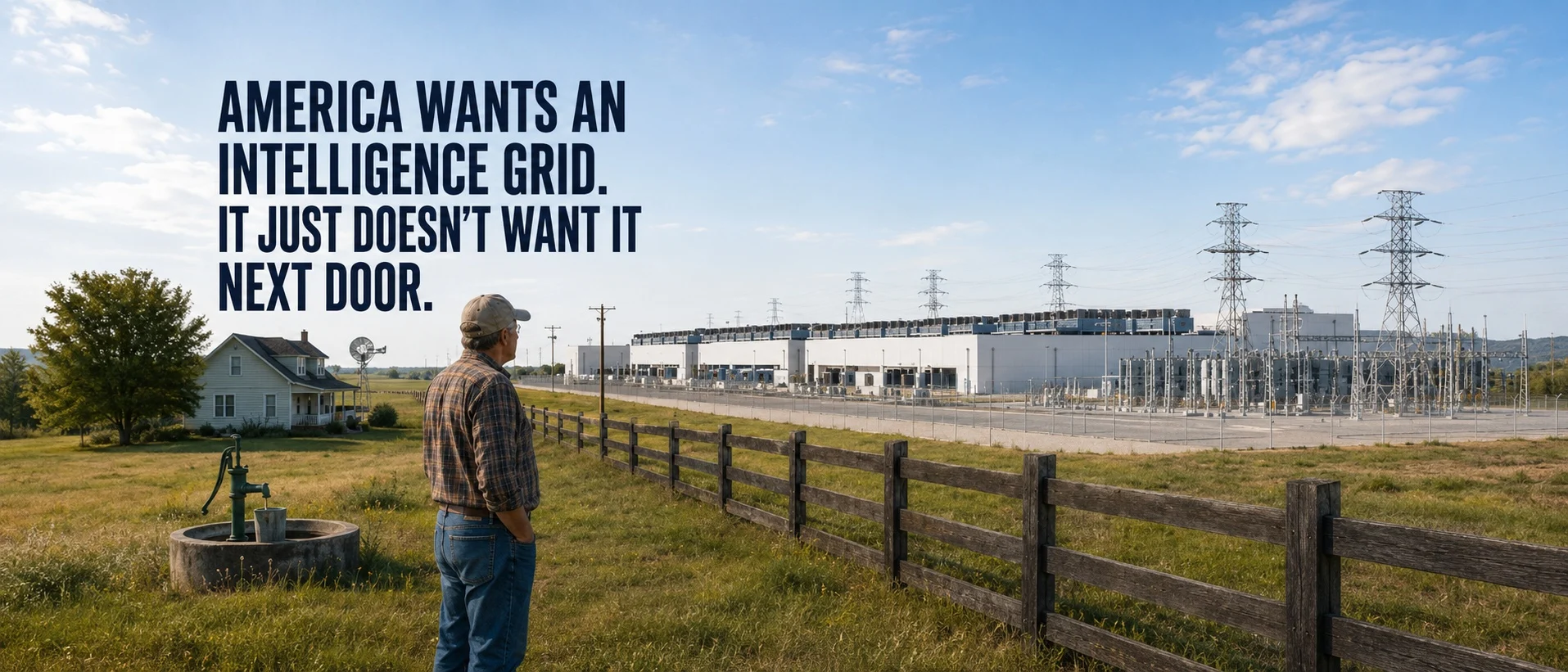
AI may live in the cloud, but its costs land locally. Data centers consume enormous amounts of land, electricity, water, and public infrastructure—often while creating relatively few permanent jobs.Communities are no longer accepting the old deal. From New York to Montana, Louisiana, Utah, Memphis, and Virginia, residents and governments are demanding clearer answers on utility bills, environmental impacts, tax breaks, and community benefits.America needs an “intelligence grid” compact. National AI leadership will require coordinated rules for power generation, transmission, financing, oversight, and fair cost-sharing—not thousands of disconnected zoning battles.
When I saw that New York had become the first state to impose a statewide moratorium on large new data centers, I did not see an isolated policy decision. I thought about a rancher in Montana driving into a town of 140 people to ask what was being built beside her property. I thought about struggling farmers in Louisiana betting that one of the largest AI campuses ever conceived might give their parish a future. I thought about a 40,000-acre proposal in Utah and a historic Black community in Memphis once again living beside infrastructure producing something enormously valuable for people somewhere else.
I have been following these projects for months, and taken together, they tell a different story from the one we usually hear about the AI race. That race is generally presented through model releases, benchmark scores, GPU shipments and funding rounds. Down on the ground, it is becoming a contest over land, electricity, water, transmission lines, tax incentives and the willingness of communities to host the factories where intelligence is manufactured.
New York has not turned against artificial intelligence. Gov. Kathy Hochul is not trying to unplug ChatGPT or chase technology companies out of Manhattan. Her executive order s new discretionary environmental permits for data centers requiring 50 megawatts or more while the state develops standards for their environmental, energy and community effects. The  can last up to a year.

New York reportedly has more than 12 gigawatts of large-load projects, including data centers, waiting to connect to its electrical grid. New Yorkers already pay some of the highest residential electricity prices in the country. Hochul has also said she will pursue the elimination of sales-tax exemptions for large data centers. Her message is fairly straightforward: If these facilities are going to consume enormous amounts of power and place new demands on public infrastructure, the state needs a better understanding of the bargain it is making.
The New York Legislature wants to go further. The Responsible Data Center Development Act would apply to facilities with a peak demand of 20 megawatts or more and add requirements involving utility rates, energy efficiency, labor standards and community benefits. Hochul has not signed that bill, choosing instead to act through a more limited executive order. Officials are no longer asking only whether they want data centers. They are negotiating the price of admission.
I first saw the human scale of this conflict while writing “The AI Race Comes to Rural America.” A 43-year-old rancher named Kassi Solberg had been driving into Broadview, Montana, to sit through city council meetings and ask what was being built next to her family’s property and who had decided it could go there.
Broadview has roughly 140 residents, a single bar and restaurant, and a school gymnasium that doubles as the center of the town’s social life. Quantica Infrastructure, a young Texas company, proposed building a 5,000-acre AI campus beside it. At full scale, the project could require as much as a gigawatt of power, more electricity than the local utility currently supplies to its entire customer base across Montana.
One of the fights involves a transmission line of roughly 21 miles and who should pay for it. That is not an argument about transformer architectures or whether the next frontier model will reach artificial general intelligence. It is a dispute over whether the company building the facility or the people already paying electric bills should finance the infrastructure it needs.
The reaction from the technology industry is often to classify people like Solberg as obstacles to progress. I see someone asking the questions an industry moving at software speed should have answered before arriving with a project measured in thousands of acres. What will happen to local wells, roads, property values and the night sky? How much electricity will the project consume, and what will happen to utility rates? What will Broadview receive in exchange?
The economic bargain is also unfamiliar. For generations, towns accepted the noise, traffic and pollution associated with a factory because the plant employed hundreds or thousands of local residents. The relationship between burden and benefit was visible. A data center can represent billions of dollars in capital and consume enormous amounts of power and water while supporting a permanent workforce that might fit inside Broadview’s only restaurant on a slow night.
That does not mean the project should be rejected. The restaurant owner would probably welcome the business, and rural communities with available land, fiber and access to power are logical places to build. It means a signed land agreement is the beginning of a community negotiation, not the end of one. The trust of a rancher in Montana may prove every bit as important to the AI buildout as access to GPUs.
The following day, I wrote about a very different community making its own calculation. “AI Down on the Bayou” examined Meta’s Hyperion campus in Richland Parish, Louisiana, through the reporting of Bloomberg Businessweek’s Riley Griffin. The story began in cotton fields where farmers were producing strong crops but losing money because commodity prices had not kept pace with the cost of equipment, seed, fertilizer and fuel.
Meta arrived with a project that could ultimately represent more than $200 billion in investment and reach approximately five gigawatts of compute capacity. Supporting Hyperion could require ten new gas-fired power plants, along with transmission, water and other infrastructure. Meta expects the project to create about 500 permanent jobs by 2035, reportedly paying approximately $90,000 a year.
Five gigawatts and ten power plants for 500 permanent jobs is an economic equation that would have sounded absurd during the era when communities competed for automobile and heavy-equipment plants. The resources look industrial. The employment model does not. Yet those 500 jobs mean something very different in a parish that has watched farms consolidate, young people leave and economic opportunity pass it by for generations.
From a distance, it is easy to criticize property tax reductions that could approach 80%, the political maneuvering and the financial risk being absorbed by the surrounding community. Up close, the choice is harder. Richland Parish has spent years waiting for a project capable of altering its economic trajectory. Hyperion may be a flawed lottery ticket with a considerable amount of fine print, but a community offered few other tickets can rationally decide that it is worth buying. Farmers understand risk better than most investors. They can do everything correctly and still lose because the weather changes, costs rise or the market moves against them. The people of Richland Parish are making another large wager. Meta has capital, financing structures and options if AI economics change. The community has its land, schools, roads, water and hope that this particular crop will pay off.
Utah expands the question from the scale of a struggling parish to something approaching regional infrastructure planning. While writing “The AI Industrial Complex,” I examined the proposed Stratos AI campus, a project envisioned across approximately 40,000 acres with potential power requirements of up to nine gigawatts.
Nine gigawatts is not an ordinary commercial load. It belongs in a conversation about the energy needs of a region. Yet Stratos is one of several planned or proposed Utah developments, including Meta’s Eagle Mountain campus, Creekstone’s proposed Gigasite near Delta, Joule Capital’s off-grid campus in Millard County and a conditional CyrusOne project on Army land near Dugway.
What struck me about Stratos was the alignment of incentives around it. Technology companies want compute. GPU manufacturers want deployments. Utilities and pipeline operators want customers. Construction firms want projects. Investors want returns. Politicians want development and national security officials want the United States to stay ahead of China. There is no need for a conspiracy when every powerful participant has a rational reason to support the same outcome.
Dwight Eisenhower’s warning about the Military Industrial Complex was not primarily about secret coordination. It was about the power of aligned institutions and incentives to create their own momentum. An AI industrial complex is forming around data centers, chips, energy, finance and government policy. It may produce infrastructure America genuinely needs, but the momentum behind it can easily outrun the public scrutiny that projects consuming this much land and energy deserve.
Then there is Boxtown.
In “The AI Tenants Can Leave. Boxtown Cannot,” I wrote about a 1961 photograph of Boxtown residents James Threadford Jr. and Albert Lee Wright riding a horse-drawn cart piled with firewood. A power plant stood behind them. Some homes in the community still lacked electricity, leaving two men to gather fuel in the shadow of a facility generating power for others.
More than six decades later, Boxtown sits beside Colossus, the massive Memphis AI complex originally built by xAI to train Grok. The infrastructure now produces machine intelligence rather than electricity, but residents are again trying to determine what their community receives in return for living beside something the wider economy considers indispensable.
The current AI tenants have protected themselves rather well. According to SpaceX’s offering documents, Anthropic’s arrangements provide access to approximately 325,000 Nvidia GPUs across Colossus and Colossus II. Google has its own agreement covering approximately 110,000 GPUs and related infrastructure. Both arrangements include provisions allowing the parties to terminate after their initial commitments with 90 days’ notice.
Anthropic can leave. Google can leave. SpaceX can redirect the GPUs to Grok or rent them to another company. Boxtown has no comparable exit clause. The community remains beside the land, turbines, emissions and infrastructure regardless of which corporate logo or AI model occupies the machines.
That story brings the entire argument down from gigawatts and billions of dollars to the distance between a family’s porch and an industrial facility operating beyond the trees. Compute always exists in a place. It draws electricity from a particular grid, affects particular air and water, and occupies land beside particular people. Those people are parties to the transaction even when their names never appear on the contracts.
The same conflicts are now surfacing across the country. The National Conference of State Legislatures says at least 14 states have considered moratoriums or comparable restrictions on data-center development. Maine’s Legislature passed a moratorium covering facilities above 20 megawatts, only to have Gov. Janet Mills veto it after objecting to its effect on a particular project. Delaware, Georgia, Michigan, Pennsylvania, South Carolina, Vermont and Virginia have considered restrictions of varying scope.
The resistance is further advanced locally. Nearly one-third of Indiana’s counties have adopted moratoriums, bans or new ordinances governing data centers. Researchers at Indiana University identified at least 17 counties with temporary moratoriums, 11 with data-center ordinances and two that have banned new facilities. This is happening while Indiana’s state government aggressively courts hyperscale investment, including Meta’s planned $10 billion campus in Lebanon.
Georgia has its own version of the conflict. The state welcomes large investments while cities and counties impose s, rewrite zoning rules or prohibit facilities in particular areas. Similar action has appeared in communities across Connecticut, Maine, Missouri, Illinois, Kentucky, Minnesota, Colorado, Washington, Nevada, Maryland and Florida.
This is not a blue-state rebellion against technology. Many of the communities pushing back are in Republican counties and states that actively promote business development. Residents may support AI, economic growth and American technological leadership while remaining unconvinced that a hyperscale data center is a good deal for their town.
Northern Virginia deserves special attention because the people there cannot be accused of fearing an industry they do not understand. Virginia has hosted data centers at an enormous scale for years. Loudoun County is home to one of the largest concentrations of data centers in the world, and the resulting tax revenue has helped finance schools, public services and lower property-tax rates.
The benefits have been real, and so have the costs. Loudoun County eliminated automatic, by-right approval for new facilities, requiring projects to face greater public scrutiny. In neighboring Prince William County, the proposed Digital Gateway development became the subject of lawsuits, organized opposition and a court decision invalidating the county’s approval. Blackstone-owned QTS recently abandoned its portion of the project. Virginia has also enacted a tax tied to data-center electricity consumption while preserving its valuable sales-tax exemption for data-center equipment.
Virginia is renegotiating a deal made when data centers were smaller, less visible and easier to absorb into the electrical system. AI has changed the physical scale of the equation. A hyperscale campus can require new generation, transmission infrastructure, substantial water, hundreds of acres and fleets of backup generators long before the surrounding community sees any benefit.
None of this means America can choose to go without data centers. The AI services appearing in our browsers and business applications can feel weightless, but the intelligence behind them is relentlessly physical. Models run on chips. Chips sit in racks. Those racks consume power and produce heat inside buildings that have to be constructed somewhere.
The cloud was always somebody else’s computer. AI is making us confront the size of that computer and the resources it consumes.
Data centers are becoming the factories of the intelligence economy. Every agent, enterprise model, sovereign AI program and military system depends on the infrastructure beneath it. If the United States intends to lead the world in AI, it will need far more compute capacity than it has today. Moratoriums can slow development in a particular jurisdiction, but they cannot make demand disappear.
The deeper failure is that America has declared an AI ambition without negotiating an infrastructure settlement. We do not have a broadly accepted answer for who should build the required power generation and transmission capacity. We have not agreed on how costs should be divided among hyperscalers, utilities, taxpayers and ordinary ratepayers. Nor have we established what a community should receive when it hosts infrastructure serving customers and corporations around the world.
Instead, we are trying to assemble a strategic national resource through disconnected zoning meetings, utility proceedings, tax-abatement negotiations and political campaigns. Each community is being asked to decide its portion of the national AI strategy using whatever information, leverage and legal authority it happens to possess.
The development of the electrical grid offers a useful comparison, although its history was messier than the simplified version we usually tell. America did not electrify itself because Thomas Edison built a light bulb and private capital handled everything else. The country assembled a system involving private utilities, public power authorities, rural cooperatives, municipal systems, state regulators, federal projects and generations of infrastructure investment. It also created financing mechanisms and rules governing who could charge what to whom.
The intelligence grid will require its own compact. National AI policy cannot stop at chip subsidies, export controls and speeches about beating China. Compute capacity depends on energy policy, transmission reform, water planning, local development and public consent.
Several jurisdictions are experimenting with pieces of that compact. Oregon has required utilities to treat large data-center loads differently so residential customers are less likely to subsidize the cost of serving them. Virginia chose an electricity-consumption tax. Ireland now expects large new grid connections to provide matching dispatchable generation or storage. Singapore reopened data-center development after an earlier moratorium under stricter efficiency and sustainability requirements.
Those policies will not all work equally well, and some will create unintended consequences. They demonstrate that governments have choices beyond opening the gates or locking them permanently. Data-center operators can be required to bring power, finance grid upgrades, meet enforceable efficiency standards and provide benefits proportionate to the resources they consume.
A state-by-state patchwork carries its own risks. Data-center demand will move toward jurisdictions with available power, water, land and political permission. That can create economic winners, but it can also push critical infrastructure toward places chosen for weak oversight or generous short-term incentives rather than security, resilience and national interest. If domestic development becomes too difficult, more capacity may move overseas, reinforcing the sovereignty and supply-chain dependencies Washington says it wants to reduce.
The technology industry also needs to recognize that community opposition is not primarily a communications problem. Better talking points will not make a transmission line disappear, lower someone’s electric bill or give Boxtown an exit clause. Hyperscalers seeking permission to build the factories of the intelligence economy need to offer communities a credible infrastructure bargain, not another economic-impact report promising that prosperity will eventually cross the property line.
New York’s moratorium is a warning that the old bargain has reached its limit. Kassi Solberg in Montana, the farmers of Richland Parish, the communities surrounding Utah’s proposed gigawatt-scale campuses and the families of Boxtown are not side characters in America’s AI story. They live where the abstraction ends and the infrastructure begins. America is attempting to construct the defining infrastructure system of the next generation without deciding how its costs and benefits will be shared. Until that agreement becomes real, the country will continue wanting an intelligence grid in the abstract while rejecting it, one zoning hearing at a time, everywhere it has to be built.