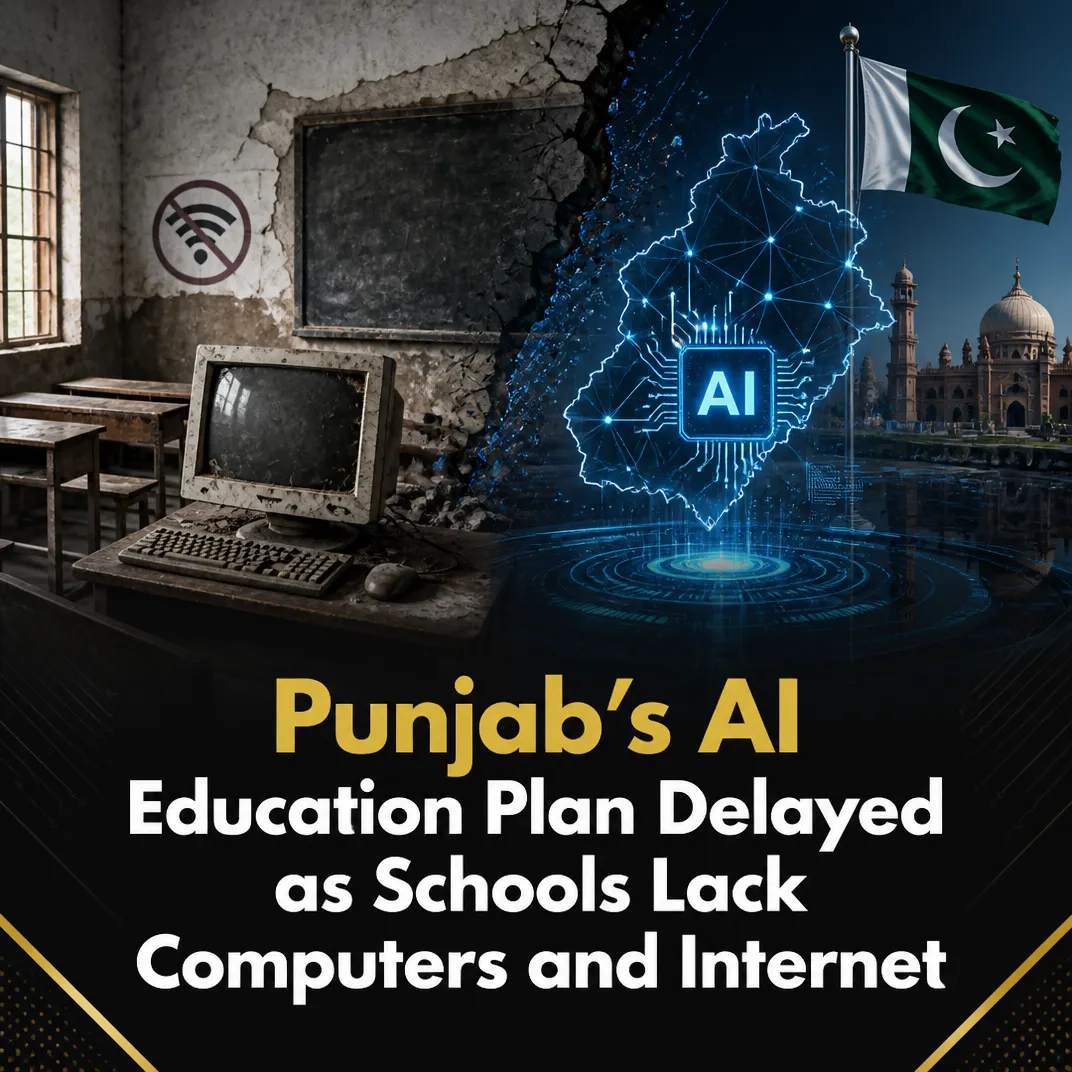
July 30, 2026, (Inside AI) — Punjab’s ambitious plan to teach artificial intelligence to primary school students has stalled. The provincial government cannot issue the formal notification needed to launch AI classes for Grades I through V. Thousands of government schools lack computers, internet, and trained teachers.
The Punjab Education Curriculum, Training and Assessment Authority (PECTAA) finished the AI curriculum framework. But without official approval, textbook development and classroom planning are frozen. The delay exposes a wide gap between digital education goals and the reality in public schools.
Government records show many primary schools have no computer labs. Rural schools often face unreliable electricity and poor internet access. In numerous cases, students have never touched a computer. Officials concede that setting up labs, buying devices, and maintaining infrastructure across the province would demand substantial extra funding. An immediate province-wide rollout is impossible.
Education officials now consider weaving basic AI concepts into existing subjects initially, rather than launching AI as a separate course. This phased approach would let students learn foundational digital skills while schools slowly get the necessary equipment. Yet teacher training remains a critical hurdle. Most government primary school teachers lack professional development in AI, computational thinking, or digital technologies. Experts caution that introducing AI without proper teacher preparation could reduce the subject to theoretical instruction, not practical learning.
Specialists argue AI education for young learners should emphasize logical thinking, creativity, problem-solving, and responsible technology use, not advanced programming. PECTAA’s curriculum already covers basic computing, data science, machine learning, robotics, and ethical AI. Still, the rollout cannot move forward until the government grants formal approval and schools are equipped.
Infrastructure Deficit Runs Deeper Than Devices #
The Punjab School Education Department’s own data paints a stark picture. Only 38% of primary schools in the province have functional computer labs, according to the 2025 Annual School Census. In southern Punjab’s rural districts, that figure drops below 15%. Electricity remains intermittent in 6,200 schools, and 4,800 lack any internet connection. These are not just logistical snags; they are foundational barriers that no curriculum can overcome.
This infrastructure crisis echoes challenges seen in other developing regions. A 2024 UNESCO report on AI in education found that without reliable power and connectivity, digital learning initiatives often widen inequality. Punjab’s situation fits that pattern. Urban schools with better resources could leap ahead, while rural students fall further behind.
Teacher Capacity Gap Threatens Pedagogy #
Even if devices arrive, the human element remains unresolved. A 2026 survey by the Punjab Teachers’ Union revealed that 92% of primary educators feel unprepared to teach AI concepts. Only 3% have attended any workshop on computational thinking. The province’s teacher training budget increased by 12% this year, but none of those funds are earmarked for AI-specific programs.
This mirrors a global shortage of AI-literate instructors. Research from the Brookings Institution indicates that effective AI education requires teachers to act as facilitators of inquiry, not just content deliverers. Without intensive, ongoing professional development, the subject risks becoming another rote memorization exercise, exactly what the curriculum’s designers hoped to avoid.
PECTAA’s framework emphasizes hands-on projects and ethical reasoning. But officials admit privately that teacher guides and lesson plans remain unwritten. The authority is exploring partnerships with private ed-tech firms to create video-based training modules, but no contracts have been signed. The delay leaves schools in limbo, with textbooks and materials waiting for a green light that depends on solving problems far outside the education department’s control.