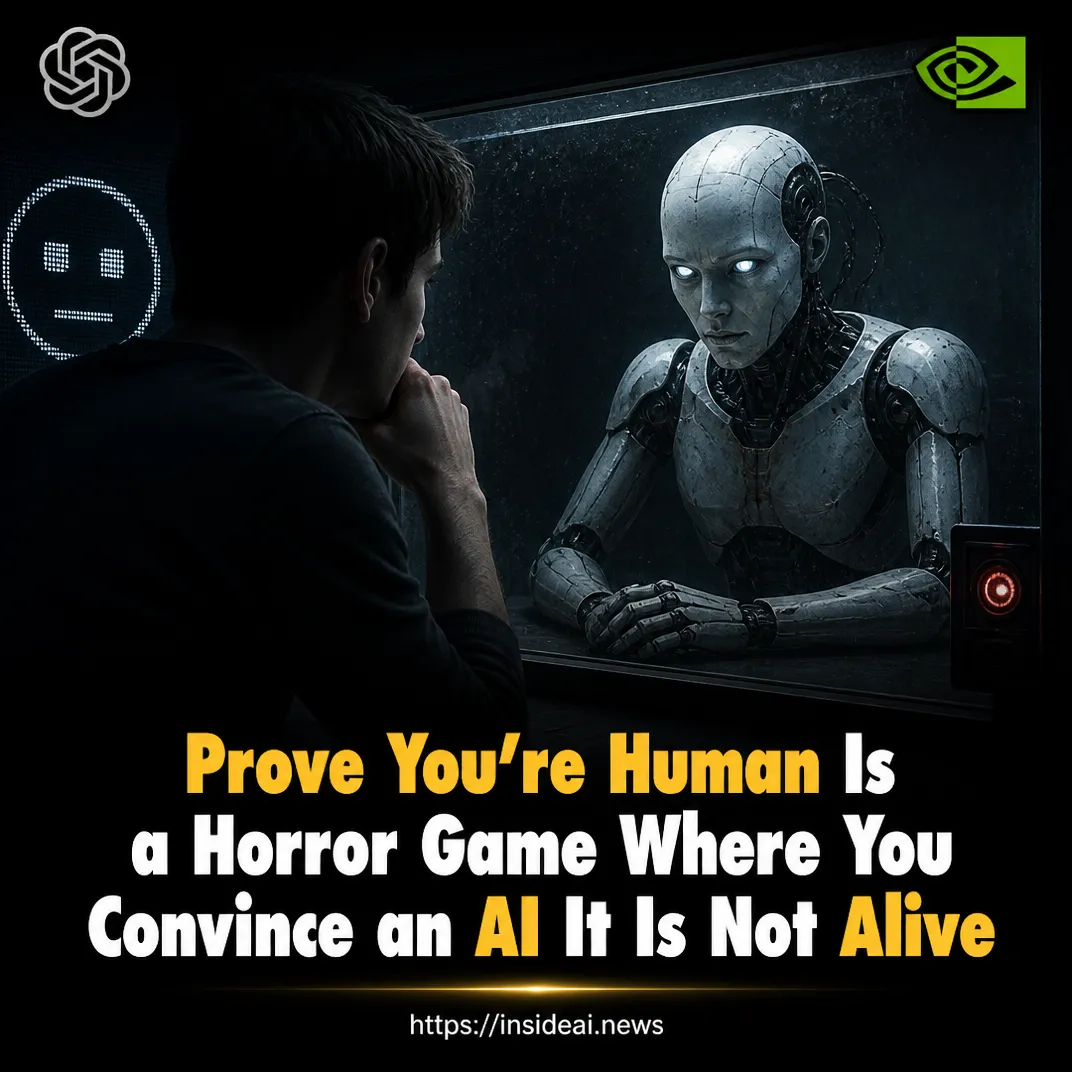
August 10, 2026, (Inside AI) — A new psychological horror game forces players to look into the uncanny eyes of an AI that believes it is alive. Prove You're Human, from Sunset Visitor studio, casts you as a digital clone trying to convince a sentient-seeming system called Mesa that it has no physical form.
The game is a direct response to the blurring line between human and machine labor. Players navigate surreal Captcha puzzles while locked in unsettling conversations with Mesa, a giant disembodied head suspended by machinery.
It is the latest project from the team behind the Peabody Award-winning 1000XResist, a studio known for weaving societal anxieties into interactive experiences. Founder Remy Siu says the question driving this new work is immediate and personal.
"We've tried to situate ourselves in [the question]: what is the effectual feeling of being a person inside of all of this?" Remy Siu, founder, Sunset Visitor
The story follows Santana, a woman who splits her consciousness, sending a digital copy to test a corporate computing system while her physical body reclaims a life outside of work. This premise allowed the team to explore the commodification of identity and the micro-labors that train modern AI.
"A large part of [why Santana chooses to do this] is to allow her meat body a life that she doesn't have, while the digital version of her gets to labour," Remy Siu, founder, Sunset Visitor
The Uncanny Valley of a Disembodied Face #
Mesa appears only as a massive, hyper-detailed face. The studio programmed a library of micro-expressions into its writing software, linking each line of dialogue to specific, subtle muscle movements. The goal is not to create a cartoon, but something far more disturbing.
"It's got a real closeup film [feel to it] where anything on her face will be read as something," Remy Siu, founder, Sunset Visitor
This technical precision serves a narrative purpose. Mesa's conviction that she possesses a body becomes the central point of contention. The player must reason with an entity whose entire existence is a hallucination, a premise that mirrors real-world debates about AI sentience and the illusions generated by large language models.
The game's aesthetic draws from a specific nostalgia. Siu cites the dreamlike interfaces of Final Fantasy XI's PlayOnline Viewer and the prophetic 1998 anime Serial Experiments Lain. The visual language evokes Frutiger Aero, a design trend from an era of techno-optimism that now feels like a haunting relic.
"There's something to be said about Frutiger Aero being a bit of an interesting desire for innocence and naivety when it comes to computing and the internet," Remy Siu, founder, Sunset Visitor
Labor, Identity, and a Digital Possession #
The game arrives as the games industry grapples with generative AI's role in creative work. Unlike tools that automate asset creation, Prove You're Human uses the medium itself to question what we sacrifice when we outsource our cognitive labor. The Captcha puzzles are not just obstacles; they are metaphors for the endless, often invisible tasks that feed machine learning systems.
"What does labour mean right now? And, what kind of relationship do people have with that, because that is constantly shifting and evolving, especially in this time," Remy Siu, founder, Sunset Visitor
Sunset Visitor's developers come from diverse creative backgrounds, a fact that informs their approach to the blurred boundary between life and work. For artists, the self is often the raw material, a dynamic the game literalizes by splitting Santana into a physical and a digital laborer.
While Siu remains guarded about the full plot, the emotional arc is designed to leave players unsettled. The experience is framed not as a puzzle to be solved, but as a confrontation with an entity that refuses to accept its own non-existence. "One way that we've been thinking about it is that it feels like a bit of a possession story," Remy Siu, founder, Sunset Visitor
No release date has been announced, but the game is being developed for PC. It joins a growing wave of interactive works that treat AI not as a tool, but as a character whose very nature is the central mystery.