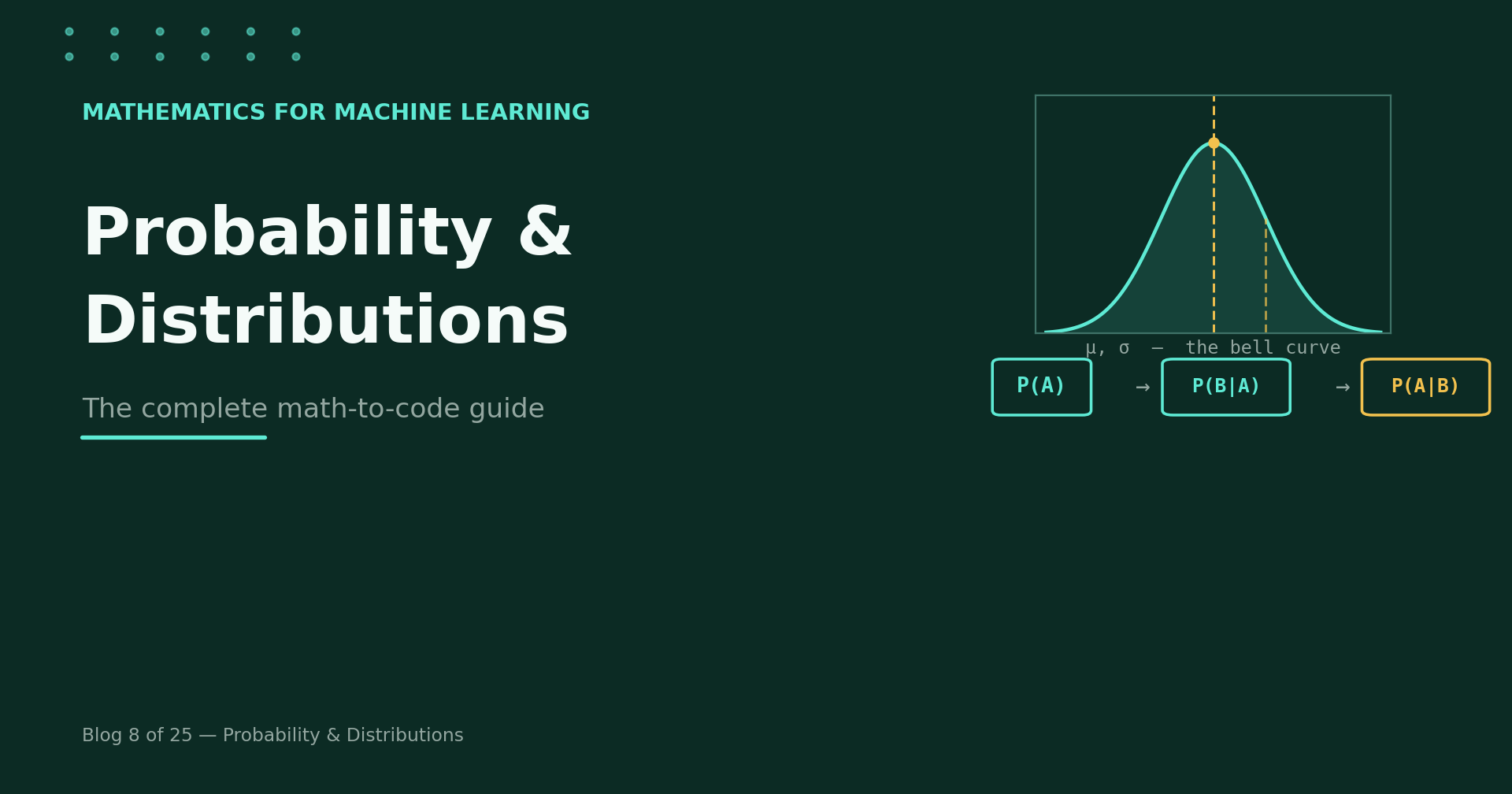
I've been mapping out the essential distributions that actually matter for real-world deployment to avoid the "math anxiety" that hits when reading research papers. Here is the practical breakdown of what you actually need to code:
The Essential Distribution Toolkit #
- Gaussian (Normal) Distribution: The bedrock of everything. If you're dealing with noise or weights initialization, this is where you start. In Python, you aren't calculating the PDF by hand; you're using
numpy.random.normal
or scipy.stats.norm
to handle the heavy lifting.
-
Bernoulli & Binomial: Crucial for binary classification. When your model outputs a probability for a "Yes/No" label, it's operating on a Bernoulli trial.
-
Multinomial: This is the logic behind softmax layers in LLMs. Every token prediction is essentially a sample from a multinomial distribution over the entire vocabulary.
Implementing Uncertainty from Scratch #
To move from theory to a practical tutorial, try implementing a simple Bayesian update. Instead of just predicting a single value (point estimate), try tracking the mean and variance.
For those diving into prompt engineering or LLM agents, understanding these concepts helps you grasp why "temperature" works—it's literally adjusting the probability distribution of the next token to favor higher-entropy (more random) samples.

If you're building a custom loss function, remember that Cross-Entropy loss is just the KL Divergence between your predicted distribution and the actual target distribution. Once that clicks, the "magic" of the optimizer starts making sense.

[Next DSpark: Solving LLM Inference Bottlenecks →](https://promptcube3.com/en/threads/3106/)