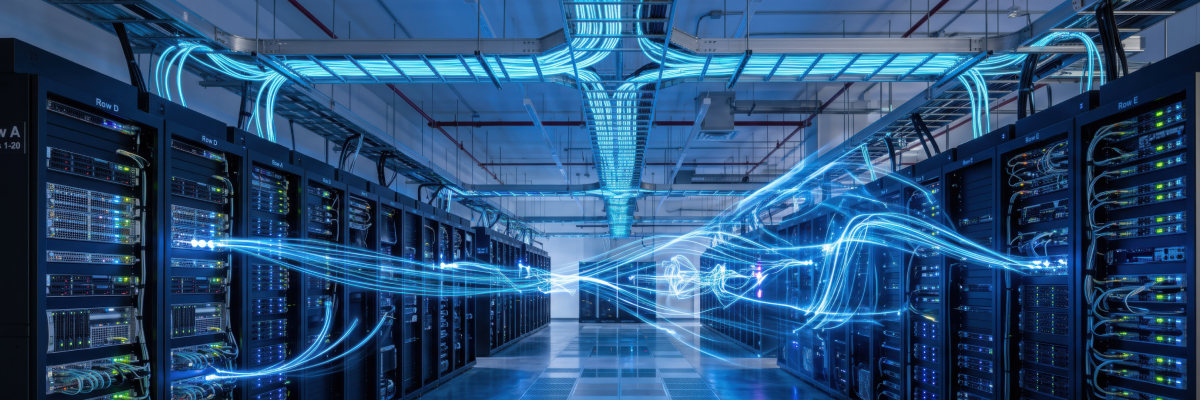
As AI moves from experimentation into production, data centers face growing demands for power, cooling, and space. Real-time inference and other AI workloads require infrastructure that can scale without adding unnecessary complexity. Conventional rack designs may not provide the density, or flexibility operators need, while proprietary designs can limit hardware choices and make expansion more complex.
Cisco helps operators integrate and scale networking into ORv3 environments while maintaining a consistent operating model.
What ORv3 changes for high-density AI data centers #
Open Rack Version 3 (ORv3) is designed for high-density environments. Developed through the Open Compute Project (OCP), it defines an open rack architecture with mechanical and serviceability specifications and supports power designs suited to modern AI, machine learning, and high-performance computing (HPC) systems.
ORv3 racks use a 21-inch equipment bay and Open Units (OU); traditional enterprise equipment commonly uses 19-inch racks and Rack Units (RU). One OU measures 48 mm, while one RU measures 44.45 mm. Some ORv3 designs accommodate 19-inch equipment with mounting adapters, but rack dimensions and usable space vary. That flexibility can help organizations introduce high-density infrastructure while continuing to support compatible equipment and existing deployment strategies.
The value of ORv3 comes down to efficiency and scale. ORv3 delivers several important advantages:
- Standardized interoperability : Components from different manufacturers can work together more seamlessly, enabling a more open, plug-and-play approach and reducing concerns about hardware compatibility.
- Higher power and cooling : A 48V DC busbar power distribution system can reduce power loss and support higher power densities compared to traditional designs. It also offers built-in support for direct liquid cooling (DLC) manifolds and blind-mate connections to manage the intense heat of AI servers.
- Sustainability benefits : Reusable components and standardized hardware help reduce waste, lower carbon footprints, and minimize operational inefficiencies.
- Operational Efficiency : Features tool-free, “click-in” assembly for IT gear and power rails, allowing for faster maintenance and reduced cabling complexity. It also supports hybrid mounting for both 21-inch OCP (OU) and traditional 19-inch (RU) equipment within the same frame.
These features make ORv3 more than a rack specification. They offer a practical foundation for aligning infrastructure density, operational needs, and future growth.
How Cisco is supporting the transition #
Cisco is preparing its data center networking portfolio for evolving rack designs. Cisco offers ORv3- compatible trays for Cisco N9000 Series switches. The trays align networking hardware with open-rack mechanical and power designs, giving operators more flexibility as they build or expand high-density data centers.
Customers can choose a bundle with the switch preinstalled on the tray or purchase a spare tray for self-installation, depending on their deployment needs.
Cisco N9000 ORv3 compliant trays for operational choice #
Key capabilities include:
- Compatibility with ORv3 rack environments for Cisco N9000 Series switches.
- Support for 48V DC power architectures aligned to modern high-density requirements.
- Mounting kits for existing 19-inch equipment, enabling traditional gear to fit into the 21-inch ORv3 environment.
Cisco power trays are designed to connect at different busbar positions, helping ensure the hardware receives the power it needs in supported rack configurations. This design readiness is essential in high-density environments, where small physical differences can have a significant operational impact.
Together, these options give organizations a path to adopt ORv3-based infrastructure while maintaining continuity in network operations, accommodating compatible existing equipment, and aligning the rack with AI’s power, cooling, and density demands.
Cisco accelerates AI infrastructure with new liquid-cooled switches: the ORv3-native N9364F-SG3-RL and the purpose-built N9164F-NS6-ML for NVIDIA MGX accelerated-computing rack deployments. These platforms deliver the critical thermal and connectivity efficiency required for modern, high-density AI fabrics.
Cisco Nexus switches are part of Cisco Nexus One, a data center networking architecture for AI and modern workloads. With Cisco Cloud Control, Nexus One supports a unified AgenticOps experience for managing infrastructure from silicon to workloads.
Who benefits most from an ORv3-ready approach #
ORv3 is especially relevant for hyperscale and enterprise data centers with roadmaps that include large-scale AI or machine learning workloads.
For these organizations, the move to ORv3 is not simply about following the latest hardware standards. It is about creating a data center foundation that can scale with the performance, density, and efficiency requirements of modern workloads.
- Simplify the deployment of a high-density fabric.
- Maintain environmental goals as infrastructure grows.
- Future proof existing investments and extend their longevity.
- Reduce total cost of ownership.
Building the foundation for what comes next #
As AI shifts into production and real-time inference, the physical design of the data center becomes a strategic consideration. ORv3 introduces an open, high-density architecture built for the power and thermal realities of AI, machine learning, and HPC. Cisco N9000 support for ORv3 helps organizations adopt that architecture with greater confidence, while preserving proven networking performance and management consistency.
Data centers need a smarter, more scalable infrastructure foundation to support continued compute growth.
To learn how Cisco Nexus switches support for ORv3 and MGX can help prepare your data center for high-density AI infrastructure, join us at the 2026 OCP Global Summit in San Jose, California, October 12 to 15, 2026. See the latest AI-ready data centers innovations in action or contact your sales representative.