Portworx by Everpure made Kube Datastore generally available today on supported SAN arrays, giving virtual machines on Kubernetes single-replica volumes backed by a shared array. Announced at KubeCon 2026, the release ships with Portworx Enterprise 3.7.2 and arrives alongside an expanded operations center, support for Red Hat OpenShift 5, and pre-staged volumes for AI inference that Everpure expects in Q1 2027.
Portworx manages data for VMs, containers, and AI workloads on Kubernetes across on-premises, cloud, and edge storage. Kube Datastore (KDS) groups Portworx storage pools that share a backend into a datastore, which gives VM administrators familiar datastore concepts and storage mobility on Kubernetes and gives platform engineers control over where volumes land and how much capacity they use.
Kube Datastore for Kubernetes VMs #
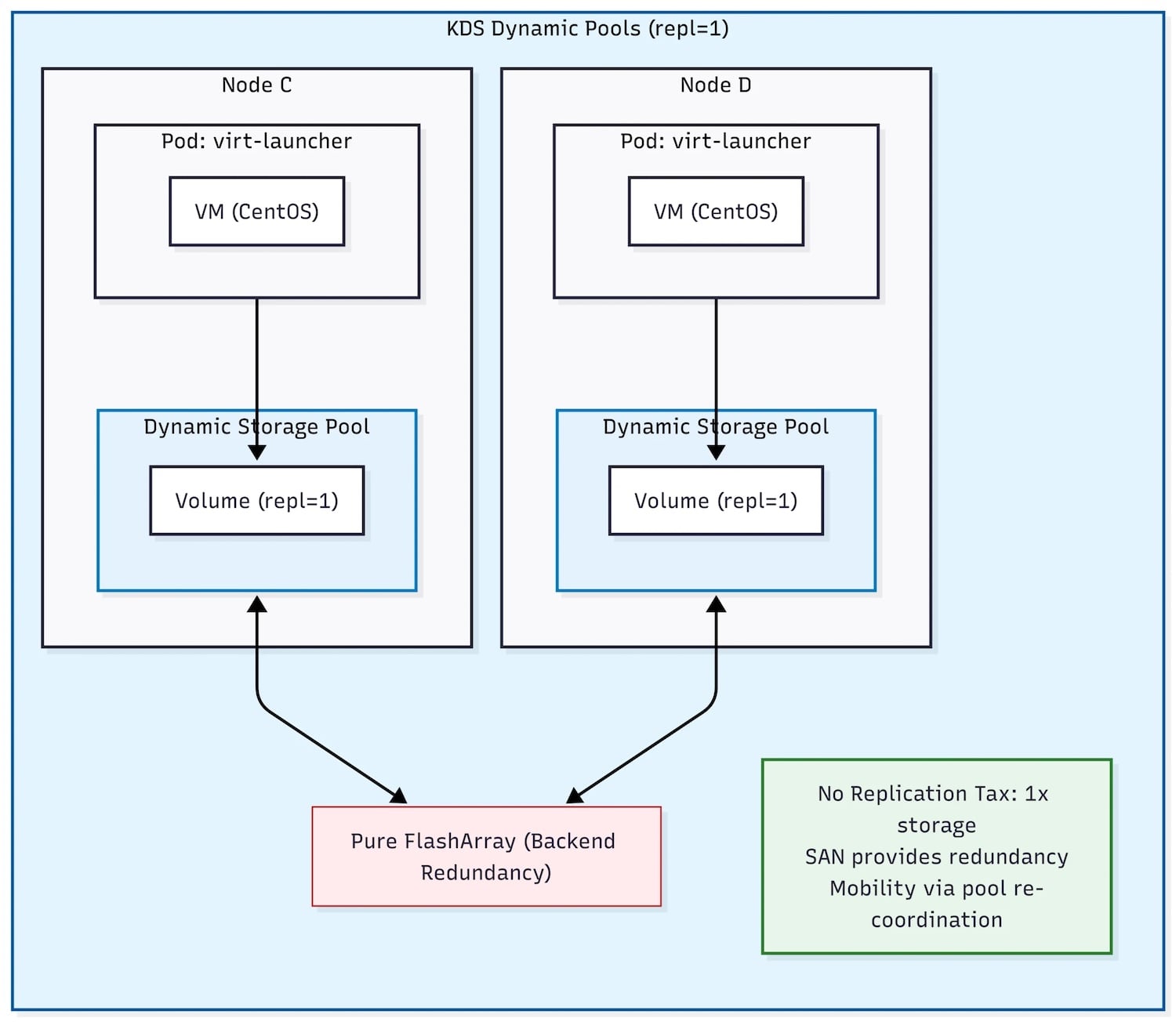
The GA release centers on dynamic pools: a dynamic pool is a Portworx storage pool created on a shared backend, and it holds volumes with a replication factor of one, leaving data protection to the array. Portworx names Everpure FlashArray as a supported backend and has not listed other arrays. Static pools remain for workloads that need replication-based availability and for volume types that are not eligible, such as SharedV4.
The efficiency case rests on the replica count: Portworx puts the traditional shared-nothing model at roughly 2x to 3x storage overhead and 3x to 5x network I/O amplification, depending on the replication factor, and a single-replica volume on an array avoids both. When a node fails or enters maintenance, the pool moves to another node as a unit, and day 2 tasks such as rebalancing run through Kubernetes-native workflows. Portworx has not published failover times.
Portworx publishes a scale profile for Enterprise 3.7.2: up to 12 storage pools per node recommended with a hard limit of 16, up to 150 volumes and 300 snapshots per pool, up to 700 attached volumes per node, and up to 5,000 attached volumes per cluster. KDS works with KubeVirt and OpenShift Virtualization.
Portworx pairs it with array-native migration off VMware that uses FlashArray XCOPY, which the company says runs up to 12x faster than the default path, moving a 2TB VM in about two hours against more than a day. These are vendor figures, and we did not run or audit them.
“Our latest innovations, including Kube Datastore, help customers simplify storage management, recover faster from infrastructure failures, and use storage more efficiently,” said Greg Muscarella, General Manager, Portworx, at Everpure.
Pre-Staged Volumes for AI Workloads #
Pre-staged volumes target the wait before an inference service can start, when model weights that run to tens or hundreds of gigabytes are often downloaded again after a pod lands on a new node. A platform team hydrates one source volume with a versioned model bundle from an approved repository, and Portworx distributes node-local copies to eligible worker nodes and confirms each one is ready.
An inference pod is then scheduled only on a node that already holds its copy, and storage policies select the copy when a workload starts or moves. Everpure says the approach cuts storage-related startup delays and speeds recovery where AI workloads are frequently scheduled, moved, or restarted. Portworx expects pre-staged volumes in Q1 2027, says scope and timing may change, and has not published startup-time figures.
Operations Center and Backup Support #
The Portworx operations center, a single in-cluster interface, now has an observability view covering pool inventory, live migration progress, and hyperconvergence state. It sits beside a topology view that maps storage nodes, pools, volumes, workloads, and VMs with health status for each object, and an alerting view that combines Portworx and Prometheus alerts with filters for severity, blast radius, and resource type.
Portworx is also opening the platform to third-party backup tools under a bring-your-own-backup (BYOB) model built on Kubernetes changed block tracking (KEP-3314), which lets a backup product copy only the blocks that changed. That support arrives with Portworx Enterprise 3.8.0, planned for early 2027, and Portworx has not named the backup products it will work with. Portworx Backup 3.2.0, planned for general availability in November, adds selective file restore for Windows VMs and IPv6-only and dual-stack networking.
Red Hat OpenShift 5 Support #
Red Hat has launched OpenShift 5, and Everpure says Portworx is a launch partner, with support available at general availability in both Portworx Enterprise and Portworx CSI. Portworx already sits under OpenShift in products such as Supermicro’s edge AI appliances. Everpure also said IDC named it a Leader in the 2026 IDC MarketScape for Container Data and Infrastructure Management Software.