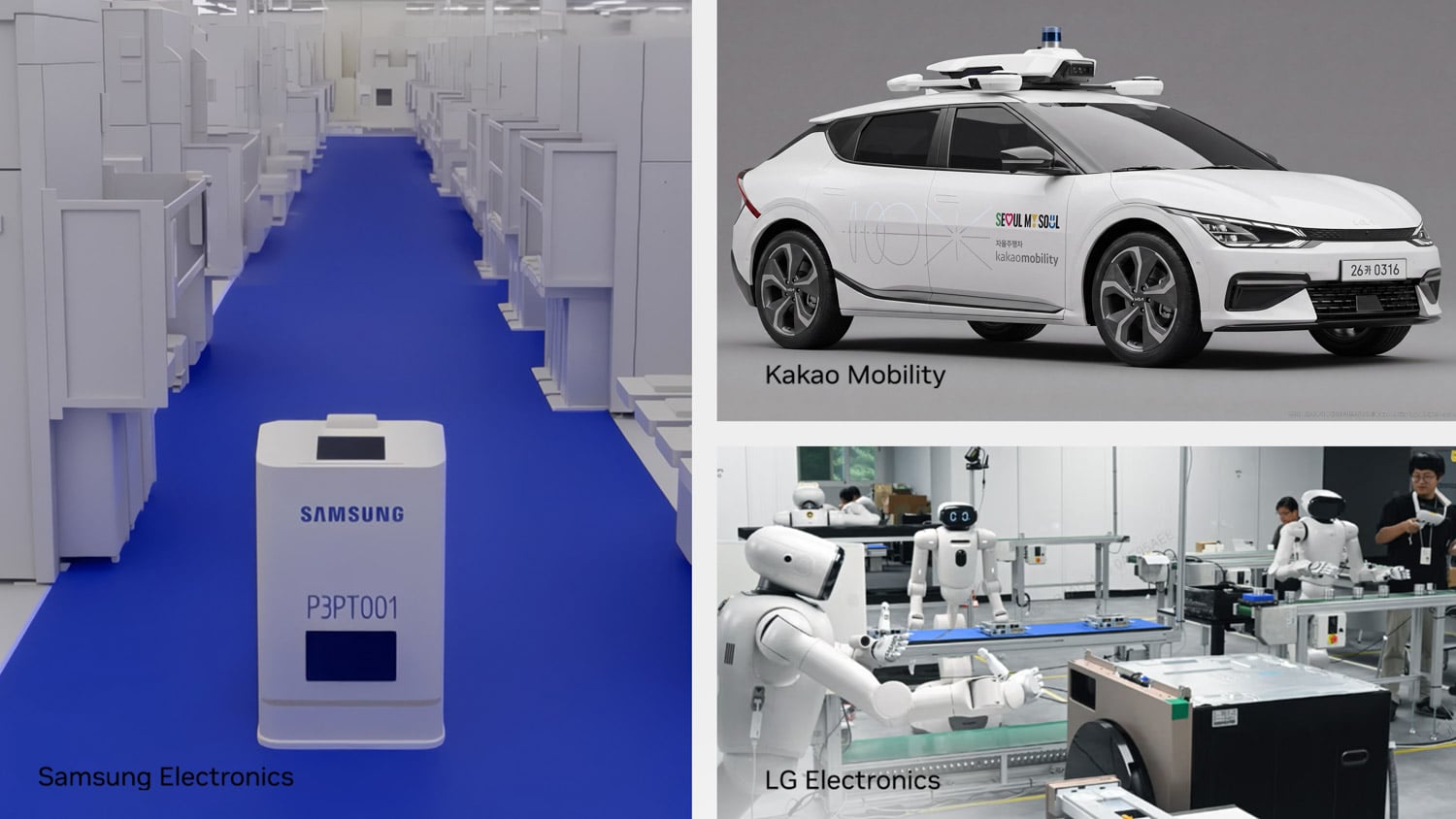
NVIDIA used AI Day Seoul to lay out physical AI work with three Korean manufacturers: Samsung Electronics on chip simulation, Kakao Mobility on a Level 4 autonomous driving system, and LG Electronics on factory robots. The headline figure belongs to Samsung, which cut one chip-scale thermal and mechanical analysis from about 18 hours on a 32-core CPU to 41 seconds on a GPU, a roughly 1,600x speedup, by combining AI-predicted material properties with a coarser grid and GPU acceleration.
Samsung Accelerates Semiconductor Simulation #
Samsung is expanding its work with NVIDIA across materials research, process development, and device engineering. For technology computer-aided design, or TCAD, Samsung is using NVIDIA cuISS and cuDSS to accelerate the sparse linear systems at the center of device simulation, and GPU acceleration also extends to its process and optical simulations. In materials research, Samsung’s sMOL platform has run selected quantum chemical calculations up to 5x faster end to end with NVIDIA cuEST, and Samsung is exploring cuEquivariance to speed the tensor operations used to train and run atomistic AI models.
The 1,600x result comes from chip-scale thermal and mechanical analysis workflows Samsung is building on NVIDIA PhysicsNeMo. In one AI homogenization case, Samsung replaced a fine-grid solve with AI-predicted effective material properties on a coarser grid and ran it on a GPU, which took the solve from about 18 hours on a 32-core CPU to 41 seconds. The comparison covers those two configurations only; NVIDIA does not identify the GPU, and the speedup reflects the coarser grid and the AI surrogate as much as the hardware.
NVIDIA adds that its Agent Toolkit could eventually connect these simulation tools and AI models so engineering agents can run analyses and compare designs, though NVIDIA describes that as a possibility and not something Samsung has deployed.
Kakao Mobility Plans Level 4 Driving System #
Kakao Mobility plans to build on NVIDIA’s vehicle computing and safety technologies to advance a Level 4 autonomous driving system, combining its proprietary driving software and its operating experience in Seoul’s Gangnam district with NVIDIA’s vehicle computing platform. The plan uses NVIDIA Hyperion, the reference platform for vehicle sensors and compute built around NVIDIA DRIVE AGX Thor, with NVIDIA Halos supporting safety across development and validation.
Initial development is planned around Kia purpose-built vehicles, and the effort aims to support future Level 4 mobility services in Korea. NVIDIA gives no deployment timeline or vehicle count.
LG Demonstrates Robot Learning in Manufacturing #
LG Electronics and NVIDIA demonstrated robotic manipulation and manufacturing tasks with LG’s CLOiD robot running NVIDIA Isaac GR00T in an actual manufacturing environment. The work implements what NVIDIA calls a physical AI data flywheel: real-world data collection, Cosmos-based data augmentation, GR00T model training, onboard computing on NVIDIA Jetson AGX Thor, and simulation-based evaluation, with the result packaged as reusable workflows for continued development and validation of CLOiD.
LG and NVIDIA are using the demonstration to refine a repeatable process for training, evaluating, and improving robots for manufacturing. NVIDIA describes a completed demonstration and ongoing development, with no production deployment date.