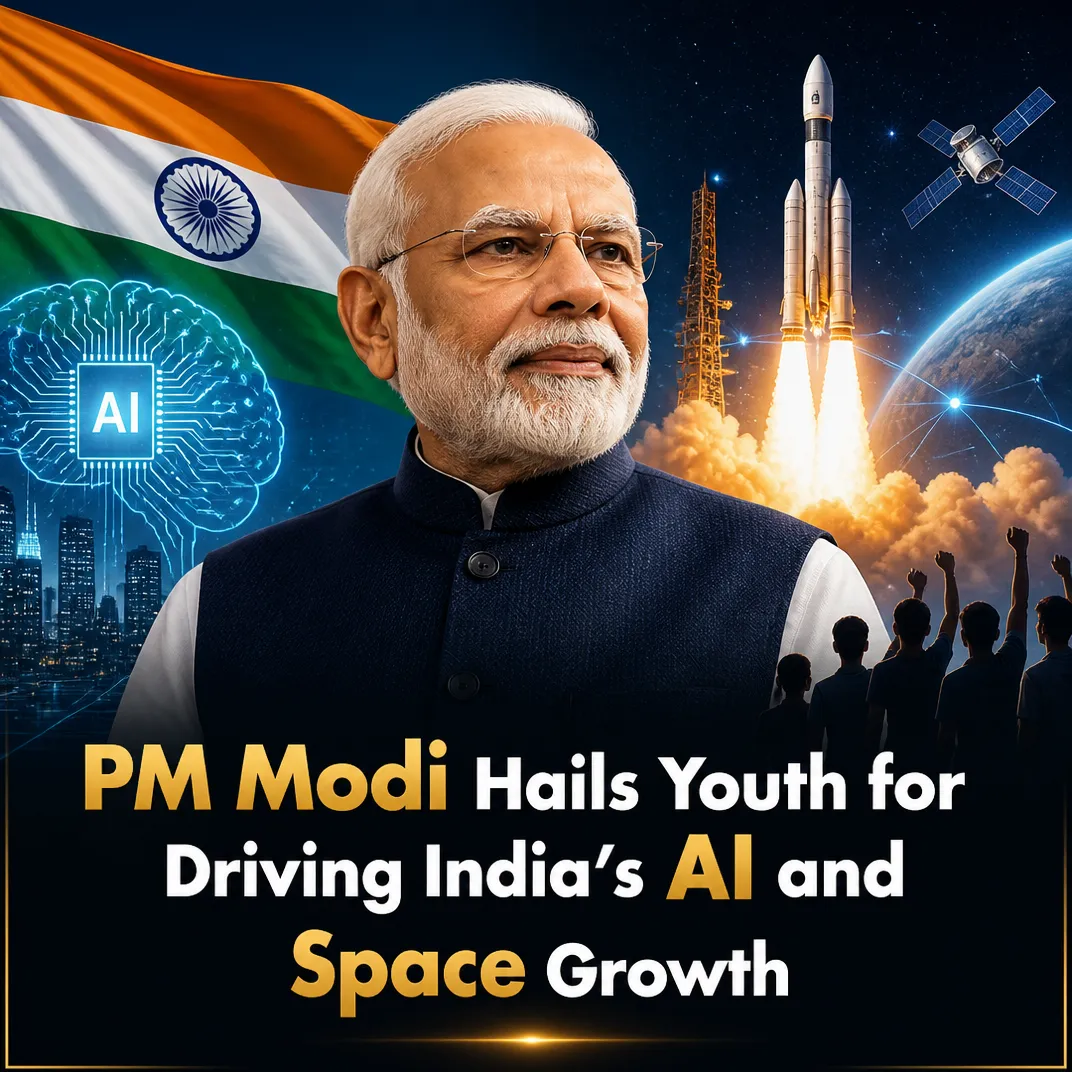
August 2, 2026, (Inside AI) — Prime Minister Narendra Modi on Saturday pointed to India's youth as the driving force behind the country's rapid technological ascent, specifically naming artificial intelligence, deep tech, and space exploration as sectors where young Indians are "writing new chapters."
Speaking at the inauguration of the Swami Vivekananda Cultural Youth Centre in Mysuru, Modi framed the nation's digital and scientific momentum as a direct result of youth empowerment, educational expansion, and policy reforms like the National Education Policy (NEP).
The prime minister's remarks come as India's AI startup ecosystem sees record funding and its space program achieves historic private-sector milestones. Modi cited the recent launch of a privately built rocket as a turning point.
"A few days ago we saw the youth of India create a sensation in space. For the first time, a rocket made by youths, a rocket made by a private company, went to space," Modi said.
That mission, carried out by Skyroot Aerospace in late 2025, marked India's first private orbital launch and signaled a new era for the country's $8 billion space economy. The company's Vikram-series rocket was developed by a team with an average age under 30, reinforcing Modi's narrative of youthful innovation.
On AI and deep tech, Modi's speech aligned with a surge in government-backed initiatives. IndiaAI, a national program launched in 2024, has allocated over $1.2 billion for compute infrastructure, datasets, and skills development. The country now hosts more than 100 generative AI startups, with total AI investments crossing $5 billion in 2025, according to NASSCOM's AI Adoption Index.
"Today India is rapidly progressing in the realm of semiconductor manufacturing because of the abilities of India's youth. Today India is writing new chapters in AI, deep tech, space, and technology on account of youths," Modi said.
His emphasis on semiconductors reflects the government's $10 billion incentive scheme that has attracted Micron Technology and Tata Group to build fabrication plants. These projects are expected to create 80,000 direct jobs, many requiring advanced AI and machine learning skills.
A Policy Engine Behind the Youth Narrative #
Modi anchored his vision in concrete educational reforms. He noted that over the past 12 years, India added 650 universities, 14,000 colleges, and 400 new industrial training institutes. The NEP, launched in 2020, now mandates coding from grade 6 and AI literacy in secondary schools.
Research from a 2025 study on India's AI talent pipeline shows that NEP-aligned curricula have boosted AI course enrollment by 140 percent in three years. Yet challenges persist: only 12 percent of AI faculty hold PhDs, and rural access to digital labs remains uneven.
"The potential of youths to be the strength of a nation is fulfilled when they receive the right opportunities and direction, and when they can dream big on the soil of their own country, and they are given the confidence to do this," Modi said.
This framing echoes Swami Vivekananda's teachings on education and equality, which Modi repeatedly invoked. He highlighted the admission of girls into Sainik Schools and the National Defence Academy, and the teaching of MBBS and engineering in regional languages as steps toward dismantling linguistic barriers.
From Startups to Sports: A Holistic Push #
Modi also spotlighted India's startup ecosystem, now the world's third largest with over 100 unicorns. He linked this to the digital economy's growth, driven by small businesses and youth-led fintech innovations. The Unified Payments Interface (UPI) processed 100 billion transactions in 2025, a figure Modi attributed to young developers and entrepreneurs.
On sports, he positioned the Khelo India and Youth Games programs as critical for building "healthy, confident and determined" citizens. While not directly tech-related, these initiatives feed into a broader narrative of a youthful, competitive workforce ready for global challenges.
Critics note that despite these achievements, India's AI research output still lags behind the US and China in top-tier publications. The country filed only 3,000 AI patents in 2025, compared to 30,000 from China. Bridging this gap will require sustained investment in fundamental research, not just application development.
Modi's speech, however, was unequivocally forward-looking. By tying cultural heritage to technological ambition, he sought to cement a national identity where youth are not just participants but leaders in AI and space. Whether the policy scaffolding can match the rhetoric will define the next decade.