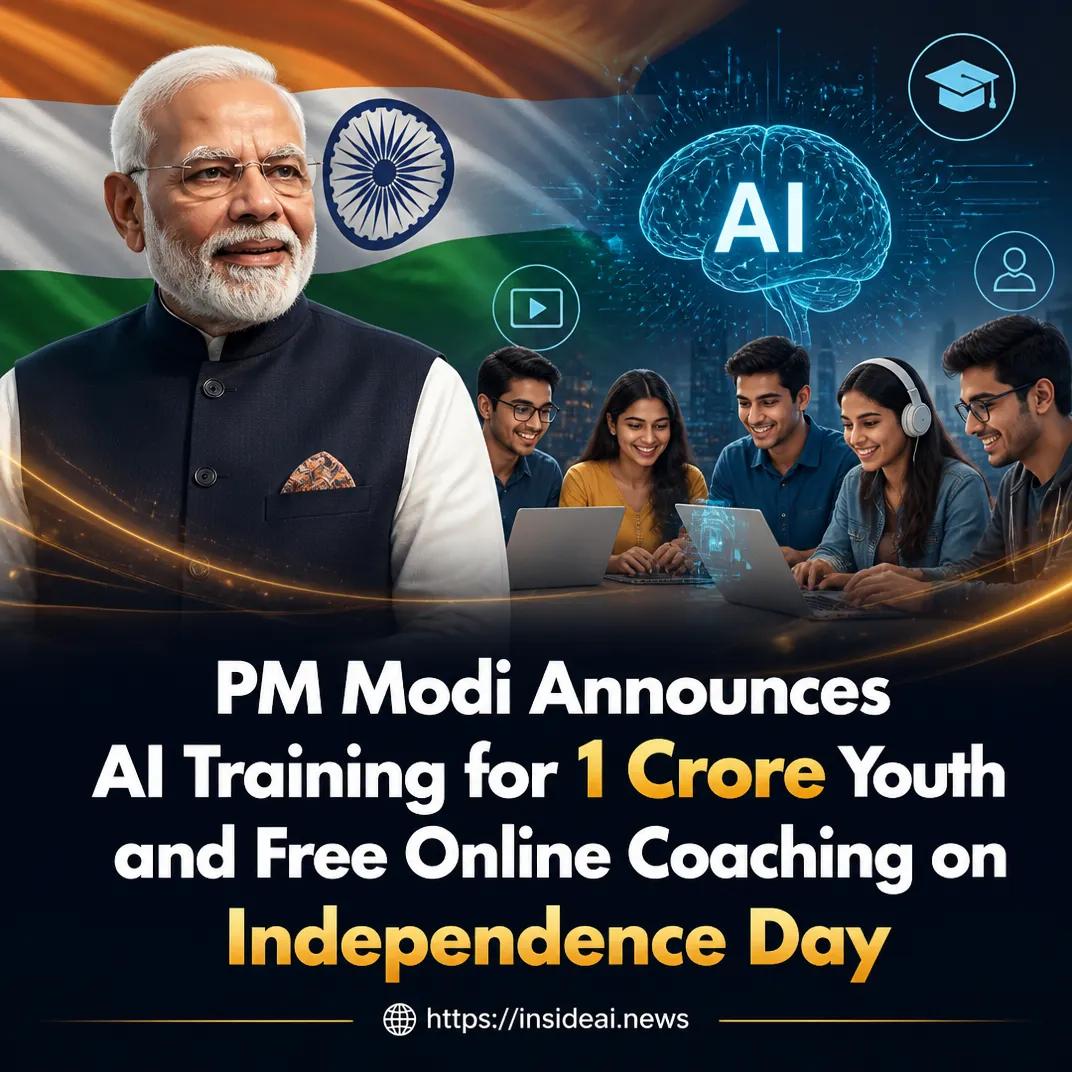
August 15, 2026, (Inside AI) — Prime Minister Narendra Modi used his 80th Independence Day address from the Red Fort to announce a national AI skilling initiative targeting one crore youth within the next year. The program aims to position India's workforce for leadership in the artificial intelligence era.
The announcement came as part of a broader technology push that Modi framed as essential to the Viksit Bharat vision. He identified artificial intelligence, quantum computing, space, robotics, and data centres as the new frontiers where India must take the lead.
Modi also announced free online coaching for competitive exam aspirants, a move designed to reduce the financial burden on middle-class and poor families who currently spend heavily on private coaching centres.
Why India's AI Skilling Bet Is a Workforce Imperative #
The AI training pledge arrives at a critical moment for India's labor market. The country's IT services sector, which employs over 5 million workers, faces disruption from generative AI tools that automate coding, testing, and business process tasks. A 2025 report by NASSCOM projected that up to 40% of existing IT roles would require significant reskilling by 2030.
India's demographic dividend, with a median age of 28, creates urgency. Without rapid AI upskilling, the country risks a skills mismatch that could leave millions of young workers unprepared for automation-driven job changes. The government's target of one crore youth trained in one year is ambitious but aligns with the scale of the challenge.
The Prime Minister tied the initiative to India's existing digital infrastructure strengths. "We have digital public infrastructure; we have excellent talent and teachers. By bringing these resources together, we are going to build a complete network to provide free coaching to the youth of the country," he said.
Modi also set a specific technology goal. "Made-in-India 6G should reach every corner, and that should be our goal," he stated, signaling ambitions beyond AI into next-generation communications.
The Coaching Centre Economics Behind the Free Online Push #
India's private coaching industry generates an estimated ₹58,000 crore annually, according to a 2024 study by Google and KPMG. Cities like Kota in Rajasthan have built entire economies around test preparation for engineering and medical entrance exams.
Modi addressed the social pressure driving this spending. "Every parent feels that if they do not send their child to a coaching class, they are not a prestigious family," he said from the Red Fort.
The free online coaching initiative will leverage India's existing digital public infrastructure, including the DIKSHA platform and SWAYAM MOOCs portal, which already host educational content. The government has not yet specified which competitive exams will be covered or the exact delivery mechanism.
The Prime Minister framed both announcements as part of a seven-point framework for national development. Technology and innovation represent the third pillar of what he called the Sapta Dhara vision.
Modi noted that India has already demonstrated global leadership in UPI payments and digital public infrastructure. The next step, he argued, is extending that model to digital public technologies that can be exported worldwide.
The AI skilling program's implementation details remain unclear. Questions about curriculum standards, certification, and industry alignment will determine whether the initiative produces job-ready talent or merely completion certificates. India's Skill India mission has faced past criticism for training numbers that did not translate into employment outcomes.
The announcement also comes as India negotiates AI governance frameworks internationally. The country has positioned itself as a leader among Global South nations seeking technology sovereignty rather than dependence on Western or Chinese AI platforms.