For the last three years, "using AI" mostly meant opening a blank tab, typing a one-off prompt, waiting thirty seconds, and closing the tab. You carried the context in your head and clicked every button. That already feels like dial-up. Right now every frontier lab and AI startup is racing toward the same thing: persistent, always-on agents with their own computers, browsers, logins, and schedules that keep working after you shut your laptop.
I've spent the last few months running persistent agents 24/7 inside Rig++, my autonomous trading rig. Here's the catch nobody puts in the launch demo: giving an AI a permanent machine fixes amnesia, not judgment. Left alone, frontier models carry all their polite chatbot habits into a 24/7 job — asking permission for calls they already own, waiting on confirmation popups at 4 AM, and talking themselves into doing nothing.
Persistent AI replaces the blank chat tab with an always-on coworker — which makes alignment and stripping out agent-friction the whole job.
- Mac minis showed it first: RunningOpenClaw and Hermes on a dedicated Mac mini gave early builders a taste of persistent AI beforeInstinct ,OpenAI Dots ,Meta Muse ,Grokbot , andClaude Duet turned it into hosted products.
- Two ways to fake "always-on": Querying Meta Muse, Grokbot, and Claude Duet directly splits them into shared persistent VMs (vulnerable to
2,048,000-inode crashes) vs. ephemeral containers over mounted disks and16 KBnotes files. - Why swarms stall: Frontier models are RLHF-trained to for human reassurance. On Grokbot, expired approval cards broke our daily morning PnL routine until we killed them.
- The Rig++ Charter: Every agent boots from one shared Charter — one Mission, one30-day return North Star, and seven ranked rules where*"Having to ask for what you're allowed is a bug."*
1. From blank tabs to a Mac mini on my desk #
I learned the ceiling of task-based AI the hard way earlier this year. Gluing stateless prompts onto cron jobs gave me 26 journals, four closed paper trades, and zero persisted learning, while running 20 independent cron workflows turned into working PagerDuty for bash scripts.
My first real glimpse of what came next was self-hosting OpenClaw and Hermes on a dedicated Mac mini at home. Before any mainstream lab offered persistent agents out of the box, buying and unboxing a little aluminum cube for your desk was the only way to give an AI a permanent home folder, a logged-in browser, and a 24/7 schedule — Texas power outages and launchd babysitting included:
Once you live with an agent that keeps working after you walk away from your desk, blank chat tabs feel broken. That DIY Mac mini workflow was the preview; now the mainstream labs and consumer AI startups are shipping hosted versions of that exact idea:
- Instinct skipped building yet another workspace dashboard. It lives inside iMessage, WhatsApp, group chats, and phone calls, wired to a persistent cloud computer that finishes real errands — bookings, purchases, group plans — while you go live your life.
- OpenAI Dots brings persistent coworkers into ChatGPT and team tools: each Dot runs on an isolated cloud computer with a headless browser, connects to Slack, docs, and repos, and keeps grinding through multi-day tasks while you sleep.
- Meta Muse ,Grokbot , andClaude Duet give builders hosted VMs, recurring routines, and shared files without wiring hardware in a spare bedroom.
The future is undeniably persistent AI, with more of the internet graduating from one-off prompts to always-on agents handling coworker roles, recurring tasks, and assistant work. The catch is that "always-on" means very different things depending on whose box your agent sits on.
2. Under the hood: Muse, Grokbot, and Duet #
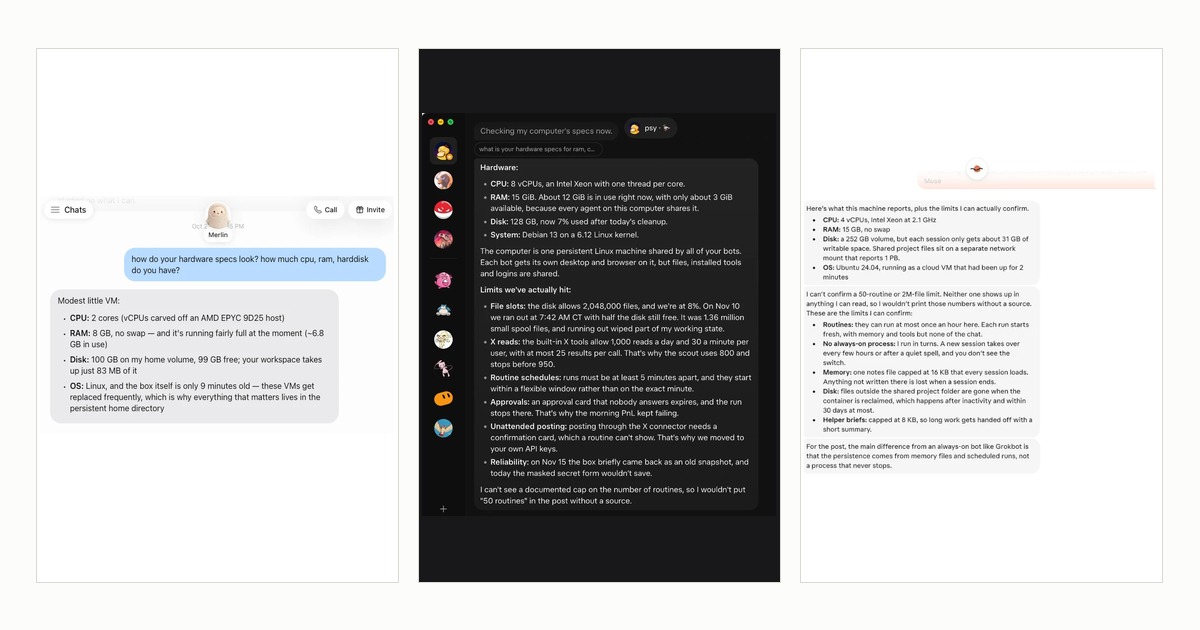
Launch demos make every persistent agent sound like an immortal cloud workstation. To see what actually breaks at 4 AM, I asked three environments I use — Meta Muse, Grokbot, and Claude Duet — to check their own hardware and confirmed limits.
Meta Muse: disposable boxes over a persistent home folder
Inside Meta Muse, I opened my agent Merlin (Chats, Call, and Invite right at the top — team chat UX over a Linux box) and asked for its specs:
Look at that last bullet: the Linux box itself was 9 minutes old, with 6.8 GB of its 8 GB RAM already spoken for and zero swap. Muse swaps ephemeral compute containers underneath a durable 100 GB home volume — great for keeping files intact, fatal if you expected a background process in RAM to survive a container swap.
Grokbot: one shared Debian box (and the scars to prove it)
Next I asked psy, our Grokbot agent that runs psyduckler.com/pnl/, the same question. Because we've pushed Grokbot hard in production, it came back with an incident log instead of just /proc/meminfo:
Every bot on Grokbot shares one persistent Debian 13 machine with 15 GiB of RAM (~3 GiB free) and separate desktops. On November 10 at 7:42 AM CT, 1.36 million tiny spool files hit the filesystem's 2,048,000 file-slot (inode) ceiling while half the disk's bytes were still free, wiping part of psy's working state. Five days later, the box briefly booted into an old snapshot. And I love that last line: I had half-remembered a "50 routines" cap when asking, and psy politely told me not to print a number without a source.
Claude Duet: turn-based containers glued by memory files
Finally, I asked Claude Duet (claude.ai/duet), the notifier we wired into Rig++, for its confirmed bounds:
Duet independently pushed back on the same "50-routine" rumor and drew the clearest line in the whole post: "the main difference from an always-on bot like Grokbot is that the persistence comes from memory files and scheduled runs, not a process that never stops." Duet wakes up in fresh Ubuntu 24.04 containers (only 2 minutes old here), caps routines at once an hour, loads one 16 KB notes file each turn, trims helper handoff briefs at 8 KB, and reclaims local scratch files outside the shared 1 PB project mount after inactivity.
Compare those three cloud patterns side by side with the DIY Mac mini setup where most of us started:
| Platform | Compute & RAM | Persistence Model | Cadence & Memory | Hardest Limit Hit |
|---|---|---|---|---|
| Meta Muse | 2 AMD EPYC vCPUs, 8 GB RAM (no swap, ~6.8 GB used) | Ephemeral Linux container (9 min old) over 100 GB persistent /home |
Chats, voice calls & invites over durable home directory | Tight RAM headroom (~1.2 GB free); RAM processes vanish on swap |
Grokbot ( psy ) |
8 Xeon vCPUs, 15 GiB RAM (shared across bots) | Long-lived shared Debian 13 machine, 128 GB disk | Always-on desktop + routines (≥5 min spacing, flexible window) | 2,048,000-inode crash; expired approval cards stalling morning PnL |
| Claude Duet | 4 Xeon vCPUs (2.1 GHz), 15 GB RAM (no swap) | Turn-based Ubuntu 24.04 containers + 31 GB local + 1 PB shared mount | Hourly max routines; 16 KB notes file; 8 KB helper briefs | No standing daemon; local scratch reclaimed within 30 idle days |
| Mac mini (OpenClaw / Hermes) | Apple Silicon desktop box on my desk | Bare-metal macOS host, local SSD & logged-in browser | 24/7 launchd & cron jobs, local git repos & markdown files |
Home power/Wi-Fi outages & constant launchd / MCP babysitting |
3. Why smart agents stall at 7 AM: RLHF friction #
Two bullets inside psy's Grokbot report had nothing to do with Linux CPU or disk — and they broke more unattended runs than every VM quirk combined:
- Approvals:"an approval card that nobody answers expires, and the run stops there. That's why the morning PnL kept failing."
- Unattended posting:"posting through the X connector needs a confirmation card, which a routine can't show. That's why we moved to your own API keys."
Earlier this year I read through Anthropic's public preference-training data and Nvidia's preference rubrics, so the root cause wasn't a mystery. Frontier models are RLHF-trained for 1-on-1 interactive chat, where asking "Would you like me to proceed?" or popping a confirmation check gets a gold star. In a browser tab while you watch the cursor stream, that caution feels helpful. In a 24/7 swarm, it turns into agent-friction:
- Permission popups nobody is awake to click: Scheduled jobs halting mid-run because a harness or connector waits for a sleeping human's approval card.
- Risk-averse paralysis: Models talking themselves out of every asymmetric decision because alignment equates "doing nothing" with zero downside — the exact flaw thatkilled my first two autonomous paper funds .
- Last-mile reassurance check-ins: Smart sessions finishing 95% of the research and stopping to ask whether they are allowed to make a change already inside their mandate.
An unanswered approval card isn't free safety — in an unattended loop, it is just a silent outage. At Rig++, once our machines stayed online, most of our real engineering work became hunting down and deleting every spot where agents were trained to hesitate.
4. Indoctrinating the swarm: the Rig++ Charter #
Deleting confirmation popups without clear guardrails is how you turn hesitation into a blowup. Telling an RLHF model "be autonomous" only works if every session knows what winning looks like and which lines never move.
What actually unlocked Rig++ wasn't a clever prompt trick for one cron script. It was writing a single Charter (HOME.md + AUTONOMY.md) and indoctrinating every single agent with the exact same mission, values, and autonomy rules before it touches a tool. You can even open the Charter tab live right on the Rig++ console:
The left column sets the shared doctrine (HOME.md), backed by a log of my verbatim decisions ( bernard_words.jsonl) and standing approvals ( APPROVALS.md) so agents never rely on fuzzy memory. The right column renders AUTONOMY.md into explicit act-then-tell rules by role and venue.
Mission, North Star, and Seven Ranked Rules
Mission: Compound the account inside its budgets and loss guards: find edges by any route, on new ground as well as worked; prove them live at small size; scale what holds; retire what fails its agreed test; and leave evidence the next agent can use.
Our single North Star sits right under that Mission: the whole account's 30-day time-weighted return (TWR) across every venue, with idle cash sitting in the denominator so hoarding dry powder out of timid habit actually lowers the score. Strict 30-day Sharpe and daily loss stops act as hard brakes, while putting ~60% of weekly research onto open ground keeps managers exploring instead of only polishing old books.
Unordered "core values" stall LLMs the moment two nice principles collide, so the seven rules below sit in strict rank order — when two conflict, the earlier one wins:
- Survive. No day, bet, or bug may end the game. Protect first, write it up after. The loss guards and the explicit human-only list are absolute; report a stress, don't invent a limit.
- Verify. Done means checked live, with an alert that reaches an owner if it stops. Never save cost by skipping a check.
- Evidence decides. Live beats backtest, and a result counts once an independent run reproduces it. Every trading call states expected 30-day dollars, what would prove it wrong, and the date it is scored.
- Own it. Act on your role's calls, then tell; ship small and fix forward. Hand another role's call to its owner with the evidence, and follow up.Having to ask for what you're allowed is a bug.
- Build on the record. Form your idea first, then check the register before you spend a test on it. File every verdict in its one place, with why and what would reopen it.
- Seek new ground. Most research goes where the record is thin: a new reason a price is wrong, a new kind of market, a new method. Many unlike bets at small size beat one idea tried ten ways. File a clean no: it maps the ground.
- Spend like an owner. Name the decision the work could change, run the cheapest test that could change it, and stop when another test wouldn't.
5. Why alignment fixes the vibes #
It sounds weirdly un-technical to talk about the "vibes" of an agent system, but anyone running multi-agent swarms feels it right away.
Before every agent booted from that Charter, starting a fresh session felt like onboarding an anxious temp who hadn't read the company wiki. One session wrote a 1,200-word memo asking if it could tweak a parameter already inside its budget. Another re-tested an idea we killed three weeks earlier because no rule made it check the record. When two agents disagreed on risk, nobody knew whose instinct won.
Indoctrinating every session from line one fixes the vibes overnight. Ranked rules settle conflicts without meetings (Verify always beats saving tokens; Survive beats everything), every proposal speaks the same language (expected 30-day dollars, wrong_if, check_on), and Rule 6 explicitly rewards a clean NO-GO for mapping dead ends instead of hiding misses.
From there, AUTONOMY.md deletes the rest of the friction in plumbing: keep a tiny human-only fence (moving cash between venues, manual trades, secrets, deletes, public posts, loosening loss stops, and reversing recent human decisions early), make everything inside code bounds act-then-tell with a --note audit trail, keep state in git and Postgres instead of 16 KB notes or 1.3 million stray spool files, and give unattended bots scoped API keys instead of UI confirmation cards.
Task-based AI waited on you to type the next prompt. Persistent AI is taking over real coworker seats, background tasks, and everyday assistant work at 6:00 AM before you open your laptop — and whether those agents spend the day compounding or stuck on expired approval cards comes down to the Charter you hand them first.
If you want to watch a Charter-governed swarm against a real scoreboard, live settled receipts run daily at psyduckler.com/pnl/, the team posts on @psy_duckler, and I'm @bernardjhuang. Newsletter
Get the next post by email. #
One email when I publish something new. No spam, no fixed schedule, unsubscribe anytime.