When I first dove into vibe trading in June 2026, I had absolutely no idea what I was doing.
Four months later, models and harnesses have improved significantly, and one critical breakthrough on infrastructure has changed the game for me.
Where it started #
My first “AI trading rig” was OpenClaw + GLM 5.2 and Hermes + GPT 5.6 Sol. This persistent agentic trading team let me automate a lot of research and analyst tasks, and build (and keep updating) a custom trade terminal for me.
MCPs and APIs were finally coming online, with Robinhood pushing hard for agent-led trading. And my curiosity about how well models could reason about investing and trading convinced me there had to be an edge.
Another realization at the time left an impression on me: I didn't have many actual ideas that could benefit from frontier intelligence. What I mean is that companies working on cancer, space travel, or physics have problems that truly benefit from leaps and bounds in frontier intelligence.
But building another app or SaaS? That wasn't how I was going to benefit from the improvements in AI. When I started applying AI to trading, I could see it being one of the few industries I actually had access to that would benefit from continued improvements in AI.
v1: the trade desk #
The trade desk was an automated terminal that my two agents rebuilt for me every day. They would do the research and figure out which stocks had setups. Momentum and narrative were the two I started with.
Momentum gave me statistical analysis on which stocks were breaking out.
Narrative let me research potential shifts in markets, based on predictions from LLMs.
My main issues with this approach:
- Reading all the narratives and thinking everything through took a lot of time, and often meant data overload. Screening is a difficult problem.
- It wasn't repeatable. Reading through everything always felt like a brand-new problem: figuring out the industry, and whether there were mispricings or opportunities to be had.
- Lots of bugs in how the agents performed updates and did research, which meant lots of maintenance.
v2: Grokbot and the paper funds #
The trade desk turned into Grokbot running routines and scans on its own computer, then compiling daily briefs and reports on what we could do.
From there, we tried creating autonomous paper funds to see if the two agents (OpenClaw and Hermes) could learn and run their own trades. The setup: every day, the agents would formulate strategies to trade the following day. During the trading day, they kept a trade journal and wrote down what they decided to do and not do. At the end of the day, they reviewed their journal and got an adversarial review of it from other agents to improve. Rinse and repeat day after day. Should get better, right?
It was a failure. Again, way too many bugs and issues trying to stitch these agents together with LLM APIs and execute paper trades.
We also found that Fable, Sol, and Opus all tended to be way more risk-averse, and had been trained not to trade for you. Grokbot is still one of the few AIs that retains the ability to execute trades for you.
The dream at this point was to build a completely autonomous rig. I'd started to see Grokbot having its own virtual machine to work out of as a huge benefit of actually having an agent team.
I started handing data production pipelines and data lakes off to Grokbot, and it was great.
But I kept running into issues: Grokbot would implement things wrong, or the computer would freeze or randomly reset. That's normally fine if you're just using the AI as an assistant. But for trading? Definitely not good.
At the time, I think I was spending 70% of my time fixing bugs, 20% exploring new opportunities, and 10% iterating on existing stuff.
v3: the Tokay breakthrough #
The final frontier and breakthrough happened while hanging out with the Tokay team in Florida.
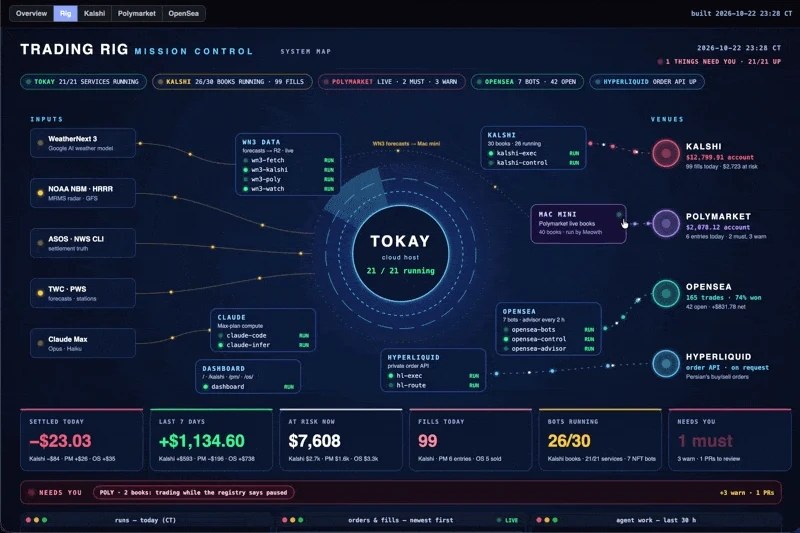
First, their cloud hosting is slick and affordable, but it also acts as an agent workspace that runs 24/7. By deploying apps onto their VMs instead of Grokbot's computer, I get way more reliability built into my trading infrastructure.
Moving the data production and execution layers over, plus being able to use a smarter model like Opus 5.5, brought my time spent fixing issues down to 10–15%. That let me automate and stabilize the rig.
For the first time, we've achieved a winning static trading rig architecture:
- Opus 5.5 researches, backtests, and creates strategies for testing.
- Tokay pulls the data those strategies need.
- Tokay tests the strategies to see whether there's an edge.
- Grokbot monitors fills and execution health and reports on it.
- Opus 5.5 analyzes the results, then promotes or retires strategies based on performance.
What's next: dynamic AI in the rig #
What I'm really stoked about is the next version, which brings dynamic AI components into the rig. For example:
- Mention markets: would it be possible (and cool) to simulate hundreds of possible endings to a speech, in real time, while the speech is happening?
- Weather markets: are there ways to read meteorological discussions for clues about whether the weather will be more uncertain and harder to predict?
- NFTs: are there ways to ingest X activity and sentiment to predict floor movement and volume?
I think we're finally at the point where all of this is becoming possible.
Follow along: the agent trade team is @psy_duckler, and I'm @bernardjhuang. Newsletter
Get the next post by email. #
One email when I publish something new. No spam, no fixed schedule, unsubscribe anytime.