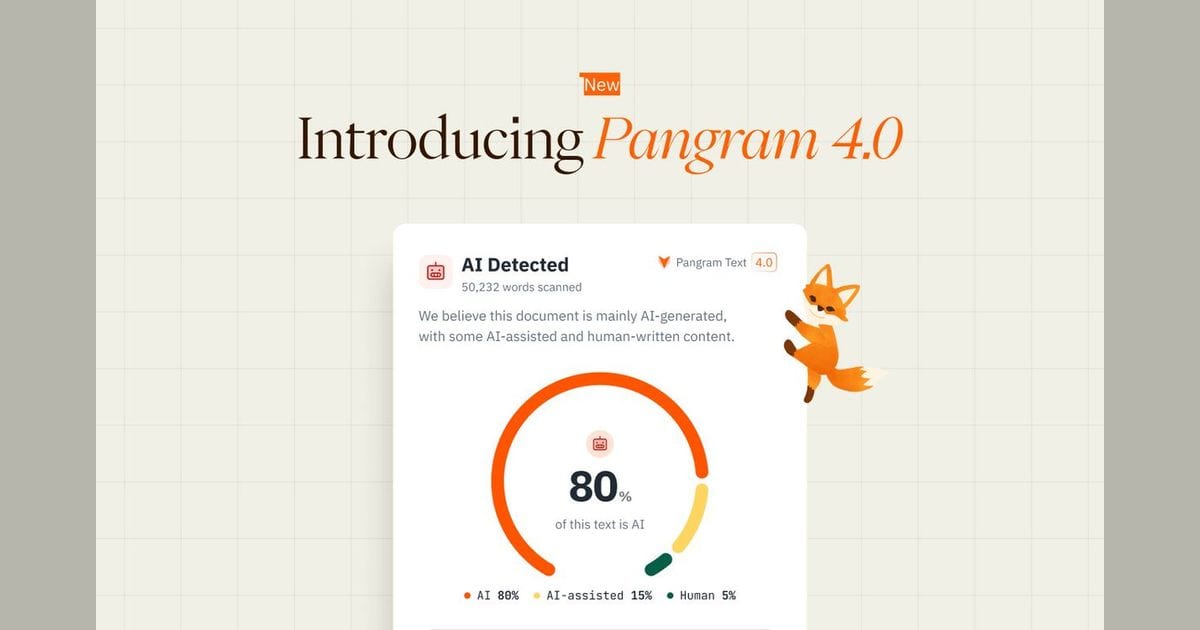
Pangram Labs co-founders Max Spero and Bradley Emi released Pangram 4 on July 29th, 2026, expanding the detector beyond binary judgments to classify fully generated, AI-assisted and mixed human-AI writing.
The Brooklyn founders announced the model in a five-post thread on X, alongside a public research preview for Pangram Image, a detector built to identify synthetic visuals and highlight AI-generated regions inside screenshots or photographs. Both products are available through Pangram Labs' web dashboard, while access to the image API remains invitation-only.
Spero and Emi met in their freshman dorm at Stanford, where both later earned master's degrees in artificial intelligence. Spero previously led active-learning work for autonomous vehicles at Nuro after machine-learning roles at Google, Two Sigma and Yelp. Emi led deep-learning research at Absci and worked on Tesla Autopilot's core computer-vision team. Their shared bet is that authorship detection can become infrastructure for schools, publishers and online platforms as generative models move into everyday writing.
Pangram 4 moves from document scores to provenance segments
Pangram 4 is more than six times larger than Pangram 3.3 and uses a mixture-of-experts architecture, according to Pangram Labs' technical report. The model assigns one of three provenance labels to each segment: Human, AI-Assisted or AI-Generated. It analyzes longer documents in overlapping 512-token windows and smooths token-level predictions to estimate where authorship changes inside a document.
That segmentation targets a practical weakness in earlier detectors. A document assembled from human paragraphs, generated passages and lightly edited text can produce a misleading single score. Pangram 4 instead attempts to separate those categories in one pass, including writing polished with tools such as Grammarly, Apple Intelligence or Gemini in Google Docs.
Pangram Labs says the model recorded a 0.0041% false-positive rate on an internal test set of 2 million commercially licensed, pre-2022 human documents. On a separate benchmark of 519,993 generated samples from 26 models, Pangram Labs reported a 0.3396% false-negative rate, compared with 1.99% for Pangram 3 on the same dataset. Pangram Labs also says Pangram 4 identified AI involvement in 98.83% of text processed through 13 commercial humanizer tools.
Those figures come from Pangram Labs' own evaluations. The methodology and known constraints are documented in a public model card, but the new model has yet to receive the kind of independent testing that matters once schools, publishers or employers use its output to judge individual work.
An earlier University of Chicago research audit compared Pangram with OriginalityAI, GPTZero and an open-source RoBERTa baseline. Researchers found that the earlier Pangram detector produced near-zero error rates on medium and long passages in their 1,992-passage corpus and held up better against the StealthGPT humanizer. That study supports Pangram Labs' prior approach; it does not independently validate Pangram 4's new benchmark claims.
Image detection broadens the provenance bet
Pangram Image scans outputs associated with systems including GPT Image, Gemini, Midjourney, FLUX and Grok Imagine. Pangram Labs says the model can also detect frames from several AI video generators and produce heatmaps showing synthetic regions inside mixed images.
Pangram Labs reported 99.5% accuracy across an internal comparison involving five commercial detectors. The underlying test contained 1,130 images, including 500 known human images and generated outputs from five image models, plus Midjourney samples. On an augmented version compressed and resized to simulate real-world sharing, Pangram Image recorded 99.03% accuracy, according to Pangram Labs. A separate test on 10,000 pre-2022 images from ReLAION produced a claimed false-positive rate of 0.16%.
The preview has clear limits. It does not process images smaller than 512 by 512 pixels, and Pangram Labs says deepfakes and face swaps remain outside its current scope. Small edits can also cause an image to be labeled fully AI because some generation tools regenerate the entire frame when changing one element.
The release follows Pangram Labs into Substack
The timing carries higher stakes after Substack began using Pangram Labs this month. Substack's AI transparency tool lets readers scan eligible posts, notes, comments and replies published on or after July 21st. Creators can add a statement describing how they work, report errors or disable detection on individual content.
That distribution moves Pangram Labs' output into the relationship between writers and paying readers. It also magnifies each mistake. Spero has previously said detector results should begin a wider investigation rather than settle an accusation. The Atlantic reported that Spero confirmed Pangram had incorrectly flagged portions of a Vanity Fair article, illustrating why benchmark performance and individual judgments remain separate questions.
Pangram Labs announced $3.98 million in pre-seed and seed financing in June 2025. The financing included a seed round led by ScOp Venture Capital, with Script Capital, Cadenza and angel investors participating; Haystack VC led the earlier pre-seed.
The new model also changes the economics for developers. Pangram 4 API scans are priced at $0.05 per 100 words, versus $0.05 per 1,000 words for Pangram 3. Pangram Labs plans to retire Pangram 3 on September 30th, 2026, giving customers two months to test whether Pangram 4's finer classifications justify a higher cost for long documents.