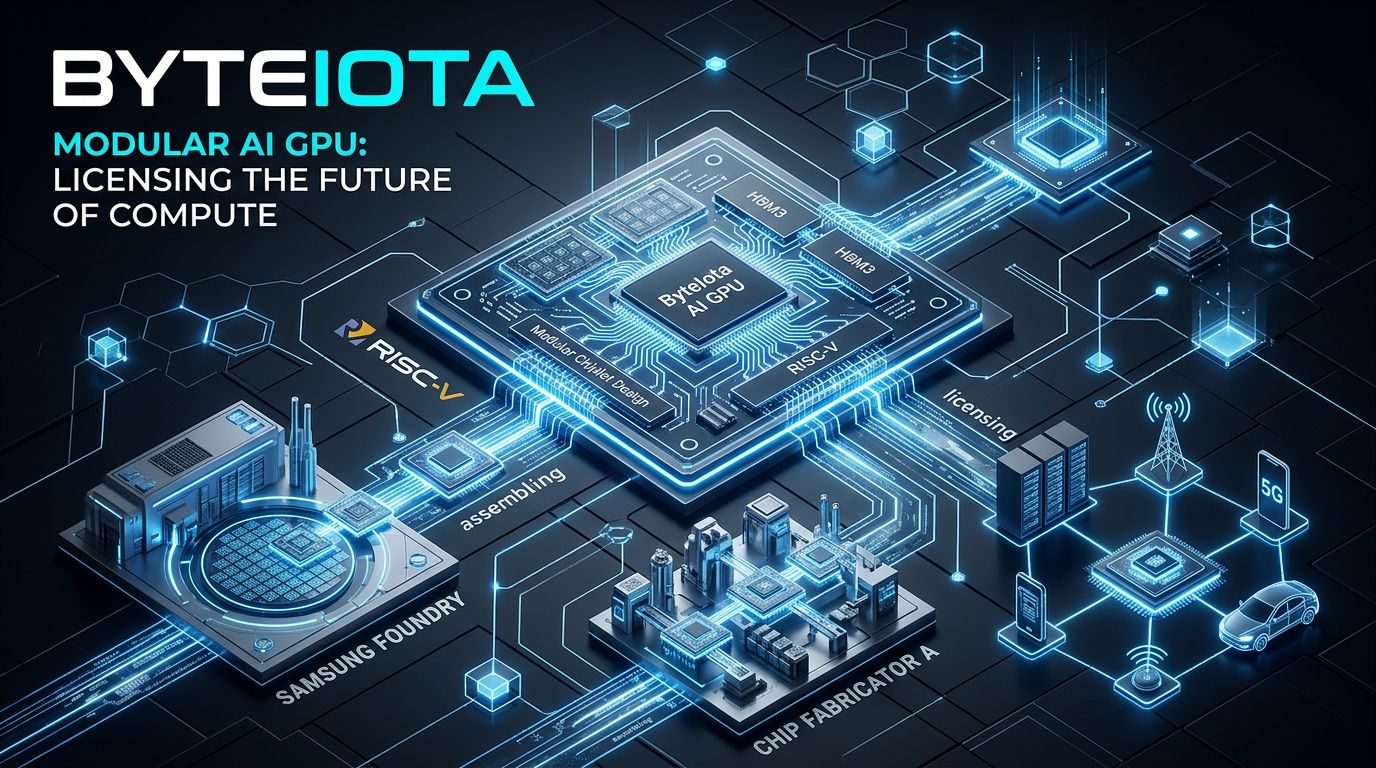
Raja Koduri just raised $35 million to build the Arm of AI chips — and if it works, your CUDA code runs on it without changes. Koduri, the architect behind AMD’s Radeon GPU revival and Intel’s Ponte Vecchio, closed a Series A for his startup OXMIQ on July 1. Samsung Catalyst Fund and Fudomo co-led the round. MediaTek and Pegatron Venture Capital also joined. The company’s total funding now stands at $60 million. The pitch is simple and the bet is large: license a GPU architecture called OxCore to anyone who wants custom AI silicon, without requiring them to build a chip company. Unlike Groq, Cerebras, or Etched — which all manufacture their own hardware — OXMIQ is selling the blueprint.
Your CUDA Code, on Non-NVIDIA Hardware #
The part that matters most for developers is OxPython. It’s a compatibility layer that runs existing Python-based CUDA applications on OxCore-powered hardware without code changes. PyTorch models port natively. No refactoring, no HIPify rewrites, no months of validation.
That directly attacks NVIDIA’s real moat. It’s not the hardware — it’s the 20 years of CUDA investment baked into every production ML stack. Developers are locked in not because they love NVIDIA but because switching means rewriting code they’ve spent years tuning. OxPython’s zero-change claim, if it holds, removes the biggest reason not to switch.
CUDA’s problems are well-documented. Version mismatches between the CUDA toolkit, driver, and PyTorch cause build failures routinely. Cutting-edge ops like FlashAttention-3 require dropping below CUDA into PTX — NVIDIA’s lower-level assembly, which is poorly documented and shifts between hardware generations. NVIDIA holds 86% of AI datacenter revenue precisely because alternatives keep stumbling on software compatibility. OxPython is a direct attempt to solve that.
What OxCore Actually Is #
OxCore is a RISC-V-based GPU IP core that integrates three compute engines in one design: scalar, vector, and tensor. It adds an orchestration layer for managing agents and coordinating workloads. The whole thing is built for near-memory compute — keeping data close to the processor to cut the latency and energy cost of moving it around, which is where inference workloads bleed efficiency.
The architecture scales via OxQuilt, a chiplet-based SoC builder. A single OxCore handles edge deployments. Thousands of cores cluster for datacenter inference. It’s SIMT-compatible, meaning it follows the same programming model as CUDA and OpenCL. Developers writing SIMT code today should find it familiar.
The software stack includes OxCapsule for high-level orchestration and claims day-zero support for new model architectures. Tom’s Hardware has more on the RISC-V foundation and CUDA targeting.
The Investor Composition Is the Signal #
The investors here are not random. Samsung manufactures chips. MediaTek designs them for mobile and edge. Pegatron builds the devices they go into. Together, they cover the full custom silicon supply chain from fab to final product. These companies didn’t invest out of financial speculation — they invested because they have direct downstream use for a licensable GPU design.
That’s a meaningful endorsement. It suggests OXMIQ’s first licensees may already be in the room.
Koduri and Keller: Two Legends on One Cap Table #
Koduri’s track record is real. He built the GPU architectures behind PlayStation and Xbox at AMD. He delivered Ponte Vecchio, the 47-chiplet GPU powering the Aurora exascale supercomputer. He knows how to ship silicon at scale.
Jim Keller joining the board adds another dimension. Keller currently runs Tenstorrent — a direct OXMIQ competitor — which makes his board seat unusual. His career spans the AMD Zen revival, Apple’s A4/A5 chips, and Tesla’s Full Self-Driving processor. AMD’s former CTO called him “the Forrest Gump of the chip industry.” His involvement signals the architecture has passed some level of technical scrutiny. Jon Peddie Research has a detailed analysis of the Arm licensing angle.
Can This Beat CUDA’s Gravity? #
It is worth being clear about what OXMIQ is not, yet. There is no finished silicon. The RISC-V foundation is open-source, which raises long-term moat questions. Arm took decades to reach its position, and it did so in a fragmented mobile market before a dominant incumbent existed. NVIDIA is not a fragmented smartphone market.
The skeptical take — that this is impressive credentials with limited technical proof — is not baseless. OXMIQ is making large claims with no public benchmark to back them up yet. The Next Web frames it well: OXMIQ is renting out chip design rather than building chips, which is either the smartest move in AI infrastructure or an idea waiting for a hard market reality check.
Still, the structural conditions for disruption exist. Inference costs are the defining infrastructure problem of 2026. Custom silicon demand is accelerating. Samsung and MediaTek are not known for speculative bets. Watch for OXMIQ’s first licensee announcement — that will be the real test of whether the Arm model translates to AI.