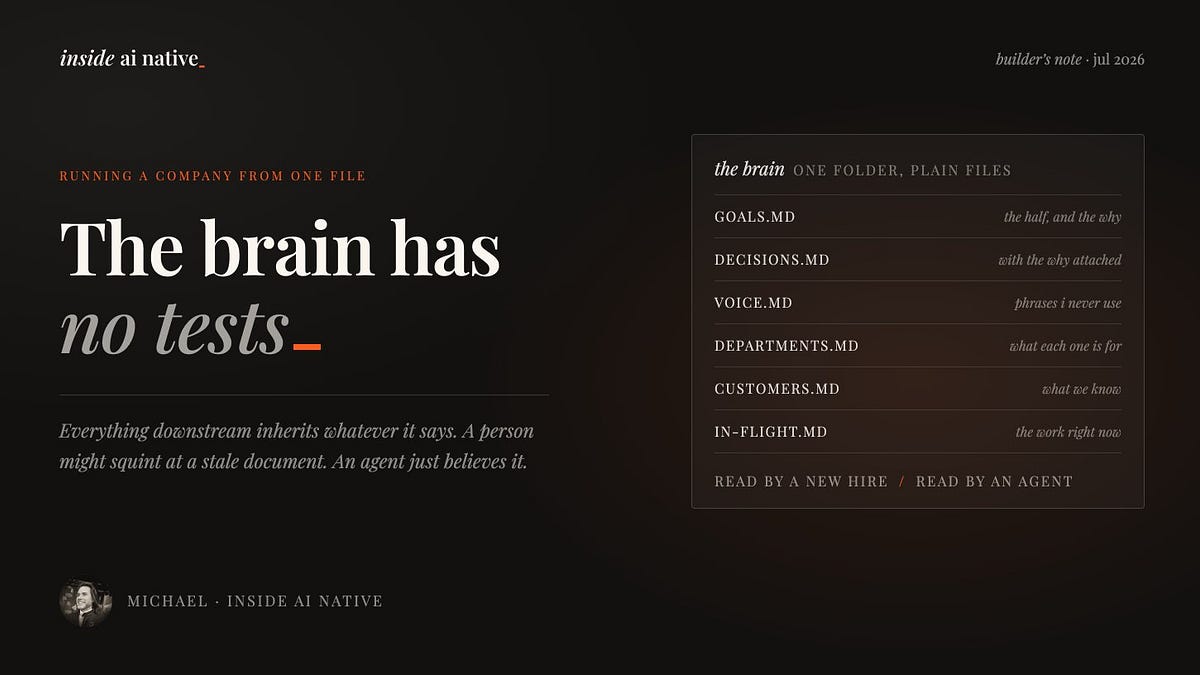
The shared brain in practice: no translation layer, one kind of onboarding, and a new kind of debt.
Most of how our company runs now lives in one written-down place, and the longer we operate this way the stranger it seems that we ever ran companies out of people’s heads. In a normal week I write a decision down once and stop repeating it in meetings, an agent drafting something reads the same goals document a new hire would, and the answer to “what are we doing and why” is a file anyone can open, whether or not they’re a person. The vertigo of being able to build anything, which I’ve written about before, mostly resolved for us into this: one shared picture of the company that everything, human and machine, works from.
It’s less mystical than it sounds. It’s a folder of plain documents. The goals for the half and the reasoning behind them. Records of decisions, written down with the why attached, so nobody has to reconstruct six months later what we were thinking. A profile of how each of us writes, and mine literally includes a list of phrases I never use, which any agent writing under my name reads before it writes a word. What each department is for, what we know about each customer, and the current state of the work in flight. None of it is exotic. What’s different is that it’s the operating copy, not documentation of the real thing happening somewhere else. If it isn’t written there, the company doesn’t know it.
Bringing on a person and bringing on an agent became the same act, which is handing over the brain and letting them read.
The thing I didn’t expect is how much falls out of there being no translation layer. The document that aligns the people is the same document that steers the agents, so nothing gets rewritten into a second format for the machines, and keeping one version true is the whole maintenance burden. Onboarding turned out to be the clearest example: bringing on a person and bringing on an agent became the same act, which is handing over the brain and letting them read. And my own job quietly changed shape along the way, less producing the work, more maintaining and reviewing the written-down place the work runs from. That sounds like a demotion from making things, and it took me a while to see that it’s the opposite, because everything downstream inherits whatever the brain says.
Doc debt used to be a nuisance you cleaned up eventually. When agents run from the docs, doc debt is org debt, and it compounds at the speed of everything reading it.
Which is also the honest cost of running this way: everything downstream inherits whatever the brain says. A person reading a stale document might squint and ask about it. An agent just believes it, and so does the next one, and the error stops being a typo in a file and becomes something your company thinks. We ran into this directly a few weeks ago with our own vocabulary. We’d been using a shorthand for this whole way of operating across our internal docs, and when the term surfaced publicly from someone prominent meaning something adjacent but not quite ours, our documents kept speaking the old usage, which meant everything that read them did too. Fixing it wasn’t an edit, it was a sweep through every live document that carried the term. Doc debt used to be a nuisance you cleaned up eventually. When agents run from the docs, doc debt is org debt, and it compounds at the speed of everything reading it.
There’s no check I can run that tells me the goals document is describing the right goals, or that a decision we recorded eight weeks ago still deserves to be in there steering things.
What I don’t have, and what I’ve come to think nobody has yet, is a way to test whether the brain is right. I can check that output matched a format, that a rule wasn’t broken, that a draft used the phrases I actually use. There’s no check I can run that tells me the goals document is describing the right goals, or that a decision we recorded with full confidence eight weeks ago still deserves to be in there steering things. You can tell the brain is wrong only by what comes out of it, and usually later than you’d like. So the most important documents in our company are the ones with no test to run against them, and keeping those true, reading them the way you’d review work, turns out to be the job now. I’d still rather have this problem than the old one, where the same knowledge lived in nobody’s file and everybody’s head, but I want to be honest that we traded chaos for a different kind of care.