Vercel runs every job on one agent and spins it out, Palantir names the token trap, and Buzz makes the earnings call
📊 We're surveying founders of AI-native companies on how they run: token spend, what they trust with agents, headcount, and the stack. Investors: DM me to get your portfolio in - you'll get and early report and a breakout of how your companies compare.
Every week I write this from inside a company that runs on AI agents, about what we’re seeing in the field. This week the whole-company agent showed up with receipts, and the bill for renting one got a name.
1. Vercel runs on one agent, and it’s becoming a product. Guillermo Rauch posted that Vercel built @v, an internal agent powering “every day-to-day job” - “expert in finance, comms, docs, marketing, engineering, business analytics” - and “growing exponentially both in daily interactions and token use.” His extrapolation, not mine: “One can extrapolate to the day AI agents run entire companies from here.” It’s also being productized: @v is “the basis for the design of” Eve, which he thinks “every company should have.” The best part of the post is the ownership argument: “that’s not your agent, that’s their agent... you being in complete control, from source → runtime → data → token, seems like a pretty big deal to me.” And the open question sits right next to it: @v is “seeded by the skills we gave it” and “constantly improving.” Improving against what definition of good, and who approved the change? The field keeps shipping the agent; the layer that keeps it true still has no name on it.
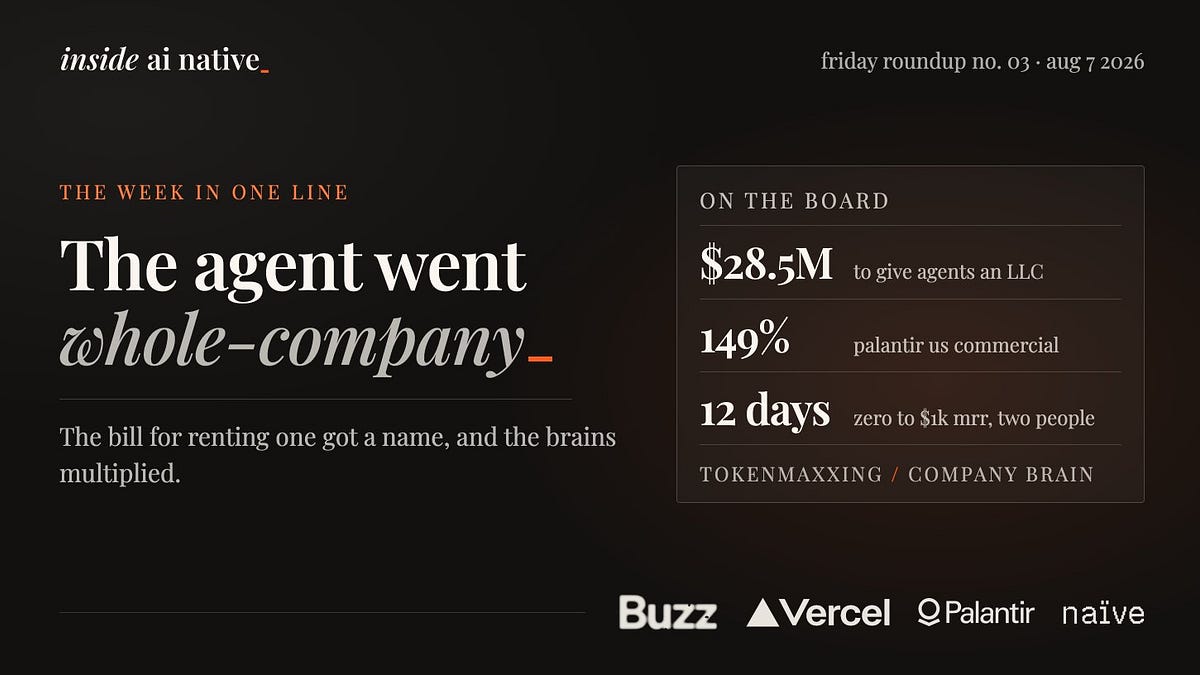
2. Palantir named the trap. On Palantir’s Q2 call (93% growth, 149% US commercial), Alex Karp argued that most enterprises are “token maxing” at their own cost - “transferring their data, their prompts, the way they run their business, their expertise to a third party.” His summary of the deal: they may be paying AI labs to learn what makes their own businesses valuable. The sharper beat came in the Q&A, on what the durable asset is: the alpha “isn’t simply the data... it’s also the metadata, the reasoning traces, the exhaust, the usage... probably more valuable than just the data.” Set his register aside (it runs hotter than mine) and the claim underneath is precise: the compounding asset is the operational judgment a company accumulates by using AI, and whoever holds it holds the business. Watch the word, too: Chamath’s AI-native operating guide used “tokenmaxxing” within days of the call. When two sources that different converge on one coinage in the same week, an anti-pattern is getting named.
3. Buzz made the earnings call. A follow-up to the last two editions: on Block’s Q2 call, Jack Dorsey cited Buzz’s shipping velocity as a highlight - internal product development runs on it with “a very small team,” and he called it a step-change for Block’s core technologies. That’s a stronger signal than launch-week stars: a public-company CEO telling investors the humans-and-agents workspace is material to results. The standing question survives its third week unchanged: a room shows you everything; it doesn’t tell you what’s true.
4. “Company brain” went generic in about two weeks. Hyper, a two-person YC S26 team, branded itself “The Self-Driving Company Brain” and went from zero to $1k MRR in 12 days, landing top-5 on Hacker News and Product Hunt. Supermemory shipped “Company Brain” as a named Slack-native feature that joins conversations with relevant context without being mentioned. And at least half a dozen more vendors published company-brain guides or took company-brain domains this month. When a term goes from contested to everywhere in fourteen days, it stops being a product name and becomes a category - and the category it names is recall. What none of the brains answer yet: what does the company believe, and who approved it?
5. Agents are getting LLCs - and $28.5M just arrived to fund it. Naïve (announced a Series A this week, led by Nexus with YC participating) is building what it calls Autonomous Company Infrastructure: company formation as an API call - KYC, state filing, EIN, spend-capped virtual cards, “a real US company” provisioned like a database - plus compute, a company-wide memory layer, and a research agenda about maximizing work per token. Two details worth holding together: the announcement’s category is autonomous companies - agents that “fully run businesses” - while in their own docs, the CEO-agent orchestration primitives (AgentCEO, AgentStaff, AgentObjectives) sit marked deprecated. The pitch is autonomy; the product that survived contact is provisioning, cost efficiency, and permission gates. Still nowhere in the stack: anything that decides what’s true or what good means. The agent can have an LLC, a card, and a phone number, and no way to know whether its work is right.
6. Quick hits. Ex-OpenAI researcher Gabriel Petersson launched Energy Thursday - a desktop agent that drives your signed-in browser, with a free tier that starts by connecting the ChatGPT account you already pay for (the bring-your-own-subscription pattern reaching consumers). Lilian Weng published “Harness Engineering for Self-Improvement” - frontier-research adoption of “harness” as the word for agent scaffolding that improves itself. The “Gartner Declares 2026 The Year of Context™” post making the rounds is satire (Joe Reis) - which mostly proves “context” vocabulary is now bloated enough to parody. And if you’re building: The AI Conference’s Startup Showdown (SF, Sept 29-Oct 1) closes applications August 14.
That’s the week. The pattern, if you want one: the agent went whole-company, the bill got a name, and the brains multiplied - and every one of those stories turns on the same missing thing. Not more capability: a definition of good the system can check, and someone accountable for changing it. I published my longer answer to exactly that this week in “The Judgment Decorator”: every loop starts with judgment and ends with realignment.