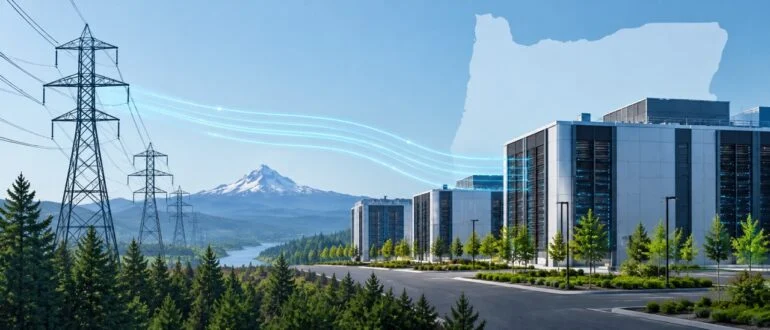
Oregon’s data center industry consumed approximately 23% of the state’s retail electricity sales in 2025, a share that researchers expect to reach as high as 32% by 2030 as AI drives demand for computing infrastructure.
The findings come from a new report by economic research firm ECOnorthwest and the University of Virginia, funded by the Portland-based Lemelson Foundation. The study provides a detailed look at Oregon’s data center industry, including its electricity requirements, employment, property taxes and planned development.
The state hosts 111 data centers occupying approximately 22.1 million square feet. Another 32 facilities, representing 6.9 million square feet, are either planned or under construction.
The rapid expansion is a major challenge for Oregon’s electricity grid, which must accommodate AI infrastructure as well as businesses and residential customers.
Researchers forecast that Oregon’s data centers could consume nearly 25 terawatt hours of electricity annually by 2030, equivalent to the electricity required to power approximately 2.5 million homes. That would represent 31% to 32% of the state’s total electricity demand.
Meeting this requirement will involve not just more generating capacity, but also the transmission infrastructure to deliver electricity to large computing facilities. The challenge is complicated by differences in how data centers operate.
Eastern Oregon hosts most of the state’s hyperscale facilities, which support massive computing operations and tend to maintain consistent electricity consumption. Western Oregon, in contrast, is expected to host a larger share of future development. Its smaller facilities often serve multiple customers that rent computing space, creating electricity requirements that fluctuate throughout the day.
This variation makes forecasting demand difficult for utilities responsible for maintaining a reliable power supply.
Employment and Property Tax Issues
While data centers require vast amounts of electricity and real estate, their direct employment contribution is comparatively modest. Oregon’s data centers employ approximately 2,630 workers. Eastern Oregon, with its concentration of hyperscale facilities, accounts for 2,205 of these jobs. In Morrow County, data centers directly employ more than 10% of the local workforce. (These figures exclude some of the jobs associated with construction and other contractors that maintain data center equipment.)
Oregon’s data center industry, like data centers in states across the country, has benefited greatly from incentives designed to attract large technology investments. Researchers estimated that property tax exemptions awarded the industry ranged from $230 million to $450 million, although incomplete information prevented a more precise calculation.
In 2025, operating data centers paid approximately $60.2 million in property taxes, substantially less than the estimated value of the property tax exemptions.
However, the researchers cautioned that exempted taxes should not automatically be considered lost government revenue. Without the incentives, some facilities might never have been built in Oregon.
The study also identified substantial gaps in available data concerning water consumption and the effects of data centers on surrounding communities. These limitations complicate efforts to evaluate the industry’s full costs and benefits.