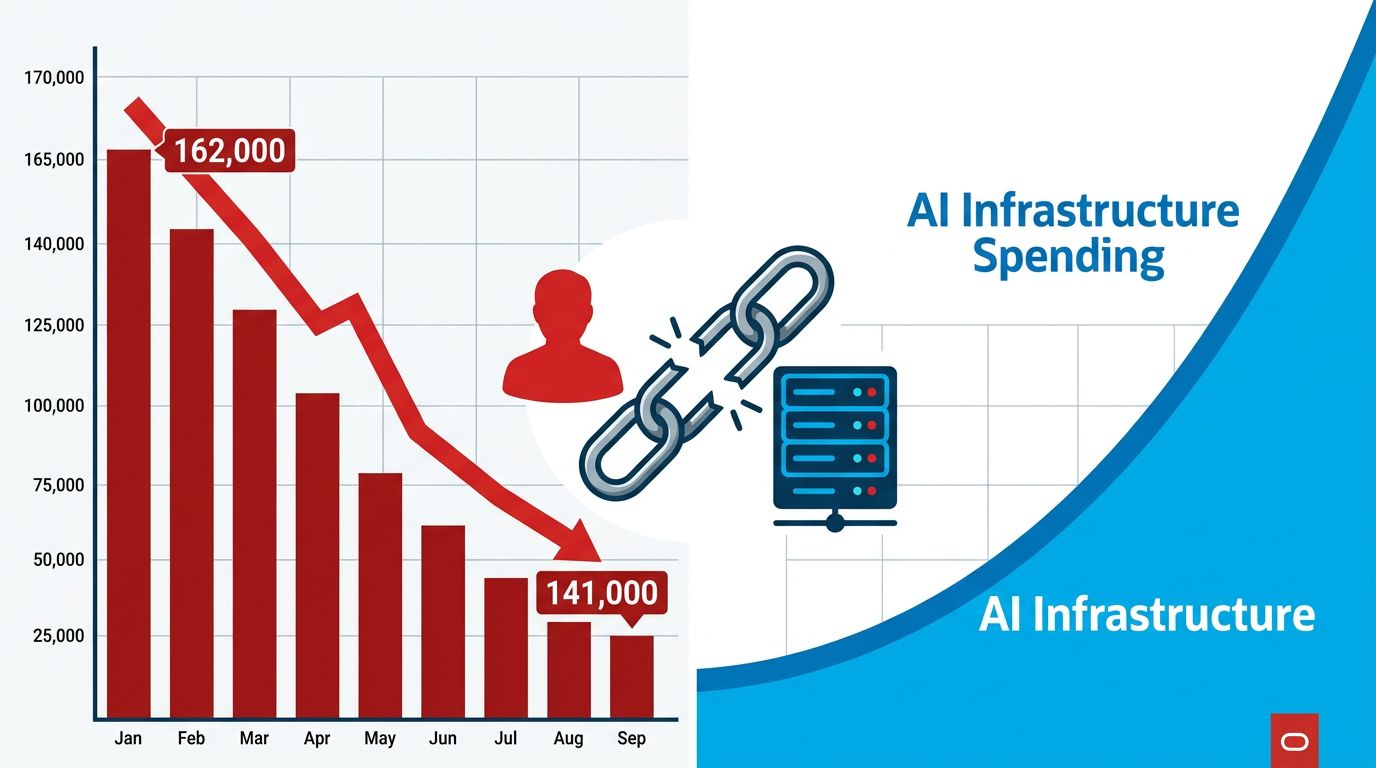
Oracle filed its fiscal 2026 annual report with the SEC on June 22 and included a sentence that no major tech company had ever put in a federal regulatory document: “The adoption and deployment of AI technologies across our operations have resulted, and may continue to result, in reductions to our workforce.” Over the past year, Oracle cut 21,000 employees — 13% of its entire headcount — dropping from 162,000 to 141,000 workers. Oracle is the first publicly-traded tech giant to formally attribute workforce reductions to AI in an SEC filing, and that distinction matters more than the raw layoff numbers.
When Lawyers Sign Off on It #
There is a meaningful difference between what executives say on earnings calls and what goes into a 10-K filing. Annual reports are signed by the CEO and CFO under the Sarbanes-Oxley Act — filing false or misleading material information is a federal crime. When Oracle’s legal team approved the phrase “AI has resulted in reductions to our workforce,” they made a legal declaration, not a PR talking point. Other companies have implied this for years in carefully hedged language. Oracle said it plainly in a document where ambiguity has federal consequences.
The disclosure matters beyond Oracle itself. If regulators treat this as a precedent, other companies citing “efficiency improvements” and “restructuring” could face pressure to disclose whether AI automation is the actual mechanism. The SEC has shown increasing interest in material AI disclosures. Oracle’s filing may have just handed regulators a template for what mandatory transparency looks like.
The Trade: Humans for Servers #
Oracle is not cutting jobs to save money — it is spending more than it ever has. Fiscal 2026 capital expenditure hit $55.7 billion, up 162% from $21.2 billion the previous year, almost entirely directed at AI data centers and cloud infrastructure. Restructuring costs — mostly severance — reached $1.84 billion, nearly five times the prior year’s $374 million. The company borrowed $30 billion in February 2026 to fund the buildout and is projecting roughly $70 billion in capex for fiscal 2027. Free cash flow was negative $23.7 billion.
The bet is explicit: sell humans, buy servers, generate more revenue per employee than before. Cloud infrastructure revenue grew 93% year-over-year in Q4 to $5.8 billion, which makes the math look coherent for now. However, that growth requires sustained enterprise AI adoption to continue at pace. Larry Ellison is betting that the AI spending cycle will not slow before Oracle’s debt comes due — a risk the company has disclosed but not resolved.
Junior Developers Are Already Feeling It #
The impact is not abstract. Stanford University’s Digital Economy Lab analyzed ADP payroll records across millions of workers and found that software developers aged 22 to 25 saw employment fall nearly 20% from the late-2022 peak. Developers aged 30 and older at the same companies saw employment grow 6 to 12% over the same period. The pattern aligns with what AI tools do well: replicating textbook knowledge and routine implementation, which is precisely the work that entry-level developers do.
One concrete example from Oracle: an Austin-based database administration unit of 47 people had its workload replaced by AI-supervised automated systems, leaving three senior architects to oversee the process. The remaining 44 positions were eliminated. Former Oracle senior director of technical writing Cynthia Sloan — a 19-year veteran — described it directly: “This is a job that I was so dedicated to for 19 years and gave everything to — and none of it matters.” As Time reported in April, many of the laid-off workers had spent their final weeks training the AI systems that replaced them. The pipeline implication is serious: developers who will be senior in 2030 need to start somewhere in 2026. If AI eliminates junior positions, the talent shortage compounds in three to five years.
Related:[Ford Rehires 350 Engineers After AI Falls Short in Quality]
Is AI Really the Cause? #
Not everyone accepts Oracle’s narrative at face value, and that skepticism is reasonable. Apollo’s chief economist has argued there is “zero evidence” of macro-level AI job displacement at the economy-wide scale. Oracle also absorbed roughly 28,000 employees from its $28 billion Cerner acquisition — some of these cuts reflect bloated post-acquisition integration more than AI productivity gains. One-third of companies that have replaced workers with AI have reportedly rehired or expressed regret. An ironic detail from Fast Company’s reporting: senior engineers report spending more time reviewing and fixing AI-generated code than they would have spent writing it themselves — the productivity gains may be exaggerated.
None of that, however, changes what is now in Oracle’s SEC filing. Regardless of what actually drove each individual layoff, Oracle’s lawyers approved language attributing workforce reductions to AI in a federal legal document signed under penalty of law. That language exists in the public record and sets a corporate disclosure standard that regulators, plaintiffs’ attorneys, and other companies will all reference going forward.
Key Takeaways #
- Oracle’s 10-K filing is the first formal SEC disclosure by a major tech company attributing layoffs directly to AI — a legal statement with more weight than any earnings call or press release
- The company cut 21,000 jobs while spending $55.7 billion on AI infrastructure — a deliberate substitution of labor for compute at enterprise scale, not a cost-cutting move
- Stanford payroll data shows developers aged 22-25 have already seen nearly 20% employment decline since 2022 — the AI workforce shift is measurable, not theoretical
- The junior developer pipeline problem compounds over time: fewer entry-level positions today means fewer experienced senior developers in 2030-2031
- Whether AI or Cerner integration caused Oracle’s cuts is debatable — what is not debatable is that Oracle’s lawyers signed “AI did this” in a federal filing, and that sets precedent