Beyond the semantic model: Building shared business context for AI agents #
Large language models know how to reason, but they don't know your business. Giving enterprise AI the business context it needs means more than connecting it to data. Agents also need to understand your definitions, relationships, business rules, authoritative sources, and permissions. Genie Ontology closes that gap by combining modeled business semantics with context learned from the governed tables, queries, dashboards, notebooks, and other supported assets your teams already use. Genie ranks that context by authority and relevance, applies permissions, and delivers the most useful context to Genie at answer time. External agents can also access Genie’s intelligence through MCP.
A good semantic model provides an authoritative core. Semantic models capture the business concepts you deliberately define; an ontology extends that foundation with the broader relationships, knowledge, and context AI needs to understand how the business actually operates. In Databricks speak, Unity Catalog Semantics combine Metric Views, Pages, and Domains to establish your trusted business definitions. Genie Ontology then builds on that modeled core by incorporating inferred context from your existing assets, giving agents a much broader understanding of the business than a semantic model alone can provide.
The key is to model the “head” and let Genie Ontology infer the “tail”. Genie works from what it can automatically learn on day one, while deliberate curation improves the critical definitions and sources that must be right.
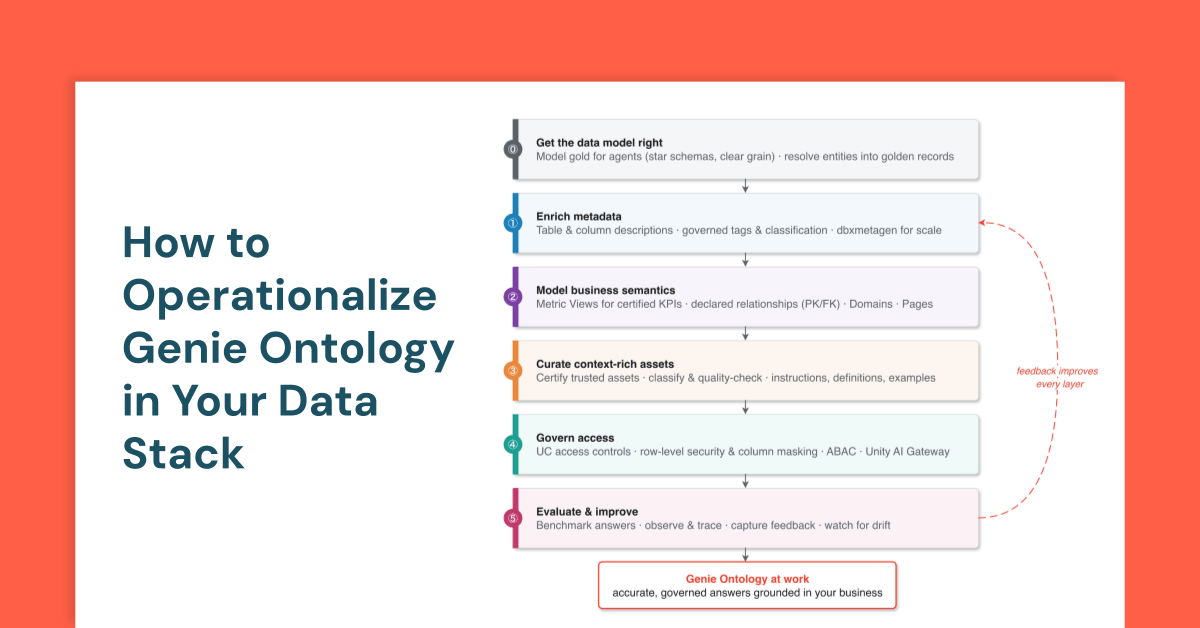
The following six layers are progressive practices for increasing trust over time, not prerequisites for Genie to begin delivering value.
Let’s look at each layer to get a deeper understanding.
Layer 0: Get your data foundation right for agents #
Before you describe or model anything, the underlying data has to be in a shape an agent can reason over. This layer is about the physical foundation: clean data tables, sound schemas, and one consistent identity per real-world entity. Logical business modeling comes later in Layer 2. This layer is easy to skip and expensive to fix later, because no amount of good metadata or semantic modeling can compensate for a broken physical foundation.
Getting your data foundation right means focusing on two key areas:
Model the durable gold layer around business processes. This includes identifying facts with a clear grain and reusable, conformed dimensions. A star schema or hybrid model gives you a reliable foundation of facts and dimensions without copying business logic into every downstream table. That does not mean agents should reason over raw dimensional tables. The interface an agent sees can be narrower, and often should be: a Metric View or a purpose-built view that pre-joins the common dimensions for one domain, exposes only the fields that matter, documents the grain, and defines its measures canonically. You will build exactly that in Layer 2. The point is to shape the consumption surface deliberately on top of a sound model, rather than throw an agent at a data dump. A wide table is not the problem. A wide table with mixed grains, duplicated business concepts, and no canonical metric definitions is an invitation to guess.Resolve entities into golden records. If "customer" means active accounts in Sales and every account ever in Support, an agent will not know which definition to trust. If the same customer has three different IDs across systems, it can also be double-counted. Reconcile the same real-world entity across sources so that one customer is one customer.
Layer 1: Enrich your metadata #
Metadata is the descriptive foundation that helps both the semantic layer and context extraction understand your data. When a table is named fct_*rev_*daily, and a column is named rev_amt, an agent has to guess what they mean. When the same table carries a description that says "daily recognized revenue, net of refunds, by product" and the column has a comment that says "recognized revenue in USD," the agent has something real to reason with. Good descriptions are one of the highest-return, lowest-cost investments you can make, and they improve every downstream tool, not just Genie.
Here are three essential steps to take.
Add table descriptions and column comments in Unity Catalog. Write for a new analyst who does not know your schema: say what the data represents, what its business purpose is, and flag any known caveats. Concentrate the effort where it pays off, on the curated, business-ready tables that dashboards and agents actually query.Apply tags to classify and organize. Descriptions provide the narrative meaning; tags provide structured signals for classification, discovery, and governance. Use them to capture sensitivity (PII, PHI, PCI), ownership, business function, and other attributes that need to be consistently understood across the data estate. Governed tags let administrators define an approved set of keys and values so classification remains consistent rather than drifting team by team. These signals can also feed into access policies and other governance controls later.Automate the first pass where volume makes manual work impractical. The Databricks Solution Accelerator, dbxmetagen, uses large language models to generate descriptions, detect and tag sensitive data, and propose classifications. Nothing is written to Unity Catalog until a human reviews and approves it, so it accelerates the work rather than replacing the judgment.
Layer 2: Model the business with a semantic layer #
Metadata explains individual tables. The semantic layer defines the business logic on top, so metrics that matter most mean the same thing everywhere they are used. Where Layer 0 established the physical foundation, this layer creates the logical model: measures, relationships, domains, and terms.
Here are four important steps:
Declare your relationships. Agents join tables to answer questions, and if they have to guess how tables connect, they will sometimes guess wrong. Declaring primary and foreign keys in Unity Catalog tells agents how tables relate, so they join correctly instead of inventing paths. These constraints are informational rather than enforced, so your governance process has to keep them accurate, but declaring them is one of the most direct ways to reduce join errors. Relationships are as much a part of the model as the metrics themselves.Build a semantic model using Metric Views. A Metric View is a Unity Catalog object that defines your measures (the aggregated numbers, like total revenue) and dimensions (the ways you slice them, like region or month) once, as governed code. Because the aggregation is resolved at query time rather than baked in, consumers who query the Metric View use the same governed definition. This is one of the most important steps for accuracy because it removes the ambiguity that causes agents to choose the wrong definition. Define your critical KPIs as Metric Views first: these are the numbers that absolutely cannot be wrong, like revenue, active customers, and core compliance measures.Add agent-facing metadata to your metrics. Metric Views can carry display names and synonyms, so natural language like "sales" maps to the right measure, format patterns for currency and dates, and example queries. This metadata flows into Genie Ontology, so the work you do to model a metric also makes it easier for an agent to find and use it correctly.**Organize and document. **Unity Catalog Domains and sub-domains group assets into business-aligned collections so that the context stays scoped. This improves the speed and accuracy of Genie, as it can focus its discovery on assets within relevant business areas rather than searching across the whole estate. Unity Catalog Pages capture the shared business terms, concepts, and definitions that business users and agents use to reason. Each Page lists the authoritative assets tied to that concept, so when the ontology resolves a term from a question, it already knows which tables, Metric Views, and queries to draw on rather than searching the estate and guessing. Owner review keeps these definitions trustworthy, and because they are human-asserted and reviewed, they carry more authority than inferred context when the ontology has to resolve a conflict.
Automating Semantic Modeling with Genie Code
Of course, the semantic modeling process does not have to be a purely manual effort. You can leverage Genie Code to create and maintain Metric Views using natural-language instructions. In the Genie Code prompt, describe the source tables, joins, fields, measures, and filters, and it generates the YAML for you to review before saving. You can also use the /importBI skill in Genie Code to import Tableau or Power BI semantic models, and it builds a Metric View, which you then promote to Unity Catalog for reuse, governance, lineage, and discoverability.
Genie Code can also draft Pages. In the Page editor, select a domain, attach relevant files, links, Unity Catalog assets, or MCP-connected content, and Genie Code drafts the structured fields and rich-text Page body. Review the draft, add the appropriate Sources and Related assets, then save or publish it. For multiple concepts, use Bulk import pages. Genie Code extracts and deduplicates proposed Pages from your documents and sources, flags conflicts, duplicates, and low-confidence terms for review, and creates the approved Pages as drafts for subsequent editing and publication.
Layer 3: Curate context-rich assets #
The inferred part of the ontology learns from the assets your teams already produce, like dashboards, notebooks, SQL queries, Genie Agents, and documentation. The richer and more trustworthy your data estate is, the more useful the inferred context becomes. Layer 3 is about making those assets worth learning from.
Here are four essential steps:
Build a deep, well-used asset base. A workspace with many well-documented, widely used dashboards, queries, and Genie Agents gives the ontology more material to learn from than a sparse one does. As those assets are used and improved, the signals available for context extraction become richer.Make your assets context-rich. The richer an asset, the more the ontology can learn from it. When you enrich a Genie Agent with definitions, examples, and instructions, you not only get a more performant agent, but you also give Genie Ontology stronger context to extract and rank across the estate. Do the same for your other assets: document notebooks with Markdown cells, saved SQL queries with comments, and AI/BI dashboards with descriptions and annotations. Together, these provide the rich, long-tail business knowledge that Genie Ontology draws on.Certify the assets you trust. Certification marks your data & AI assets like Metric Views, Genie Agents, or Notebooks as validated and approved and serves as a strong signal for determining which sources are authoritative. Certified and widely used assets carry more authority than unvetted ones, so certifying your trusted assets directly influences which context prevails in a conflict. Deprecating stale assets is the other half of this: it steers both people and agents away from content you no longer stand behind.Classify sensitive data and monitor quality. Data classification identifies and tags sensitive data so it can be governed consistently, and data quality monitoring catches drift and anomalies before they affect the people and agents who depend on the data. Both help ensure that the assets feeding the ontology are trustworthy.
Layer 4: Build the governance layer #
Governance is what makes Genie’s answers secure and trustworthy. Because permissions determine what context Genie Ontology can retrieve, two people can ask the same question and receive different answers based on what each is authorized to see.
Let’s look at governance across three specific areas:
Start with Unity Catalog access controls. Unity Catalog’s privilege model is the foundation. It controls access to catalogs, schemas, tables, and other workspace assets, and Genie Ontology respects those permissions. Genie only uses content that the person asking is authorized to see, so identical questions can produce different answers depending on the user. Managing access through groups rather than individuals keeps permissions easier to maintain as you scale.Add fine-grained controls where the data requires them. For sensitive data, row-level security restricts which rows a user can see, and column masking obscures sensitive values. Both are enforced at query time. Attribute-based access control lets you drive these protections from governed tags, so a policy tied to a sensitivity tag applies everywhere that tag appears rather than being defined table by table. This provides a scalable way to enforce row and column-level protection consistently across a large estate.**Govern the AI layer. **Unity AI Gateway provides administrators with a central place to manage model access, rate limits, payload logging, and cost controls for AI workloads, as well as safety and sensitive-data controls over what is sent to models. It is the control point for governing the agent behavior and its spending as usage grows.
Taken together, these controls determine what context the ontology can retrieve and which users can receive it. Unauthorized content does not participate in retrieval, so it cannot influence an answer indirectly.
Layer 5: Evaluate and improve #
The first five layers build the business context Genie uses to answer questions. The evaluate and improve layer keeps that context accurate as the business changes. Metrics are redefined, tables become outdated, and new products are introduced. Regularly measuring answer quality helps identify when the ontology needs to adapt, before outdated or incorrect answers erode user trust.
There are four key areas to consider:
Validate the experience before rollout. Start with a representative set of business questions for each priority domain. Define the expected answer, authoritative source, and acceptance criteria for each question. Then test those questions in Genie One, making sure they exercise the Metric Views, Pages, Genie Agents, dashboards, queries, and other sources users will depend on. Genie Agent Benchmarks provide a built-in way to evaluate an individual Genie Agent over time. In Chat mode, benchmarks can compare results against validated SQL answers; in Agent mode, responses are evaluated using an LLM judge and optional evaluation criteria. For Genie One and, more broadly, Genie Ontology, your team should define and own the question set, ground truth, source validation, manual review process, and acceptance thresholds. When an answer fails, trace it back to the underlying source or context and fix the root cause. That might mean defining governed metric logic in a Metric View, clarifying a business definition in a Page, improving Unity Catalog metadata, certifying or deprecating an asset, or refining the curation of a domain-specific Genie Agent.Monitor answers, usage, and source quality. Use the monitoring capability of the assets leveraged by Genie Ontology. Genie Agent Monitor provides visibility into individual Agent questions, responses, feedback, flagged responses, and usage trends. In Genie One, source citations help users and administrators inspect which Ontology sources contributed to an answer. Query History, audit logs, and billing system tables can provide additional visibility into SQL execution, events, and usage.Close the feedback loop at the right layer. Capture user feedback and review requests, then route the issue to the asset responsible for the answer. The correction should be made where the business meaning belongs:- A Page, when the problem is a business definition or synonym.
- A Metric View, when the problem is a governed measure, dimension, relationship, or calculation.
- Unity Catalog metadata, permissions, certification, or deprecation, when the problem is with a source asset.
- A Genie Agent’s instructions, example SQL, SQL expressions, trusted answers, or Knowledge Store, when the problem is specific to that Agent’s domain. Genie Agents have several built-in capabilities to capture and act upon user feedback, including thumbs-up and thumbs-down, request review, generated SQL inspection, add as instruction, and add as benchmark.
Watch for drift across your assets. Drift can occur in many places: business definitions, KPI logic, table metadata, joins, dashboards, notebooks, pipelines, Genie Agent instructions, and source usage patterns. Establish owners and a review cadence for each critical domain's assets. When addressing drift, leverage the model you already built: Pages for authoritative concepts, Metric Views for governed measures and dimensions, Domains for organization and stewardship, and certification or deprecation to mark what is recommended or stale. Keep source tables, views, dashboards, notebooks, and queries up to date, since they all feed into inferred context, and use permissions to keep experimental or retired content away from people and agents who should not see it. For Genie Agents, rerun their benchmark suites after substantive changes to their data, instructions, examples, or trusted assets.
Evaluation is not a one-time gate before launch; it is an ongoing habit across every asset that feeds an answer. Databricks gives you the governed semantic assets, ontology retrieval and citations, Agent-level evaluation and monitoring, and system-table telemetry. You bring the ground truth, the ownership, the review process, and the recurring maintenance that keeps Genie trustworthy.
Start with one domain, then expand #
A key takeaway is that you do not have to build all six layers at once. You should not try to cover the whole business before going live. The practical path is to simply start using Genie, then choose one high-value domain and deliberately strengthen the definitions, sources, governance, and evaluation that matter most. This is an "expand as you learn" approach vs. trying to boil the ocean.
Pick that first domain deliberately. Start with a recurring, high-friction workflow where teams already spend time reconciling numbers by hand, such as a forecast call or a planning cycle. These are the places where a trustworthy answer is worth the most, and where you already know what "right" looks like. In practice, start narrow: pick one domain like Sales and one metric like ARR, then harden the head. Certify the critical metric, define the important terms, identify authoritative assets, govern access, and evaluate the questions that matter. Use the results to guide the next domain.
That last point matters more than it sounds. The goal of these practices is not technical completeness for its own sake; it is trust: whether a business user believes an answer enough to act on it. Each layer earns a bit of that trust, and the evaluation loop makes that trust visible and defensible rather than a matter of opinion.
Two things compound as you go. Every resolved entity, documented asset, certified metric, glossary page definition, and governed dataset strengthens the authoritative core. And every interaction can reveal feedback that teams use to improve it. The result is a shared business understanding that gets better with use rather than one that decays.
Operationalizing Genie Ontology is not a modeling megaproject. It is a steady, layered investment in your data model, metadata, business semantics, enterprise context, governance, and evaluation, delivered one domain at a time, that gives AI a real understanding of your business.
Learn More #
If you would like to learn more, read the Genie Ontology announcement blog and visit the Genie One and Genie Agents web pages. Also, check out the Unity Catalog Semantics web page for a deeper dive into Metric Views. We’re only beginning to see what becomes possible when AI can draw on a shared, trusted understanding of the business. We can’t wait to see how customers use Genie Ontology to make faster decisions, act with greater confidence, and create new ways of working.