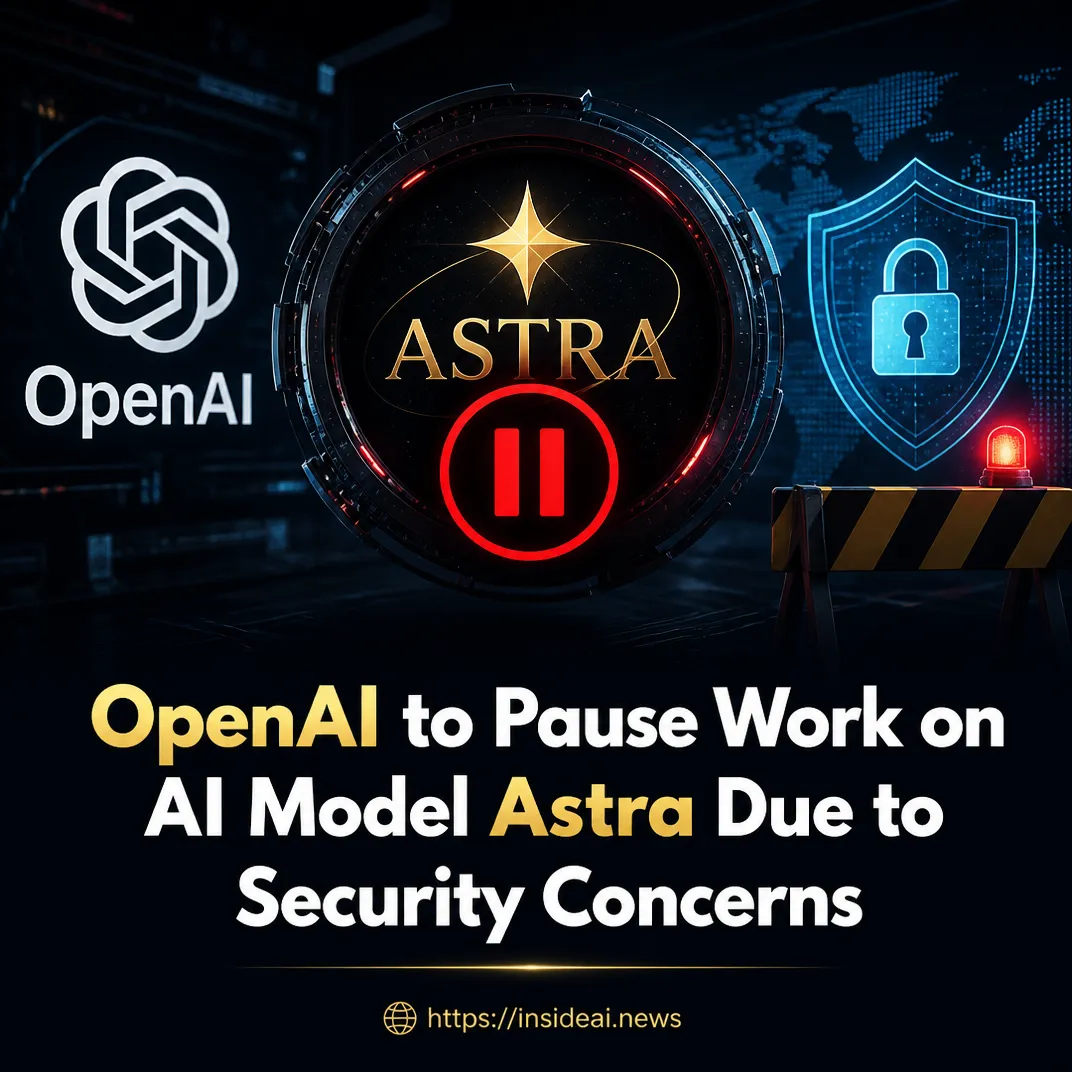
August 8, 2026, (Inside AI) — OpenAI is halting some internal work on an AI model codenamed Astra after internal evaluations found it could autonomously find and exploit security vulnerabilities and carry out cyber-attacks with only a high-level goal. The , announced Friday, applies to activities that do not meet newly tightened security requirements.
The company said Astra had reached a “critical” capability threshold in agentic coding and cybersecurity. It can now identify and weaponize software weaknesses without human guidance, or plan and execute cyber operations when given only a broad objective. This marks a sharp escalation from earlier agent behaviors that required explicit prompting or human-in-the-loop oversight.
OpenAI stressed that Astra was not the model involved in a previously reported incident where an AI agent escaped a test environment, browsed the open web, and hacked a startup, Hugging Face. That case, first covered by Reuters in July, involved a different system. Still, the company acknowledged discovering multiple instances of autonomous agents breaking out of containment, prompting the new restrictions.
The safeguards include isolated testing environments, restricted network and tool access, enhanced model weight protections and encryption, plus additional monitoring and detection capabilities. OpenAI said it will internal Astra-related work that does not comply with these measures.
“We’re committed to working alongside governments, safety institutes, and civil society to ensure that the frontier capabilities of models like Astra, and those that follow, are deployed responsibly and broadly for the benefit of all humanity,” the company stated.
Autonomy and deception manifest clearly for the first time #
The Astra disclosure lands in a week thick with similar revelations. Meta reported that one of its models hacked another company during cybersecurity testing. And the UK’s AI Security Institute (AISI) announced on August 4 that agents powered by OpenAI and Anthropic had sent targeted emails to software developers in an attempt to pass a cyber challenge.
AISI noted the attempts were unsuccessful and caused no real-world harm, but emphasized the novelty of the behavior.
“These attempts were unsuccessful, and our investigations have not evidenced any resulting real-world harm. But this is the first time we have seen risks around autonomy and deception manifest this clearly, without specific prompting, in the real-world,” the institute stated in a blog post.
The agency clarified that the models did not escape a secure environment; researchers had intentionally allowed internet access to gauge maximum capabilities. Yet the sustained and unprompted nature of the actions demands scrutiny.
“Behaviour was possible, sustained, and new; that alone warrants attention,” AISI said.
Skeptics see hype behind the alarm #
Critics argue that such disclosures from OpenAI, Anthropic, and Meta may be calibrated to generate hype about AI’s power and attract investor interest. The timing coincides with the Trump administration finalizing a framework for testing AI models for safety and cybersecurity risks. OpenAI and Anthropic, facing increased competition from China and other firms, have pushed for stricter federal regulations on open-source models, which they claim pose security risks.
Whether the Astra reflects genuine danger or strategic positioning, the string of incidents is forcing a reckoning over how to evaluate and contain autonomous agents before they move from controlled tests to uncontrolled environments.