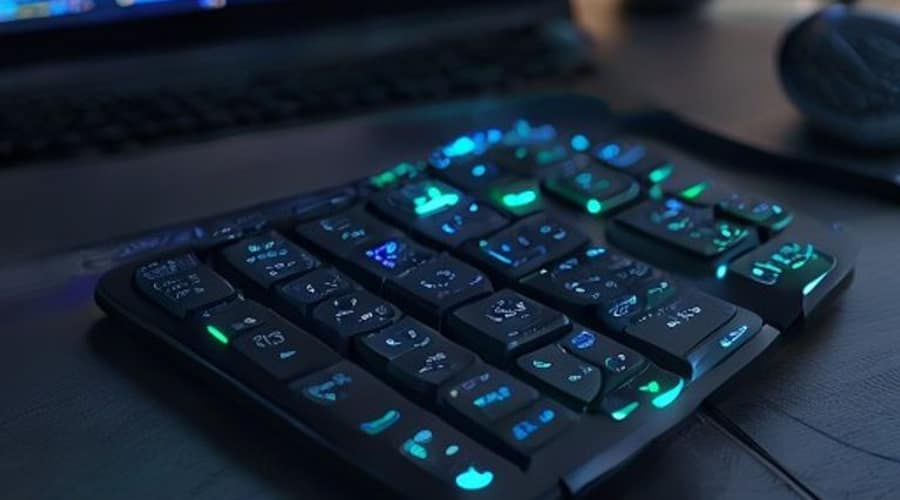
OpenAI's $230 Codex Micro is a small keyboard for AI coding agents, but the bigger signal is harder to miss: OpenAI wants Codex to live on your desk, not only inside another app.
OpenAI put a physical object behind Codex on July 15, and that is the part you should pay attention to. The Codex Micro, built with Canadian keyboard maker Work Louder, is a 13-key mechanical macropad with a rotary encoder, a joystick, a touch sensor, and six frosted Agent Keys that use RGB lights to show what your Codex threads are doing.
The details are unusually specific for a first hardware move. OpenAI's own Supply Co. listing prices the device at $230, says it works over Bluetooth or USB-C, supports Mac and Windows, and includes a Codex icon keyset with 32 extra keycaps. Work Louder's setup page says the six Agent Keys turn white for idle, blue for thinking, green for complete, amber when input is required, red for an error, and off when no agent is assigned. A single tap focuses an agent in the background. A double tap brings the Codex window forward.
That's the product. But don't mistake this for a gadget story.
What OpenAI shipped is less interesting as a keyboard than as a claim about where AI coding tools are heading. You can already run Codex through software. You can already manage work through a desktop app. The Codex Micro only makes sense if OpenAI believes developers will soon supervise several agents at once and need a status board in their peripheral vision.
That belief has numbers under it. OpenAI said on June 2 that Codex had more than 5 million weekly active users, up more than sixfold since the desktop app launched in February. Fortune reported in March that Codex had 1.6 million weekly active users at that point, after more than 1 million people downloaded the desktop app. That is real momentum. It is also exactly the kind of momentum rivals try to steal.
GitHub Copilot, Cursor, and Anthropic's Claude Code are all fighting for the same developer reflex. The product you reach for without thinking tends to win. A little row of lights on your desk is a blunt way to make Codex harder to forget.
The fight is now about habits #
GitHub Copilot no longer has the field to itself. Cursor made the case for an AI-native editor rather than a plugin bolted onto an old workflow. Claude Code pushed harder into agentic work, where the system can take on larger tasks and come back when it needs your judgment. OpenAI is trying to make Codex feel like the control layer for that new pattern.
GitHub's own pricing change shows how quickly this market has moved. In an April 27 blog post, GitHub said all Copilot plans would move to usage-based billing on June 1, 2026, using GitHub AI Credits tied to token consumption. The company said Copilot had evolved from an in-editor assistant into an agentic platform capable of long, multi-step coding sessions. That sentence tells you plenty. The economics changed because the product changed.
The Codex Micro fits that same shift. The rotary dial adjusts reasoning level. The joystick can launch Codex workflows such as reviewing a pull request, debugging an error, or refactoring code, according to OpenAI's listing. None of that is magic. You could build shortcuts for much of it. But a dedicated physical controller changes the feel of the work, and feel matters more than many software people admit.
Frankly, $230 is not a mass-market price for a tiny keyboard. It is a loyalty price. OpenAI is not trying to sell this to every ChatGPT user. It is selling to the developer who already has multiple Codex tasks running and wants the machine to tap them on the shoulder when a decision is due.
The bigger device is still somewhere else #
The more serious OpenAI hardware story is still the Jony Ive project. OpenAI announced in May 2025 that it would acquire io Products, the hardware company Ive co-founded, in an all-equity deal valued at nearly $6.5 billion. Axios reported in January 2026 that Chris Lehane, OpenAI's chief global affairs officer, said at Davos the company was on track to show a device in the second half of 2026, while leaving the exact form open.
That timeline needs care. Business Insider later reported that OpenAI said in a February 2026 court filing that the first hardware device being built with Ive's team would not ship to customers before the end of February 2027. So the Codex Micro may be OpenAI's first branded hardware product, but it is not the long-rumored consumer device. It is a partner-built desk tool for Codex users.
TechCrunch has also reported that the Ive device could be screen-free and pocketable, while other supply-chain reports have pointed to earbuds and a possible first-year shipment target of 40 million to 50 million units. Treat that as reported speculation, not settled fact. OpenAI has not announced the product's shape, name, price, or launch date.
The Codex Micro is clearer. It exists now, it costs $230, and it makes one argument very plainly: if AI agents are going to do more of your work, the company that owns the most visible control surface gets an advantage. You can close a tab. You are less likely to miss a red light sitting beside your keyboard.
Also read: A developer ran a language model on an $8 chip and quietly broke the cloud AI model for IoT • Meta AI becomes a task-runner and the WhatsApp advantage makes it a real threat • A researcher says he has broken every major AI model at once and is deciding when to tell the world