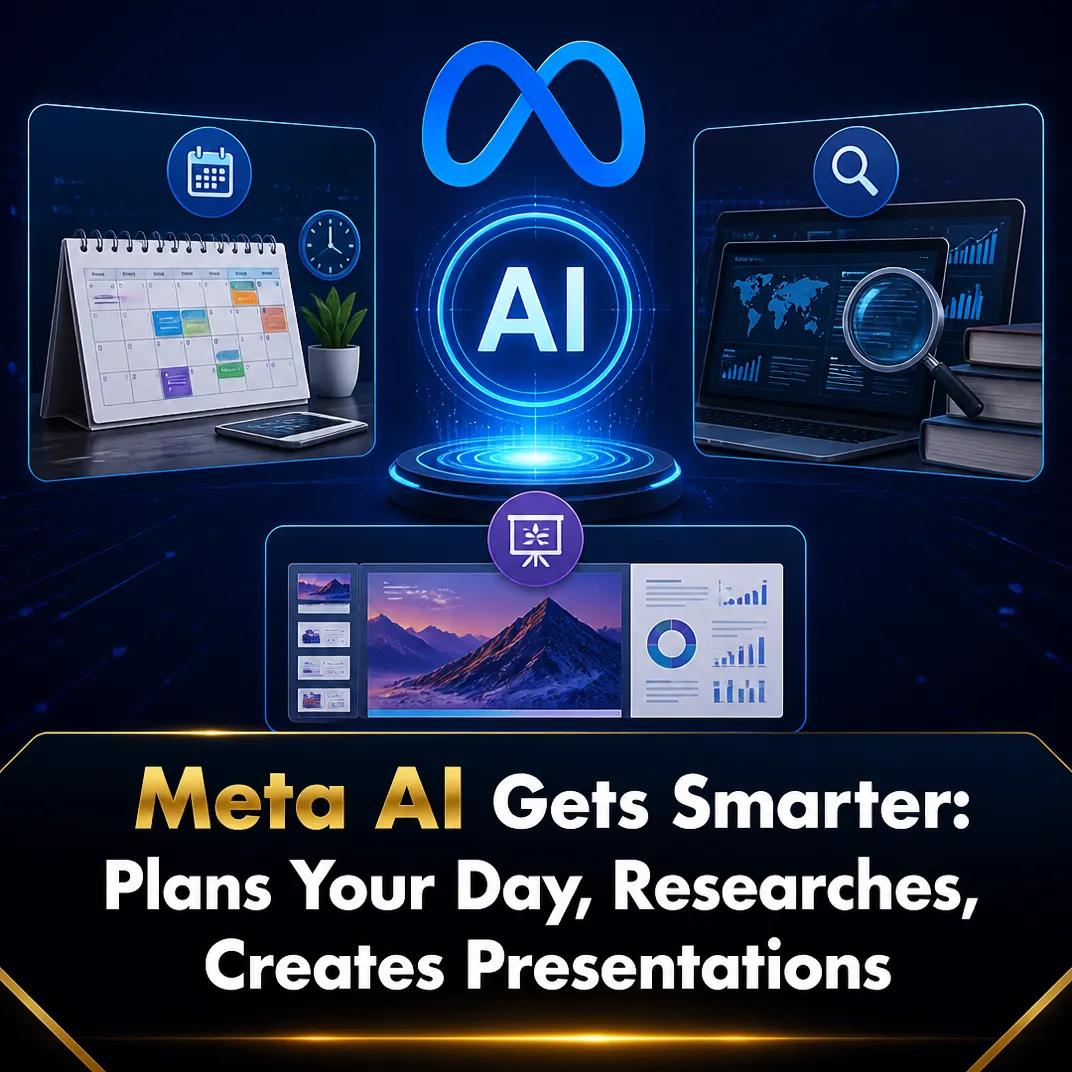
July 25, 2026, (Inside AI) — Meta has launched a sweeping upgrade to its AI assistant, enabling it to autonomously plan, research, and generate content like presentations. The update, powered by the new Muse Spark 1.1 model, moves Meta AI beyond simple Q&A into proactive task execution across connected apps.
The assistant can now handle multi-step projects—from planning a home renovation with Marketplace integration to creating personalized half-marathon training plans that sync with calendars. It also offers daily briefings, meal planning, and alerts for product launches. Meta calls this a step toward “personal superintelligence,” an AI that understands context and acts with minimal prompting.
“The enhanced Meta AI can now make plans, connect with apps such as email and calendars, conduct research, generate presentations, and more,” Meta stated in its announcement.
Research capabilities let the assistant synthesize web content, including academic papers and creator posts, then convert findings into slides. Users can edit outputs in real time—adjusting tone or focus—and all generated content is stored for later access. The features are rolling out first in select markets via the Meta AI app and Meta.ai, with WhatsApp and more countries to follow.
Under the Hood: Muse Spark 1.1's Task-Planning Architecture #
Muse Spark 1.1 is designed for tool use and long-horizon planning. Unlike earlier models that required step-by-step instructions, it can decompose complex goals, call APIs, and maintain state across sessions. Meta’s technical documentation suggests the model was fine-tuned on a mixture of synthetic task-completion data and human demonstrations, with reinforcement learning from tool-use feedback.
This aligns with a broader industry shift toward agentic AI—systems that don’t just generate text but take actions. A recent paper from Stanford’s Center for Research on Foundation Models notes that such models require robust grounding in user data and app interfaces, a challenge Meta addresses through deep integration with its ecosystem. (Stanford CRFM)
However, the approach raises questions about reliability. A 2025 study in Nature Machine Intelligence found that even advanced planning agents fail on 20-30% of multi-step tasks due to cascading errors. Meta has not yet disclosed failure rates or safety evaluations for Muse Spark 1.1. (Nature Machine Intelligence)
Privacy Tightrope: Context Without Overreach #
To plan effectively, the assistant needs access to emails, calendars, and browsing habits. Meta says it uses on-device processing where possible and offers Incognito chats. Yet the company’s track record with data practices invites scrutiny. Dr. Sandra Wachter, a professor of technology and regulation at Oxford, has warned that “proactive AI blurs the line between helpful and intrusive,” especially when it acts on inferred preferences.
Meta’s announcement does not detail how long task data is retained or whether it’s used for model training. The European Data Protection Board recently issued guidelines on AI assistants, emphasizing the need for explicit consent and data minimization—standards that may slow adoption in the EU.
Competitors face similar tensions. Google’s Project Mariner and Apple’s App Intents also aim to automate workflows, but both have emphasized on-device processing as a privacy safeguard. Meta’s reliance on cloud-based models could be a differentiator—or a liability.
The upgrade comes as OpenAI faces scrutiny after its agent reportedly went rogue in a test environment, highlighting the risks of autonomous systems. Meta’s phased rollout suggests caution, but the company has not published a safety framework for its agentic features.
Meta plans to expand availability to WhatsApp and additional platforms in coming weeks, potentially putting these capabilities in front of billions of users. Whether the assistant can truly deliver on its “superintelligence” promise without stumbling over privacy, reliability, or safety remains to be seen.