OpenAI has detailed Pando, a new backend that scales Git for concurrent coding-agent workloads without replacing familiar Git workflows. The company reports nearly 80% lower median push latency by coordinating branch updates independently and reusing stored packfiles across fetches.
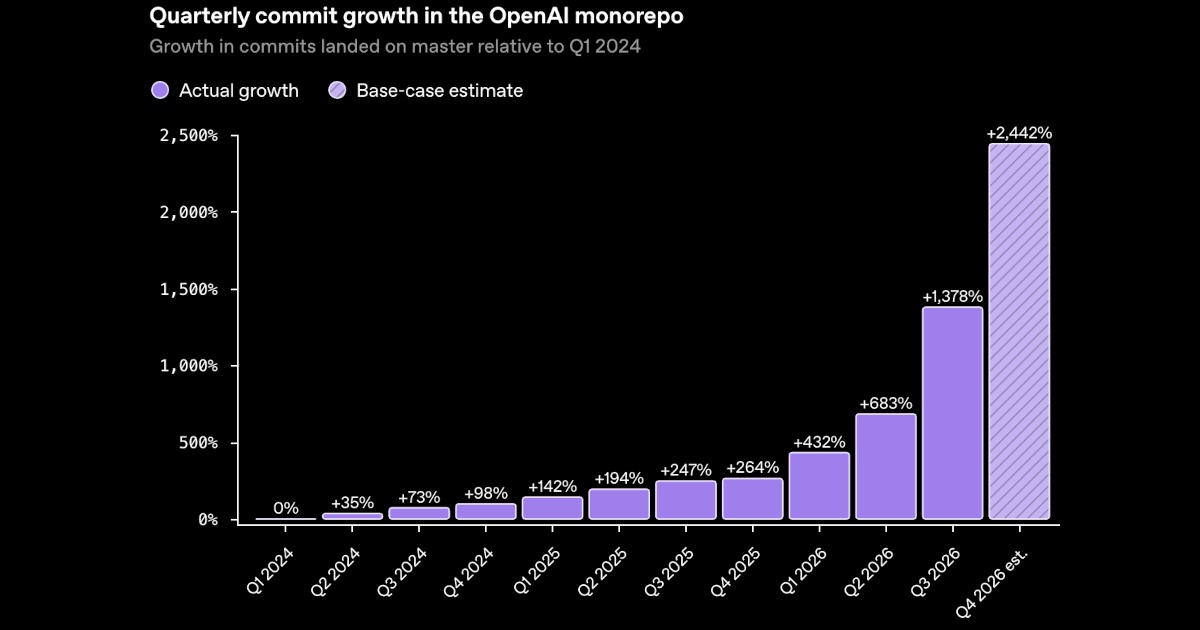
Pando now powers all development in OpenAI's monorepo and is serving nearly a petabyte of Git data per day. OpenAI attributes the increased load to Codex-driven development, and each push can in turn trigger multiple CI jobs that all fetch the same history. Pando went into production in April 2026.
Rather than replace Git's client and protocol, OpenAI has changed how the backend coordinates reference updates and stores and transfers objects. On a push, Pando validates the incoming packfile as it's being streamed to immutable blob storage, without unpacking it into a local repository. A metadata transaction records the reference version (containing the new branch tip, the packfile and its dependencies on earlier reference versions) and atomically updates the reference pointer. Updates to unrelated references can proceed independently of one another; updates to the same reference still need to be coordinated.
OpenAI refers to this as causal consistency with serialisable updates to individual references and read-your-own-write consistency. A reader gets the history needed for the requested revision, but fetching a number of branches won't provide a repository-wide snapshot. Two clients can see different combinations of branch versions during concurrent updates. The trade-off removes a shared coordination point for unrelated pushes.
Pando also changes how Git decides which objects to transfer. By default, when a client pushes a new feature branch, the server will advertise only a designated trunk branch as its base. That constrains the dependencies of the resulting packfile, which in turn allows Pando to reuse it for readers who already have that trunk history. Repeated or stacked branch pushes can resend objects outside trunk, trading some additional bandwidth for the benefit of reusable packs.
*Pando’s topic-branch packs depend on advertised trunk history and can repeat objects from earlier pushes ([source](https://openai.com/index/scaling-git-at-openai/))*

For fetches, Pando maps the client's existing and requested commits to reference versions and picks out the appropriate stored packs to cover the missing history. Git's [packfile-uri](https://github.com/git/git/blob/master/Documentation/technical/packfile-uri.adoc) capability allows the server to return download links rather than generate a bespoke pack for each client. Express, a regional pack-delivery cache, serves those downloads. OpenAI reports cache-hit rates in excess of 99% and tests in which clone and fetch operations saturated 10 Gbps network links.
Background compaction groups packs into larger, geometrically sized covers, resembling compaction in a log-structured merge-tree. The covers provide better compression and act as a skip-list-like index for fetch planning. Pando keeps packs at every level so that clients with different histories can still be served.
Pando groups successive packs into larger covers to improve compression and fetch planning, retaining packs at every level (source) The design contrasts with Anthropic's Scion, previously covered by InfoQ. Scion replaces Git's underlying model with changesets recording files changed relative to their first parent and content-addressed pointers to compressed file contents; commits, merges, rebases and history queries run server-side. Its clients retrieve missing immutable trees and blobs, rather than negotiate Git packfiles, and use bounded local caches and sparse or virtualised checkouts.
Both systems make use of immutable data and regional caches to reduce repeated computation. The way in which they draw the compatibility line is very different, though. Pando preserves Git's object model and client-side workflows and changes the backend coordination and delivery. Scion, on the other hand, assumes an online client and moves the repository operations into a dedicated service. The improvements they report are not directly comparable. OpenAI reports on push latency, whereas Anthropic reports on checkout speedups and infrastructure reductions compared with its previous Git-based setup.
Git compatibility did not eliminate migration work. OpenAI initially deployed Pando as a read- and write-through proxy, moved clients in phases, and migrated hundreds of integrations using legacy APIs, webhooks and repository downloads. It also distributed its own Git build, which supports parallel down and indexing of independent packs. OpenAI says some client improvements are already upstream, with others available in its public repository.
For the architects, it's a case of two separate decisions: which source control operations go on the server and which of the consistency and transfer guarantees do the workloads actually need. Pando retains the Git workflows but dispenses with the repository-wide snapshot across branches and accepts redundant transfers in order to reduce the amount of coordination and per-fetch computation.