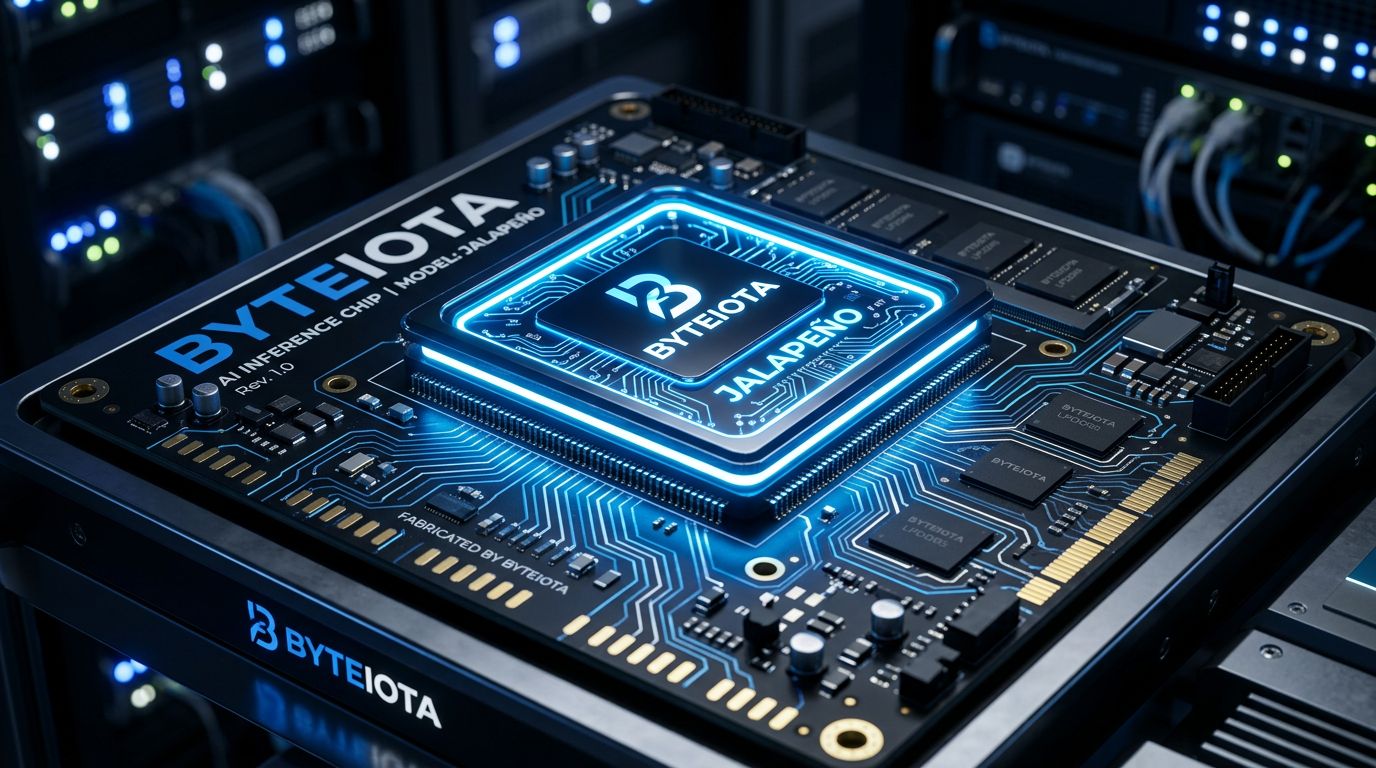
OpenAI just unveiled its first custom AI chip — and the name, Jalapeño, is the most understated thing about it. Built in nine months alongside Broadcom on TSMC’s 3nm process, this purpose-built inference ASIC arrived on June 24 with a headline claim that will get every developer’s attention: 50% lower cost per inference token than current Nvidia GPUs. The actual story is more nuanced than that number — and for developers who rely on OpenAI’s APIs, the nuance matters more than the headline.
Why a Purpose-Built Inference Chip Is a Different Beast #
Most coverage of Jalapeño frames it as an Nvidia challenger. That framing misses the point. Nvidia GPUs are general-purpose accelerators: they run training, simulation, graphics, scientific computing, and inference. That flexibility is valuable — and for research and training, it’s irreplaceable. But LLM inference doesn’t need that flexibility. It needs one thing done extremely well: moving data as efficiently as possible through matrix multiply operations, billions of times per day.
LLM inference is memory-bandwidth-limited, not compute-limited. General GPUs waste substantial silicon area and power on capabilities that go unused during inference. Jalapeño’s systolic array architecture was designed around this insight from the ground up: minimize data movement, maximize utilization for the specific math LLMs actually perform. Eight HBM3e stacks sit on a silicon interposer alongside a ~840mm² compute die — close to the physical limits of EUV lithography — to keep data paths short and utilization high. The result, if the benchmarks hold, is an ASIC that runs inference at meaningfully lower cost and power than a general-purpose GPU.
The 50% Claim: Take It Seriously, Not Literally #
Broadcom CEO Hock Tan told Reuters and Bloomberg that Jalapeño delivers performance on par with Nvidia Blackwell chips and Google TPUs, at roughly 50% lower cost per inference token. That number is worth taking seriously — and worth interrogating.
The phrase “current-generation GPUs” is doing a lot of work in that claim. It could mean H100s (two generations old), H200s, or the latest Blackwell B200s — a deliberately flexible target. The benchmarks are internal, from pre-production lab samples. Independent verification won’t arrive until Broadcom publishes its technical report later this year. Nvidia stock barely moved on announcement day — down 0.26% — which suggests the market understands the nuance.
But here’s the thing: the number doesn’t have to be exactly 50% to matter. If Jalapeño handles 20–30% of OpenAI’s internal inference load at even 25% lower cost, that’s hundreds of millions of dollars in annual savings. At OpenAI’s scale — running ChatGPT, Codex, and the APIs for millions of developers — infrastructure unit economics determine what gets built, how aggressively it gets priced, and how fast the next model generation ships.
What Changes for Developers (And When) #
In the near term: nothing visible. There will be no ChatGPT setting to run on Jalapeño. The chip is internal infrastructure, not a product. API consumers will see the same pricing, the same latency targets, the same model lineup.
Medium term is where this gets interesting. The pattern since 2023 has been consistent: when OpenAI’s infrastructure costs drop significantly, cheaper models appear within 6 to 18 months. GPT-4 to GPT-4o, GPT-4.1, and GPT-5.4 Nano all reflect a cost curve that bends downward as compute gets cheaper. Jalapeño is the fuel for the next bend. Expect that to show up in API pricing — not announced as “because of Jalapeño,” but reflected in new model tiers and lower token costs as the chip ramps through 2027 and 2028.
Engineering samples are already running GPT-5.3-Codex-Spark in the lab. That’s a concrete signal the chip is close enough to production-ready to handle real workloads.
The Part Worth Pausing On: AI Designed Its Own Hardware #
The nine-month development timeline — from initial design to tape-out — is described by Broadcom as potentially the fastest ASIC development cycle ever in high-performance semiconductors. That speed came partly from OpenAI using its own GPT models to accelerate parts of the chip design and optimization process. The same models Jalapeño will eventually serve helped engineer the hardware it will run on. That’s not a cute marketing detail; it’s evidence that AI-assisted hardware design is a real capability with compressing timelines the industry is still catching up to.
OpenAI Joins the Custom Silicon Club #
Google has TPUs. Meta has MTIA. Microsoft has Maia. Amazon has Trainium. Now OpenAI has Jalapeño. Every major AI hyperscaler now builds its own inference silicon.
| Company | Chip | Primary Use |
|---|---|---|
| TPU Ironwood (v7) | Training + inference | |
| Meta | MTIA 300 | Ad ranking inference |
| Microsoft | Maia 200 | Azure inference |
| Amazon | Trainium 3 | Training |
| OpenAI | Jalapeño | LLM inference only |
The pattern across all of them is identical: inference at hyperscale is too expensive to outsource indefinitely. When you’re running billions of queries per day, owning the inference substrate is a structural cost advantage that compounds over time. For developers, the good news is that this cost reduction will eventually flow through to API pricing. The less comfortable reality is that vertical integration deepens lock-in. The more of the stack OpenAI owns — models, infrastructure, silicon — the higher the switching costs become for developers who’ve built deeply against the API.
Jalapeño isn’t available to buy, deploy, or benchmark independently. What it is: the clearest signal yet that OpenAI is building a vertically integrated AI stack, and that the era of simply renting Nvidia compute is ending for any company at hyperscale. For developers, that’s worth paying attention to — even if the 50% number turns out to be 30%. TechCrunch has more on the strategic context.