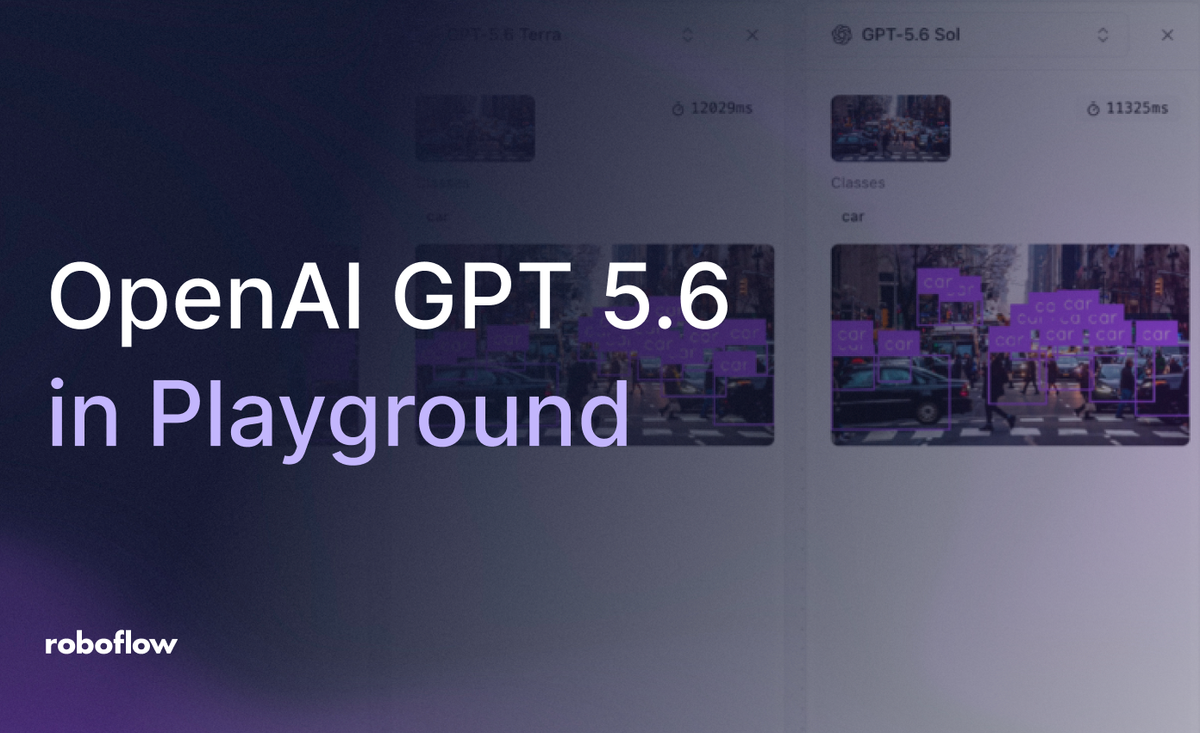
OpenAI's GPT-5.6 family launched today with three tiers: Sol for maximum reasoning, Terra for balanced everyday work, and Luna for high-volume, low-latency tasks. All three are now available in the Roboflow Playground, where you can drop in your own images and prompts and compare up to five zero-shot models at once.
OpenAI's GPT-5.6 model family (Sol, Terra, and Luna) launched today, July 9, 2026, and all three models are now available for testing in the Roboflow Playground.
Sol, Terra, and Luna are three trade-offs between cost, speed, and accuracy. Sol is the most capable and most expensive; Luna the fastest and cheapest; Terra in between. All three are better at operating software directly, and at catching visual problems in rendered interfaces, and all three support Programmatic Tool Calling, where the model writes code to run a sequence of tool calls and filter the results, instead of routing every intermediate result back through the model.
Here's what each model does, what OpenAI's launch benchmarks assert, and how to evaluate all three against your own visual data today.
OpenAI GPT-5.6 for Vision: The Lineup at a Glance #
According to the OpenAI, the token infrastructure pricing breaks down as follows:
| Model / Tier | Input Cost (per 1M tokens) | Output Cost (per 1M tokens) | Core Operational Focus |
|---|---|---|---|
| GPT-5.6 Sol | $5.00 | $30.00 | Frontier flagship; specifically deep reasoning & long-horizon tasks |
| GPT-5.6 Terra | $2.50 | $15.00 | Enterprise workhorse; balanced cost/intelligence |
| GPT-5.6 Luna | $1.00 | $6.00 | Low-latency edge; ultra-fast high-volume streaming |

### GPT-5.6 Sol:
Sol is engineered for maximum accuracy, deep contextual understanding, and long-horizon tasks. OpenAI reports SOTA results across coding, knowledge work, and science. This is all while maintaining superior token efficiency compared to competing frontier models.
Ultra Mode: Sol can automatically coordinate multiple subagents across parallel workstreams (four agents by default) to finish complex, multi-file tasks faster than a single-agent architecture.Max Reasoning Effort: Sol is currently the only tier that unlocks a dedicated variable computation setting, giving the model maximum time to think through hardened tasks.
| Sol highlight | Why it matters |
|---|---|
| Frontier reasoning | OpenAI reports a 13.1-point lead over Claude Fable 5 on Agents' Last Exam |
| Visual and design judgment | Catches visual and functional issues in interfaces and inspects rendered results |
| Programmatic Tool Calling | Filters intermediate tool data in code, cutting round trips and token usage |
Test GPT-5.6 Sol in Playground
GPT-5.6 Terra:
Terra serves as the optimal spot between price, performance, and speed. This is all while getting strong results on everyday work, without the same prices as Sol.
The Standout Metric: OpenAI's launch data highlights Terra scoring just above Anthropic's flagshipClaude Fable 5on the Coding Agent Index, finishing complex tasks in roughly 1/3 of the time at ~1/16th of the operational token cost.
| Terra highlight | Why it matters |
|---|---|
| Automated workflows | Reliable reasoning steps in multi-stage visual or text pipelines |
| Cost efficiency | Frontier-level output at a fraction of flagship pricing |
| General image and data understanding | Tagging, classifying, and summarizing standard inputs at scale |
Test GPT-5.6 Terra in Playground
GPT-5.6 Luna:
Luna is built for high-volume, real-time work where speed and cost matter most. It skips the heavy reasoning steps to answer fast.
Despite being the smallest model in the family, OpenAI reports Luna outperforming Opus 4.8 on key benchmarks in about 1/3 the time, using half as many output tokens.
| Luna highlight | Why it matters |
|---|---|
| High-volume triage | Sorts thousands of frames, documents, or data points per minute |
| Edge deployments | Fits scenarios where compute, time, and bandwidth are constrained |
| Simple extraction and counting | Fast presence/absence checks and structured extraction |
Test GPT-5.6 Luna in Playground
Test OpenAI GPT-5.6 on Your Own Data #
Public OpenAI benchmarks only indicate how models behave on curated evaluation sets. The only benchmark that genuinely dictates your deployment success is how they perform on your data. However, you can evaluate these models right now using the Roboflow Playground. The Playground removes the setup cost of provisioning APIs, letting you drop in your custom images, text, and prompts to compare outputs side by side. You can select up to five zero-shot models at once.
Load up Sol, Terra, and Luna alongside existing foundation models like Claude Fable 5 and Gemini to see exactly how they handle your data and witness real-world capability versus economic trade-offs in real time.
Cite this Post
Use the following entry to cite this post in your research:

[Aarnav Shah](https://blog.roboflow.com/author/aarnavshah/). (Jul 9, 2026).
OpenAI GPT-5.6 (Sol, Terra, and Luna) for Vision: Now in Roboflow Playground. Roboflow Blog: https://blog.roboflow.com/openai-gpt-5-6-sol-terra-and-luna/