OpenAI made its Decisions API generally available on October 22 — a classification endpoint built on GPT-6 Luna that returns typed answers in 100–180 milliseconds. This is not a general language model. You give it a finite list of possible answers and it picks one, which makes it purpose-built for content moderation, request routing, and the per-step decision-making inside agent loops.
Three Things You Can Ask It #
The API exposes three question types. A predicate question returns a probability between 0 and 1 — useful for yes/no conditions like “does this image contain source code?” A choice question selects one option from a developer-defined list and returns per-option probabilities alongside a confidence score. A score question rates an input against a rubric of 2–10 ordered levels and returns the probability-weighted average.
Each request goes to POST /v1/decisions with the model set to gpt-6-luna. You define up to 400 questions per request. Inputs can be text, JSON, or images — passed as base64 or a public URL. The response is an answers array keyed by the developer-assigned question name, not prose.
The Speed Numbers #
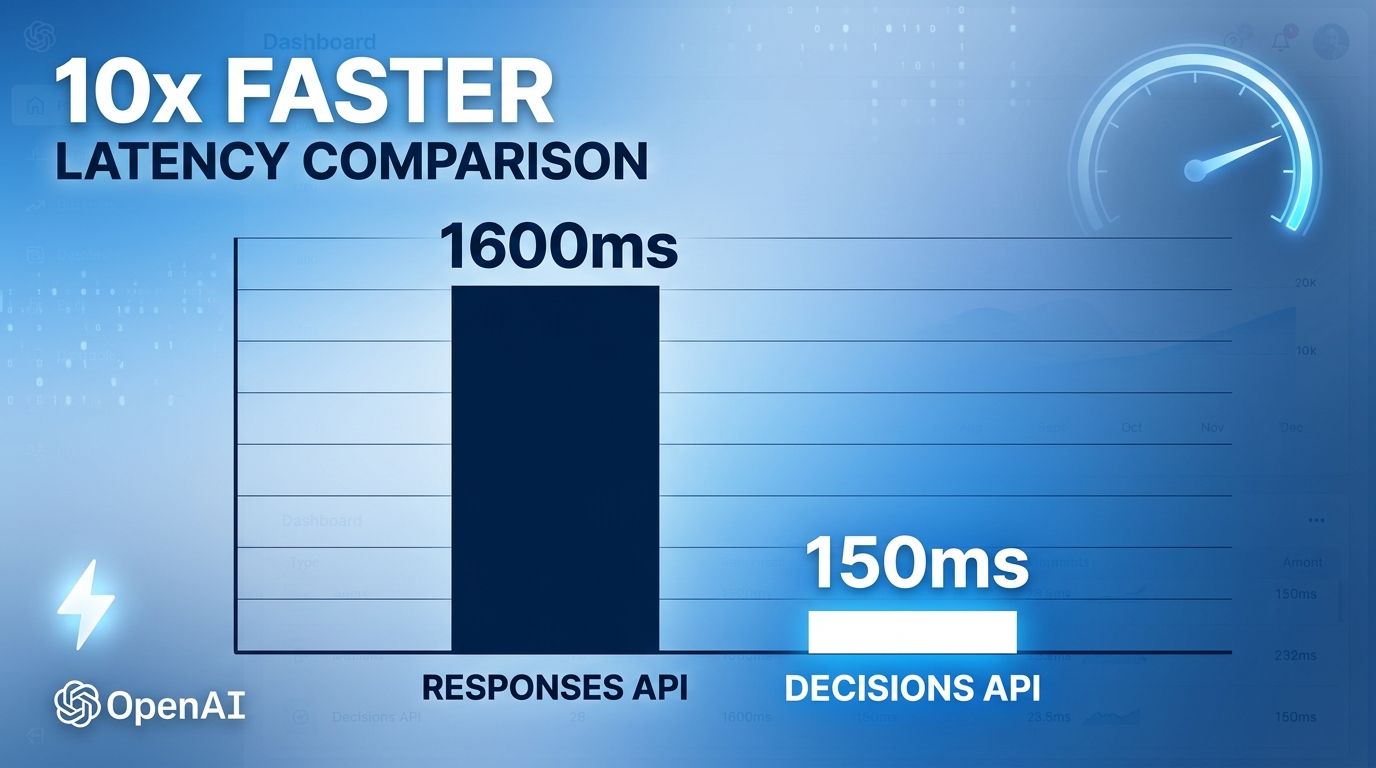
A standard Responses API call to GPT-6 Luna runs 1–3 seconds. The Decisions API runs at 100–180ms. OpenAI’s own DevDay slide put it at 150ms versus 1,600ms — roughly a 10x improvement.
In production, Speak (the language learning app) replaced a model call with the Decisions API and cut time between actions from 1.4 seconds to 0.13. That is a 10.8x speedup on a real user-facing interaction. When your agent needs to make dozens of routing decisions per task, that difference accumulates fast.
Where It Fits in Agent Architecture #
The pattern the Decisions API is built for has a name: planner-executor. A capable frontier model does the planning — breaking down a goal, deciding strategy, handling ambiguity. Then a fast, cheap model handles the per-step routing: which tool to call next, which queue to send this to, whether a condition is met.
The Decisions API is designed for that executor role. This separation matters because it lets you control costs and latency independently. The expensive model runs infrequently; the fast model runs constantly. Until now, developers had to approximate this with JSON schemas and post-processing. OpenAI is making it a first-class endpoint.
The Price and the Comparison You Need to Make #
The Decisions API costs $0.10 per million input tokens. TypeSafe Jev — the incumbent that OpenAI is clearly positioning against — costs $0.042 per million input tokens. Jev also offers free output tokens. At scale, the difference is not trivial: 1 million 500-token classifications cost about $50 with OpenAI versus $21 with Jev.
Where OpenAI wins is image inputs. Jev is text-only. If your classification task involves screenshots, product photos, or documents with visual content, the Decisions API is the only option in this category. For pure-text routing, Jev is still faster and cheaper — developer benchmarks put Jev’s P50 latency at 210ms versus OpenAI’s 100–180ms range, with better accuracy on judgment-heavy text tasks.
This is not a knock on OpenAI’s launch. It is a market that is expanding quickly — MarkTechPost counted 20 Jev alternatives as of October 17. More competition means better tools, and OpenAI entering validates the category TypeSafe built.
One Limitation Worth Knowing #
There is currently no caching for the Decisions API. For high-volume classification with repeated or similar inputs, that will matter. OpenAI says caching may come later, but it is a real gap compared to caching-friendly setups on the Responses API.
Who Should Test It First #
If you are building agent workflows and classification is a bottleneck, the Decisions API is worth a direct test. The official documentation has the request schema and question type reference. For a hands-on walkthrough, DataCamp’s tutorial covers the three question types with working examples. If you are comparing it against Jev specifically, Firecrawl’s benchmark breakdown has the data you need. The GA pricing is live; TechCrunch’s coverage has the full product timeline.