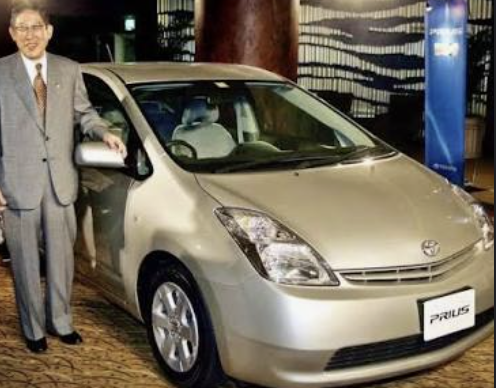
Support CleanTechnica's work througha Substack subscription,on Patreon, oron Stripe. Help us produce all of thehigh-quality, original content we publish week after weekdespite the challenges of content-scraping AI, antisocial media, inflation, and other hurdles.THE automotive world lost a visionary on August 8. Hiroshi Okuda, the former chairman of Toyota Motor Corporation, who passed at 93, was the first outsider to break the Toyoda family’s grip on the company. But his true epitaph is this: he was the ruthless pragmatist who dragged a reluctant, manufacturing giant into the modern global era. Under him Toyota began to innovate again, retire from complacency and, in doing so released an unproven technology in a hybrid called the Prius.
I was at the Tokyo Motor Show in 1997, a guest of Honda, but I just had to sneak into the Toyota booth to see this curious contraption they called a hybrid. Back then the only other hybrids I knew were trains, but Okuda, just fresh from taking over the helm of Toyota from Tasturo Toyoda who was forced to step down after being hospitalized and suffering from health complications, widely reported as a stroke. At least that was the buzz at least during the 1995 Tokyo Motor Show when a Filipino journalist asked about the whereabouts of Tatsuro-san, son of company founder Kiichiro Toyoda.
Okuda in the Philippines
When Okuda became president of the Toyota Motor Corporation in 1995 his deep financial and operational expertise allegedly gave him the edge. He worked in the Philippines for Toyota Japan’s local partner Delta Motors Corp. in the 70s a few years after Martial Law was declared. He was sent to the country, allegedly as a debt collector, and effectively as a demotion because he had an altercation with his boss.
The Philippines proved crucial for his career. It is some sort of urban legend that he crossed a mountain to talk to leftist rebels who were supposedly opposing the setting up of a Toyota factory in Manila but the only Toyota factory had in the 70s until the late 90s was in the middle of the city in a place called Parañaque.
Rising through the ranks after joining the company in 1955. His appointment marked a strategic transition, making him the first executive outside the founding Toyoda family to lead the automaker in 28 years.
Waking up a giant
When Okuda took the presidency in 1995, Toyota was a classic case of success breeding stagnation.
Its domestic market was shrinking, its leadership was a closed loop of local elites, and its global footprint lagged far behind its ambition. More dangerously, the company had grown fat on its “lean” reputation, confusing process perfection with strategic vision.
His first act was to wage war on this complacency. He dismantled the seniority-based promotion system, shoved younger managers into power, and ordered the construction of factories in the United States, Europe, and China, transforming Toyota from an exporter into a truly multinational manufacturer. He even closed domestic plants, a sacrilegious act that sent shockwaves through Japan’s corporate culture.
But his most consequential decision was not about factories; it was about faith in an unproven technology.
The Prius ultimatum
In the mid-1990s, a small internal team was tinkering with a project called “G21” a car for the 21st century. Their idea was a hybrid powertrain, combining a gasoline engine with an electric motor. At the time, this was considered a technological sideshow. Gas was cheap, American rivals were doubling down on V8s, and most Toyota engineers viewed the project as an expensive, low-margin distraction. The team estimated they could have a production-ready car by 1998.
Okuda flatly rejected that timeline. In a meeting that became company legend, he demanded: “Can you do it in 1997?”
When the team hesitated, he made it clear this was not a request but an order. His logic was brutally simple and politically astute. The Kyoto Climate Conference was scheduled for December 1997, where the world’s nations would gather to forge a landmark agreement on reducing greenhouse gas emissions. Okuda saw an unmissable opportunity: Toyota could debut the world’s first mass-produced hybrid vehicle on the exact same global stage where humanity was confronting its carbon future. The Prius would not just be a car; it would be a statement, a tangible answer to the climate crisis, and a powerful symbol that Japanese industry was leading the way.
He understood that the 21st century would belong to efficiency, and Toyota needed to own that future before anyone else. The Prius was not merely a product; it was a disruption of Toyota’s own conservative DNA, a declaration that the company would define the next era rather than follow it.
The impossible?
By forcing the launch a full year ahead of schedule, Okuda subjected the engineers to near-impossible pressure.
They had to reinvent battery management systems, power control units, and manufacturing processes from scratch, all while the rest of the industry scoffed. When the first Prius rolled off the line in December 1997, just days after the Kyoto Protocol was adopted, it was dismissed by critics as a glorified science experiment. But the timing was deliberate and masterful. Okuda had positioned Toyota at the very center of the global conversation about sustainability.
History proved him devastatingly right. The Prius became the flagship of Toyota’s green revolution, establishing a technological moat that competitors spent two decades trying to cross. Today, hybrid technology is the profit engine of the entire group, and the Prius’s DNA runs through every model in the lineup. More importantly, it proved to Toyota’s own workforce that they could lead in radical innovation, not just incremental improvement, a psychological shift that paved the way for future bets on hydrogen fuel cells and solid-state batteries.
The other electric bet
Yet the Prius was not Okuda’s only electric gamble. At the very same time, he also approved a quieter, less celebrated project: a pure battery-electric SUV called the RAV4 EV. This was not a science experiment. Unlike the two-seat GM EV1 coupe, it was a practical, four-seat vehicle built on the existing RAV4 platform, a deliberate choice to keep costs down and make it feel like a normal car.
Its secret weapon was its battery pack. While rivals relied on weaker lead-acid units, the RAV4 EV used advanced nickel-metal hydride batteries, giving it a range of about 120 to 200 kilometers per charge and a top speed of 125 kilometers per hour. Before it even went on sale, the prototype proved its mettle by taking first place overall in the first FIA-sanctioned Scandinavian Electric Car Rally in August 1995, an early validation of its performance.
The RAV4 EV went on sale in Japan on September 1, 1996, with a modest target of just 100 units per year. It arrived in the United States in 1997, and by 1998, Toyota sold about 320 units in California, partly to meet that state’s strict zero-emission vehicle mandates. Over its entire production run, which lasted until 2003, total global sales reached approximately 1,900 units, with about 1,500 of those in America.
Why is the RAV4 EV a historical footnote while the Prius became a legend? The answer lies in Okuda’s strategic pragmatism. The RAV4 EV was a compliance play and a technology testbed, a limited-run vehicle that proved Toyota could build a pure EV. But Okuda recognized that without a charging infrastructure, battery-electric cars were not yet ready for the mass market. The Prius, by contrast, required no new habits from drivers and could be sold anywhere in the world. He was never ideologically opposed to pure electrics; he simply placed his biggest bet on the technology with the best chance of winning the mainstream. The RAV4 EV was the proof of concept; the Prius was the revolution.
A double-edged sword
Of course, Okuda’s legacy is not without shadows. His relentless drive for scale, his famous target of 10 million annual sales, pushed Toyota into a breakneck expansion that eventually strained quality controls, culminating in the massive recall crisis of 2010 and Toyota’s first annual loss in seven decades. His successor, Akio Toyoda, would spend years cleaning up that mess, preaching a return to “the feel of the car” over spreadsheet targets.
Yet even his harshest critics concede a singular truth: without Okuda’s willingness to break the company’s own rules, there might not have been a Toyota left to save. He inherited a cautious, provincial firm and bequeathed a global powerhouse. He took the biggest technical gamble of the decade and won. And he taught a generation that in business, the most dangerous phrase is not “we failed,” but “we’ve always done it this way.”
Okuda’s passing closes a chapter of Japanese corporate history marked by audacity, friction, and a stubborn refusal to accept limits. The cars on every road today, and the industry’s ongoing pivot to electrification, are in many ways the continuing echo of his single, insistent question: “Why not 1997?”
Sign up for
CleanTechnica's Weekly Substack for Zach and Scott's in-depth analyses and high level summaries, sign up forour daily newsletter, andfollow us on Google News!Have a tip for CleanTechnica? Want to advertise? Want to suggest a guest for our CleanTech Talk podcast?
Contact us here.Sign up for our daily newsletter for 15 new cleantech stories a day. Or sign up forour weekly one on top stories of the weekif daily is too frequent.
CleanTechnica uses affiliate links. See our policy
here.CleanTechnica's Comment Policy