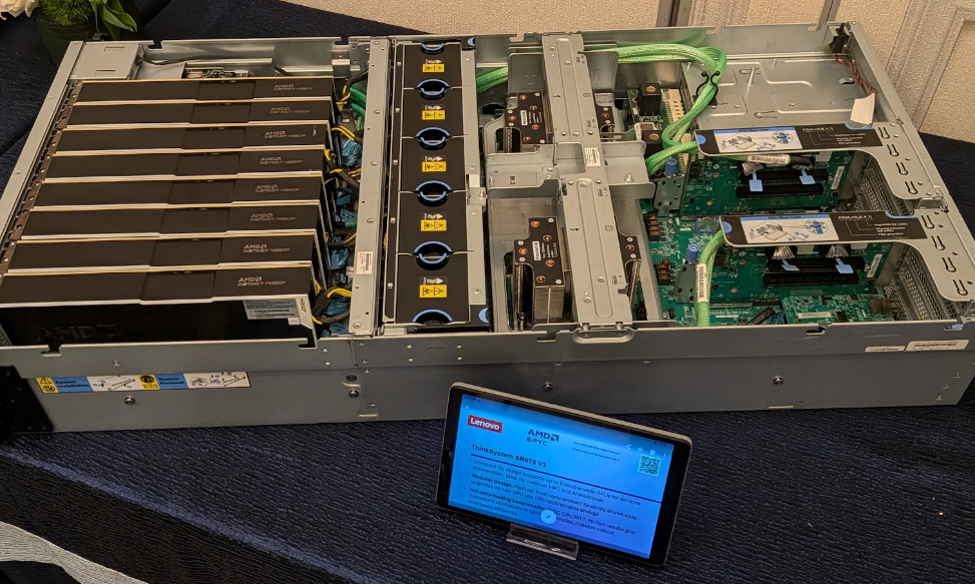
At VMware Explore 2026, we had the chance to sit down with Stuart McRae, Executive Director of Lenovo’s Enterprise Storage, Software, and Solutions Offering Group.
Rather than focusing on a specific product or technology, as we often do, this conversation took a broader view. We covered everything from how AI is reshaping buyer options and the ongoing RAM shortage to a spirited debate over whether Texas or North Carolina has the better BBQ. Below are our takeaways from that discussion.
The High Stakes Return to On-Prem #
In the early years of the data center, system architects took pride in the “build-it-yourself” ethos. Each infrastructure build had its own local flavor, carefully assembled from preferred “Lego pieces” of compute, storage, and networking. We were the architects of bespoke data centers.
However, the enterprise is now undergoing a fundamental shift. The high-cost gamble of generative AI, combined with the escalating and often unpredictable cost of public cloud, has accelerated the return to on-premises infrastructure. Today’s environment demands immediate, predictable results rather than architectural tinkering.
In our conversation with McRae, it became clear that the mission has changed: We are moving away from piecemeal assembly and toward integrated, turnkey “factories,” where the infrastructure becomes invisible, reliable, and supportable.
The “RAM Apocalypse” is a Catalyst for Innovation #
The industry is navigating what many have called the “RAM apocalypse.” A volatile mix of DRAM and flash supply constraints has driven commodity prices sharply higher, turning memory into a growing bottleneck for data center expansion. For memory architecture, this is a now-or-never moment for innovation.
Memory tiering is not new, but previous approaches were often technically viable yet operationally fragile, depending on complex configurations at the operating system or application layer. That made them difficult to deploy consistently across a diverse enterprise environment. What is changing now, led by Lenovo and VMware, is the move to bring this intelligence into the hypervisor layer within VMware Cloud Foundation (VCF). By tiering data down to NVMe drives at the software-defined layer, organizations can begin to decouple performance from DRAM cost.
Broad Adoptability: Because this happens at the hypervisor level, it requires no “rip and replace” of existing applications or OS rewrites.Economic Impact: Organizations are realizing up to 45% savings on DRAM costs by optimized tiering.
“The old proverb asks, ‘ When’s the best time to plant a tree? 20 years ago. When’s the next best time? Tomorrow. Well, the best time to buy a server would have been a year ago… the next best time is today,” McRae told us.
Moving from “Lego Pieces” to Turnkey AI Factories #
We are witnessing the inevitable collision of enterprise density and the necessity for “just give me something that works.” The psychological shift in IT is profound: the joy of tinkering has been replaced by the necessity of the “appliance approach.” For organizations looking to stand up AI capabilities, the complexity of sizing and validation is too high to manage on their own.
This has necessitated the rise of the Hybrid AI Factory. By integrating Lenovo’s hardware with the VCF Private AI stack, Lenovo provides a pre-validated environment in which SSDs, network cards, and firmware revisions are guaranteed to work together.
But this is more than hardware; it is about life-cycle management and peace of mind. In an era where security and resilience are non-negotiable, a validated stack ensures that the “Lego pieces” not only fit together on day one but also stay together through every subsequent update and patch. We are moving from being component builders to supervisors of a unified, automated production line.
The Enterprise is Finally Embracing Liquid Cooling #
For decades, liquid cooling was a niche luxury, the province of High-Performance Computing (HPC) and specialized research labs. Today, we are witnessing a sea change as water cooling becomes a mainstream requirement in the enterprise. This shift is driven by the immutable laws of thermal physics: as we pack high-density CPUs and power-hungry GPUs into the same rack, traditional air cooling has reached its limit. To manage this thermal load, Lenovo has three distinct architectures for the modern data center:
Warm Water Cooling (Lenovo Neptune): A sophisticated direct-to-node approach that manages heat with incredible efficiency, often eliminating the need for power-intensive chillers.Closed-Loop Cooling: A vital “middle ground” for facilities without existing water infrastructure, utilizing liquid-cooled heat sinks that circulate entirely within the chassis.Air Cooling: Still the baseline for standard workloads but increasingly relegated to low-density zones as liquid takes over the heavy lifting.
The 10-Day Delivery: Logistics as a Competitive Feature #
In a volatile market, logistics and purchasing are no longer boring back-office functions; Lenovo has turned them into a competitive advantage. Speed of deployment has become a primary metric of infrastructure efficiency. Through programs like Lenovo’s “Top Choice Express” and “AI Express,” Lenovo is offering 10-day delivery cycles for VCF-ready and AI-optimized servers.
Perhaps more importantly, Lenovo has a 30-day price guarantee. In a market where quotes often expire within 72 hours due to component volatility, this stability is a strategic lifeline, particularly for public-sector entities bound by tight and rigid budgeting processes.
The hunger for this hardware-centric stability was palpable at recent industry events, even at software-focused conferences like VMware Explore, where sessions on infrastructure cost control filled up early.
“We’re the only server-focused vendor here at Explore. We are seeing massive traffic at our booth and intense interest in hardware… usually at software conferences, those are not the sessions that fill up fast,” McRae said.
AI as the “Quantum Step” in Systems Administration #
One of the most transformative shifts we at Storage Review anticipate is not AI as a workload, but AI as the interface for the hypervisor itself. We covered VMware’s new AI Assistant in our write-up on VMware announcements made at Explore this year.
We are moving toward a vision of “Natural Language administration,” where the friction between an administrator and the hardware is virtually eliminated. We got a taste of this when we reviewed Aipex, a product that does this for Windows, Linux, and macOS systems, and we were excited when we saw that VMware will be deploying an AI Assistant in VCF, and even better, VMware builds on this AI integration by supporting 3rd-party Management Packs for it.
It’s easy to imagine a future where a kernel fault or a system crash no longer triggers a weekend of manual log analysis. Instead, an administrator asks the system, “Why did this machine crash?” and the AI assistant, deeply integrated into the VCF stack, identifies a specific driver fault, locates the patch, and requests permission to deploy it.
This represents a quantum leap forward, harkening back to the early days of virtualization, when provisioning required a month-long dance among storage, network, and server teams. By reducing these complex workflows to simple dialogue analyzed and implemented by AI, we finally remove a barrier that has plagued IT for decades.
“It’s the way it should be,” as McRae put it.
Conclusion: The Blueprint for the Next Three Years #
To wrap up our conversation with McRae, we hit him with an important, yet impossible-to-answer question: What will the data center look like in the next three years?
He said that the blueprint for the private cloud over the next three years is toward total integration. We can expect a shift in which VCF and vSAN are the default standards, and GPU resources are integrated directly into clusters as peers rather than as specialized outliers. The “integration-first” philosophy will dominate as enterprises prioritize data sovereignty and operational efficiency over the public cloud’s complexity.
Ultimately, AI is the tool that will finally make our infrastructure “invisible.” By automating the manual labor of troubleshooting, remediation, and provisioning, we are reaching the point where technology works for the business rather than the business working for technology. The goal is no longer to build the best “Lego” tower; it is to run the most efficient factory.
Finally, when pushed to choose a BBQ style, McRae diplomatically said he liked the vinegary tang of North Carolina barbecue just as much as the slow-smoked brisket of Houston and Austin. He had no comment on Cincinnati BBQ.