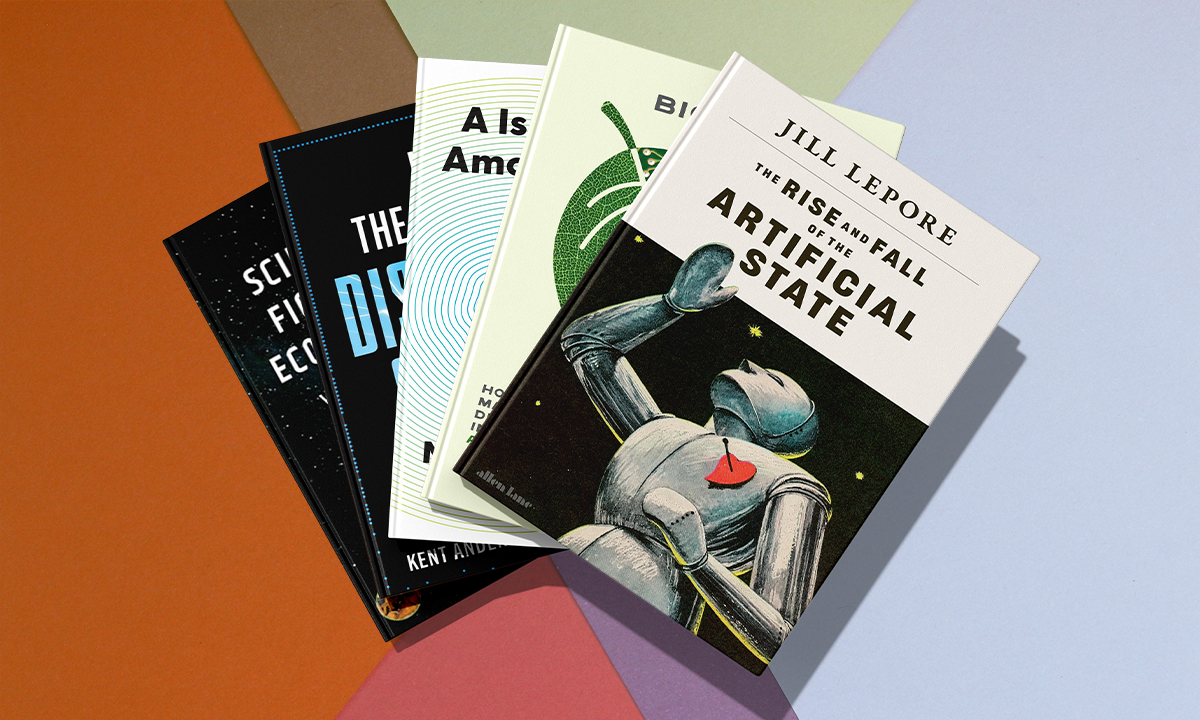
Summer’s still going strong, and I, for one, am not done with my summer reading just yet. I’m planning to wrap up my summer with a few more science-fiction novels, an illustrated book about traditional plant uses, and a few nonfiction books that offer some hope for the future. If any of that sounds good to you, read on: Here are the books I’m most excited about this month.
Maya: Seed Takes Root** by Anand Gandhi & Zain Memon**
This novel features a planet-wide Maya tree network, through which the humans connected to it can precinct every action, and thus control the world through the shape of desire. But what happens where there’s one person who is not already hooked into the network? Maya blends science fiction, fantasy, and philosophy, and I can’t wait to read it. And, as a bonus, it comes with a thoughtful forward by neuroscientist and Nautilus contributor Anil Seth.
A Is for Amoeba: The Story of Life in a Single Cell** by Nicholas P. Money**
The amoeba doesn’t get enough credit. Far from being a generic blob bumping about randomly, the titular organism emerges in this book as a creature that makes decisions, hunts its prey, and has achieved a sort of immortality through its unusual reproduction. Beyond that, author Nicholas Money explores how the amoeba can help to advance a number of scientific fields, from cancer treatment to robotics.
Science Fiction Ecologies: Worldmaking with Butler, LeGuin, and Merrill** by Shelly Streeby**
There’s nothing I love more than a novel with thorough and engrossing world building. In this nonfiction book, author Shelly Streeby investigates how these three groundbreaking, feminist science-fiction authors used the historical events in the worlds around them to construct imaginary worlds that still feel incredibly relevant to our modern milieu.
It Could Be Otherwise: Science in the Age of Uncertainty** by Stuart Firestein **
It’s bleak out there. It feels like science is being attacked on a number of fronts, all while the world burns around us. Nevertheless, author and Nautilus contributor Stuart Firestein gives us a beacon of hope. He argues for science that embraces uncertainty, promoting creativity and possibility. He paints science as an agent of freedom, and illuminates a path that makes redemption through science feel possible.
Bioinspired: How Nature Made Us Modern, Drives Technological Innovation, and Inspires a Future Worth Inventing** by Samuel Cord Stier**
From sharks helping airplanes fly to ants shaping video games, this book takes a look at the many ways nature has inspired, and continues to inspire, modern inventions. The book doesn’t stop with the past—it also explores how bioinspiration just might prove key to a sustainable future. The Rise and Fall of the Artificial State** by Jill Lepore**
In this book, historian Jill Lepore describes how technology has corroded democracy itself. From political campaigns driven by algorithms to corporations controlling public discourse, Lepore suggests that we’ve given over too much of our agency to artificial intelligence. She uses the lens of history to show us just how far we’ve gone down this precarious path. But it isn’t all despair—Lepore encourages us to recognize what we’ve done, undo the things we shouldn't have done, and fight for a better future now.
A Plagued Sea** by Kim Bo-Young**
In this new novel, an underwater volcano erupts, unleashing havoc on a small coastal community in Korea. Along with reshaping the landscape, the volcano belches up a virus that transforms those humans who contract it. If you’re looking for a sci-fi horror novel that’s as hard to forget as it is to turn away from, look no further.
How the Internet Disrupted Science** by Kent Anderson & Joy Moore**
More information is available to the average person than ever before. But how much of it can you trust? This book dives into how the internet has actually hurt the pursuit of science, from unreliable online reports to big-money skewing what we study. The authors tell us it’s not too late, we can return to the self-correcting practices that make for good science—but we need to act now.
Sacred Plants of the Americas** by Jill Pflugheber & Steven F. White**
This book profiles plants used by Indigenous cultures for centuries, including the lore as well as the scientific properties those plants possess. The entries, which include coca, peyote, sweetgrass, and more, are accompanied by beautifully detailed illustrations. The book combines anthropology, ancient wisdom, and art, and I can’t wait to dive in.
Lead image: Tasnuva Elahi; with image by Yulia / Adobe Stock