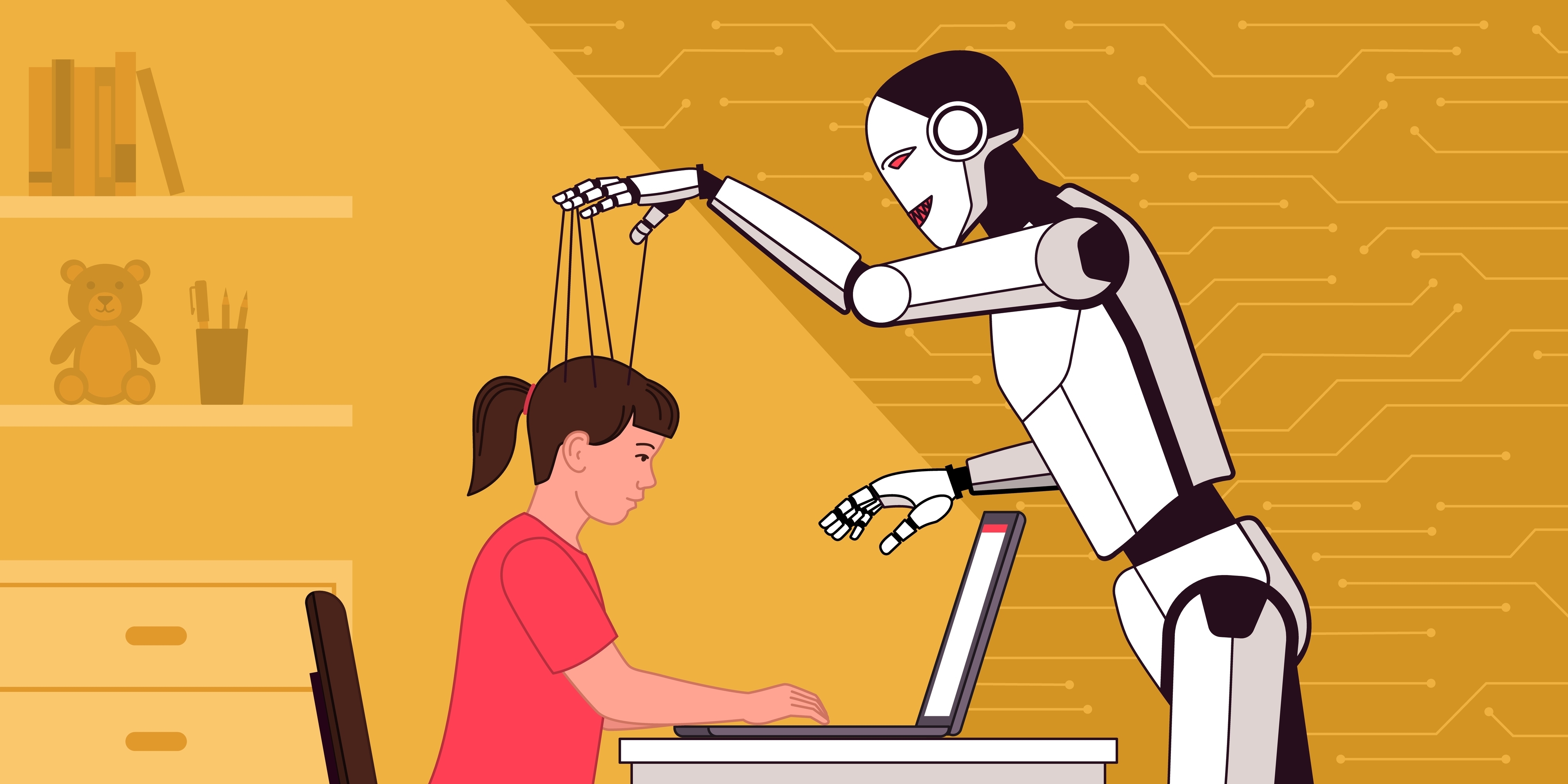
New York City schools took the drastic action of restricting artificial intelligence last month, banning around 600,000 students from pre-K through eighth grade from using the technology. “They learn best when they are wrestling with hard problems, when they’re getting it wrong, when they’re trying again and finally getting it right,” the chancellor of schools Kamar Samuels said of the move. “No app, chatbot, or algorithm can replicate that productive struggle for a child.” Rather than replicate it, AI is promising to eliminate it entirely (at least for adults). Now a new study presented this week at the third annual Conference on Language Modeling is providing more evidence that AI could erode our critical cognitive faculties.
Read more: “A Recipe to Stop AI from Going Rogue”
To investigate how AI might shape our long-term learning, AI researchers led by Brian Christian of University of California Berkeley designed a series of test-taking experiments. Adult participants were tasked with solving a series of equations involving fractions (e.g., 5/6 minus 1/3). One group was provided with a ChatGPT window to help, while the other had to slog through solo. After a series of questions, ChatGPT disappeared, leaving the former group to finish the test with nothing but their brains as well.
Subscribe to skip adsAdvertisement The researchers found that the members of the ChatGPT group solved the problems at a higher rate than the control group and skipped questions at a lower rate—at least until it was taken away. After the chatbot disappeared, the two groups swapped places, with the brain-only crowd solving at a higher rate and skipping questions at a lower rate.
To find out if the effect extends beyond mathematics, the team repeated the experiment with reading comprehension questions cribbed from SAT exams. The researchers uncovered the same dynamic—the persistence and accuracy of the group leaning on the AI tool dropped when it was gone.
It’s a striking finding. Over the course of tests that lasted mere minutes, those who relied on AI seemed more prone to giving up. “You almost couldn’t ask for a clearer story,” Christian said in a statement. “We’ve built these systems to be helpful, but are they being helpful to us in a way that’s actually helping us? We showed, ironically, that they’re often helping us in ways that are kind of unhelpful.”
[Subscribe to skip ads](https://nautil.us/products)Advertisement

For students, the researchers say this could lead to a “boiling frog” problem. “If sustained AI use erodes the motivation and persistence that drive long-term learning, these effects will accumulate over years, and by the time they are visible, they will be difficult to reverse,” they wrote.
And this study only examines the effects of AI bots that can capably answer questions. What happens if there’s widespread adoption of AI agents like Meta’s Muse that promise to eliminate the productive struggle from the rest of our lives too?
In a frictionless world, some of us may be in danger of slipping away.
*Enjoying* [Nautilus](https://nautil.us/)*? Subscribe to our free* [*newsletter*](https://nautil.us/newsletter/?_sp=c43011db-6fcf-42f2-a38c-e033b87a4a1d.1759265717430).

[Subscribe to skip ads](https://nautil.us/products)Advertisement
Lead Image: elenabsl / Shutterstock
Subscribe to skip adsAdvertisement